开源智能体

Search documents
金元证券每日晨报-20260312
Jinyuan Securities· 2026-03-12 04:52
Market Overview - A-shares experienced a collective increase, with the Shanghai Composite Index rising by 0.25% to 4,133.43 points, the Shenzhen Component Index increasing by 0.78% to 14,465.41 points, and the ChiNext Index up by 1.31% to 3,349.53 points, with a market turnover of approximately 2.53 trillion yuan [6][12] - In the Asia-Pacific market, the Hong Kong Hang Seng Index fell by 0.24% to 25,898.76 points, while the South Korean Composite Index rose by 1.4% to 5,609.95 points [12] - European markets saw declines, with the UK FTSE 100 down by 0.56% to 10,353.77 points and the German DAX 30 down by 1.37% to 23,640.03 points [12] - In the US market, the Dow Jones fell by 0.61% to 47,417.27 points, while the Nasdaq rose slightly by 0.08% to 22,716.13 points [12] International News - The International Energy Agency (IEA) agreed to release 400 million barrels of strategic oil reserves to address supply disruption risks due to the conflict in Iran, marking the largest coordinated release in the agency's history [14] - US President Trump stated that military actions against Iran are "about to end," although officials have not received any internal orders to cease operations [10][11] Domestic News - The National People's Congress (NPC) and the Chinese People's Political Consultative Conference (CPPCC) held their sessions, with significant discussions on government work reports and the 14th Five-Year Plan [15] - The Ministry of Industry and Information Technology issued recommendations to mitigate security risks associated with the OpenClaw AI system, prompting at least 20 brokerage firms to issue compliance reminders [15][16] Company Announcements - Puxin plans to invest 2.051 billion yuan to establish a negative electrode material production base in Malaysia [18] - Anhui Weimei intends to raise no more than 3 billion yuan through a private placement to its controlling shareholder [18] - Newguo plans to invest 16.2 million yuan to establish a subsidiary focused on AI smart hardware [18]
开发者TALK双城行,共建开源智能体新生态
Xin Lang Cai Jing· 2025-12-25 12:40
Core Insights - The core focus of the news is the launch and enhancement of iFLYTEK's Astron Agent platform, which aims to facilitate the deployment and optimization of AI agents in real business processes, emphasizing the importance of open-source technology for scalability [1][2][3]. Group 1: Platform Features and Market Potential - IDC predicts that the enterprise-level Agent application market in China will reach a conservative estimate of $27 billion by 2028, highlighting significant market potential despite challenges such as deployment complexity and limited efficiency [2][11]. - The iFLYTEK Star Agent platform serves as a one-stop service for the development, tuning, deployment, and operation of AI agents, providing a reliable and scalable foundation for application innovation [2][11]. - The platform supports flexible calls to various models, including the Starfire large model and mainstream open-source models, allowing developers to customize professional-grade agents based on specific enterprise needs [2][11]. Group 2: Deployment and Integration Challenges - Developers face challenges in deploying agents in real environments, particularly in achieving stable and traceable execution mechanisms when agents need to operate across systems [4][13]. - The integration of RPA (Robotic Process Automation) with agents addresses these challenges by automating repetitive business processes, thus enhancing the overall efficiency of agent deployment [5][13][14]. - iFLYTEK's self-developed Star RPA offers a rich set of automation components and a simplified design, facilitating the rapid deployment of automation applications [5][13]. Group 3: Developer Engagement and Community Building - The Astron Agent platform has gained significant traction, with over 12,000 stars on GitHub, indicating a growing community of developers contributing to the ecosystem [3][12]. - iFLYTEK has initiated the first Astron open-source agent training camp, aimed at equipping developers with the necessary skills for agent development and open-source collaboration [16]. - Developer events, such as the Developer TALK series, have been organized across multiple cities, fostering direct communication and collaboration among developers and industry experts [9][10][16].

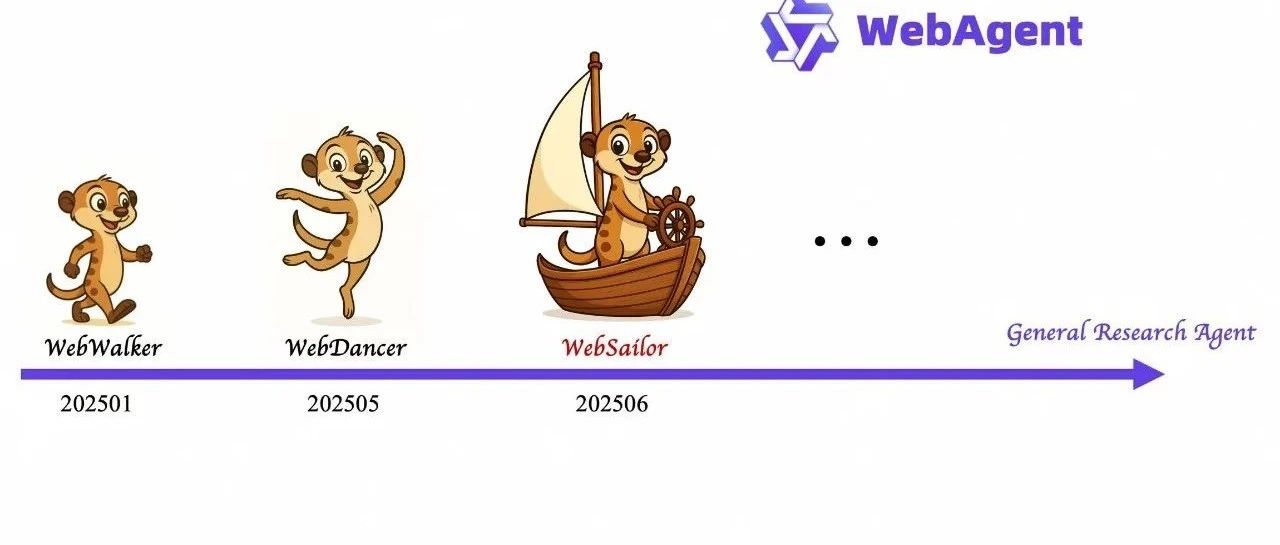
开源Agent新标杆:通义WebSailor多榜夺魁,挑战OpenAI高难度Agent基准BrowseComp
机器之心· 2025-07-07 07:50
Core Viewpoint - The article discusses the limitations of open-source Web Agents in handling complex information retrieval tasks compared to proprietary systems, highlighting the introduction of WebSailor as a breakthrough solution to enhance reasoning capabilities in high uncertainty tasks [2][19]. Group 1: Background - In the era of information overload, traditional search engines struggle to meet users' needs for deep, multi-step information retrieval [2]. - Open-source models have shown poor performance in complex tasks like BrowseComp, with accuracy rates nearly at zero, indicating a lack of effective reasoning patterns [2][3]. Group 2: Technical Innovations - WebSailor introduces a systematic approach combining challenging training tasks and efficient training strategies, including the creation of the SailorFog-QA dataset and innovative reasoning trajectory reconstruction [7][10]. - The classification of information retrieval tasks into three levels of uncertainty helps in understanding the challenges faced by open-source models [8][10]. - The construction of a complex knowledge graph through random walks in real web environments ensures that the training data reflects real-world complexities [11][13]. Group 3: Experimental Results - WebSailor outperformed various open-source and proprietary models across multiple benchmarks, particularly excelling in the challenging BrowseComp tasks [19][21]. - The model demonstrated compatibility with simpler tasks, showcasing its efficiency and adaptability beyond high-complexity scenarios [22]. Group 4: Conclusion and Future Outlook - WebSailor aims to bridge the performance gap between open-source and top-tier proprietary systems in complex information retrieval tasks, emphasizing the importance of innovative training methodologies over mere model size [26][27]. - Future research directions include addressing limitations in context length and exploring asynchronous reinforcement learning frameworks to enhance training efficiency [28].