开盒乱象

Search documents
中央网信办再度点名开盒乱象!南都曾起底外泄个人隐私黑灰产
Nan Fang Du Shi Bao· 2025-12-26 12:43
Group 1 - The Central Cyberspace Administration of China issued a notice on December 25 to regulate the behavior of internet celebrity accounts, including a negative list of behaviors such as doxxing [1][2] - The notice emphasizes the significant influence and demonstration effect of internet celebrity accounts due to their large follower base and high social attention, aiming to guide them to self-regulate their online behavior [1] - Websites and platforms are required to adhere to the negative list, strengthen community rules and user agreements, and manage the behaviors of internet celebrity accounts to prevent negative impacts [1][2] Group 2 - The negative list includes spreading vulgar content, promoting undesirable values, and doxxing, which involves disclosing personal information such as names, photos, and addresses, potentially inciting online violence [2] - A significant investigation by Southern Metropolis Daily revealed the illegal acquisition of personal information, leading to a court ruling where three defendants were convicted of violating personal information laws, with penalties including prison sentences and fines totaling 42,466.34 yuan [2] - The investigation received widespread media coverage, with over 200 media outlets and influencers sharing the findings, resulting in over 100 million views across platforms, prompting the Central Cyberspace Administration to enhance regulatory measures against doxxing [3]
报告:“开盒”乱象严重 超六成网民称自己或身边人遭遇过
Nan Fang Du Shi Bao· 2025-12-21 04:49
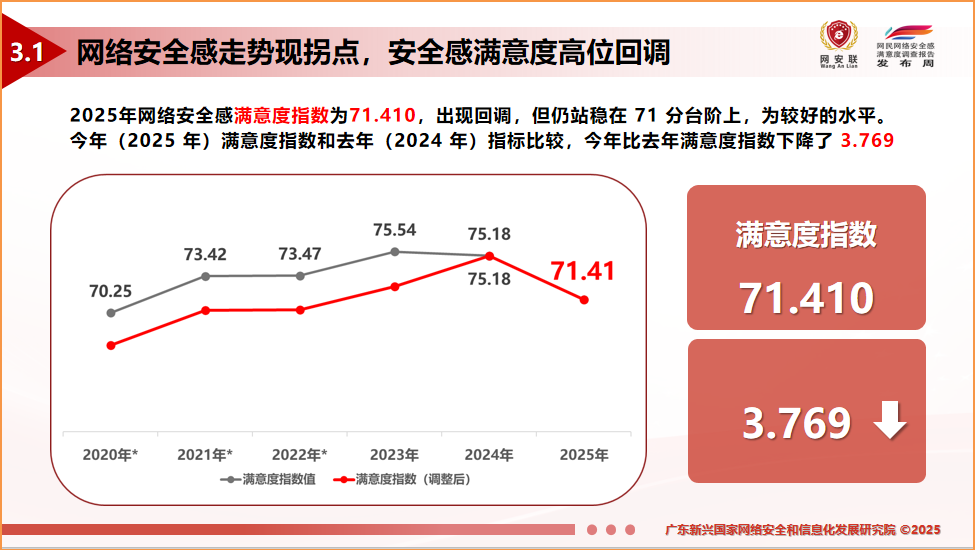
Core Insights - The 2025 National Internet User Cybersecurity Satisfaction Survey Report was released, revealing a significant issue with "open box" incidents, where 65% of internet users reported experiencing or knowing someone who has experienced such incidents [1][10] - The Cybersecurity Satisfaction Index for 2025 is 71.410, showing a decline from previous years, with a notable drop in positive evaluations of cybersecurity from 69.49% to 56.16% [3][5] Group 1: Survey Findings - The survey collected approximately 1.65 million questionnaires, with 780,000 valid responses, indicating a robust data collection process [3] - The positive evaluation rate of internet users regarding cybersecurity has decreased significantly, reflecting a shift towards more neutral and negative assessments [3][6] - The increase in concerns about cybersecurity is linked to the misuse of artificial intelligence and geopolitical tensions affecting public trust [6] Group 2: Cybercrime Trends - There is a rising trend in cybercrime, with personal information violations and online fraud incidents increasing, particularly a 4.12 percentage point rise in personal information infringement [8] - 45.58% of users believe the likelihood of encountering online fraud has increased, with specific scams involving AI technology becoming more prevalent [8][9] Group 3: User Response Strategies - Users are becoming more proactive in their responses to cyber threats, with a notable increase in reporting incidents to law enforcement [9] - Over 70% of users express satisfaction with personal information protection measures, indicating a positive trend in public perception of data privacy [9][10] Group 4: Legislative and Regulatory Context - The report highlights the need for improved legislation to address "open box" incidents, with over 43% of users preferring legal avenues for recourse [11] - There is a growing concern about the use of big data and AI for user profiling, with 78.08% of users worried about targeted scams [11]

新闻1+1丨以“零容忍”态度坚决打击“开盒”乱象 具体怎么做?
Yang Shi Wang· 2025-05-27 22:33
Core Viewpoint - The central government is taking a "zero tolerance" approach to combat the "open box" phenomenon, which involves the illegal collection and dissemination of personal information online, emphasizing the need for stricter regulations and platform accountability [1][4]. Group 1: Definition and Impact of "Open Box" - "Open box" refers to a new form of online violence where individuals illegally gather and publish personal information such as names, photos, ID numbers, and contact details [2]. - Victims of "open box" often face online harassment, including insults, defamation, and real-life disturbances like incessant calls and messages from strangers [3]. Group 2: Regulatory Measures and Responsibilities - The Central Cyberspace Administration of China has already penalized three major online platforms, signaling that all platforms, regardless of size, must comply with laws protecting personal information [4]. - The emphasis on punishing large platforms is due to their greater technical capabilities and user bases, which impose a higher legal and social responsibility to monitor and prevent personal information leaks [4]. Group 3: Future Actions and Expected Outcomes - The next steps include blocking dissemination channels, enhancing protective measures, and increasing punitive actions against violators [7]. - If these measures are effectively implemented, they could significantly reduce the illegal collection and misuse of personal information, thereby enhancing the protection of individual rights [7]. Group 4: Systematic Approach and Collaboration - Addressing the "open box" issue requires a coordinated effort among various government departments, including the Ministry of Industry and Information Technology, the State Administration for Market Regulation, and the Ministry of Public Security [8]. - The irreversible nature of personal information leaks necessitates a focus on preventing new incidents from occurring at the source [8]. Group 5: Vulnerabilities in Personal Information Security - The primary vulnerability in personal information security is the ease and prevalence of obtaining personal data, often required for various online services [9]. - The frequent sharing of personal information increases the likelihood of it being illegally accessed [9]. Group 6: Legal Framework and Enforcement - China has a comprehensive legal framework for protecting personal information, including laws like the Cybersecurity Law, Data Security Law, and Personal Information Protection Law, along with relevant provisions in the Civil Code and Criminal Law [11]. - In 2024, law enforcement agencies have already cracked over 7,000 cases related to the infringement of personal information rights, indicating active measures are being taken to address these issues [11].