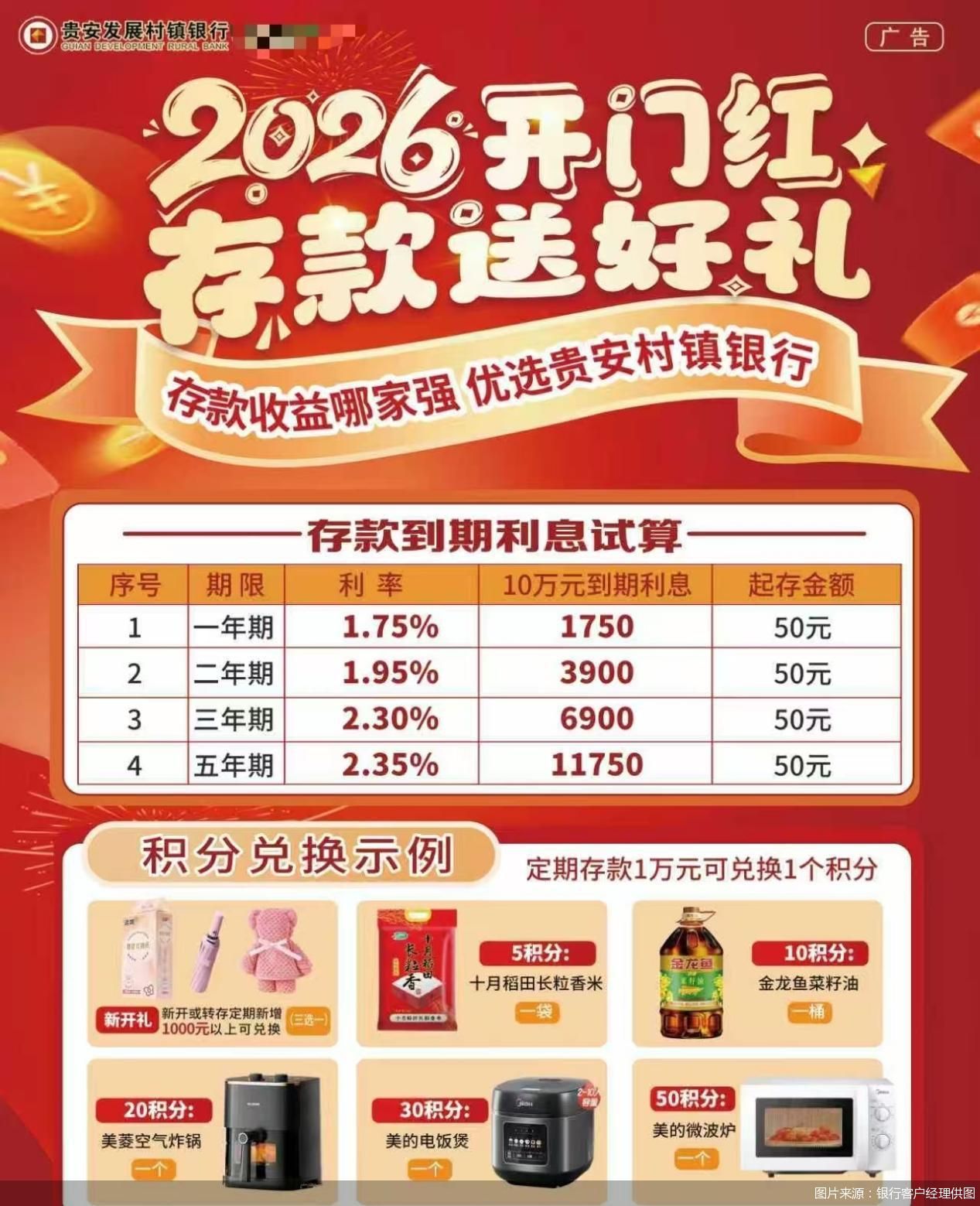
开门红活动

Search documents
五年期利率2.35%,比大行高1个百分点左右!村镇银行能否吸引“存款特种兵”薅息差
Bei Jing Shang Bao· 2026-02-25 14:14
Core Viewpoint - The banking industry is experiencing a shift as deposit rates have entered the "1 era," leading to a resurgence of interest in high-yield deposits, particularly from regional small and medium-sized banks, despite the overall decline in deposit rates across major banks [2][10]. Group 1: Deposit Rates and Products - Some village and town banks in Guizhou Province are offering attractive deposit rates, with three-year rates at 2.3% and five-year rates at 2.35%, significantly higher than the 1.3% offered by major state-owned banks [1][3]. - For a deposit of 100,000 yuan in a five-year term at a village bank, the interest earned would be 11,750 yuan, compared to only 6,500 yuan at a major bank, highlighting a more than 1 percentage point advantage [1][3]. - The minimum deposit amount for these high-yield products is as low as 50 yuan, making them accessible to a wider range of customers [3][9]. Group 2: Marketing Strategies and Customer Engagement - The marketing campaigns of these village banks, such as the "opening red" activities, include not only competitive interest rates but also additional benefits like point redemption for goods, which further attract customers [3][9]. - Customer engagement through social media and direct communication from bank staff has been noted, with some customers sharing their experiences of traveling to Guizhou to take advantage of these offers [2][9]. Group 3: Industry Trends and Analyst Insights - Analysts suggest that the high deposit rates offered by village banks are a response to pressure on their liabilities rather than a sustainable long-term strategy, indicating that these rates may not last beyond the initial promotional period [10][11]. - The current trend shows a divergence in banking strategies, with larger banks adopting a more conservative approach while smaller banks are aggressively raising deposit rates to attract customers [11][12]. - Regulatory scrutiny is increasing, with authorities prohibiting banks from using unconventional methods to attract deposits, which may impact the sustainability of high-yield offerings in the future [12][13].