定期存款产品

Search documents
逆势拉高利率 村镇银行唤醒存款特种兵
Xin Lang Cai Jing· 2026-02-25 16:56
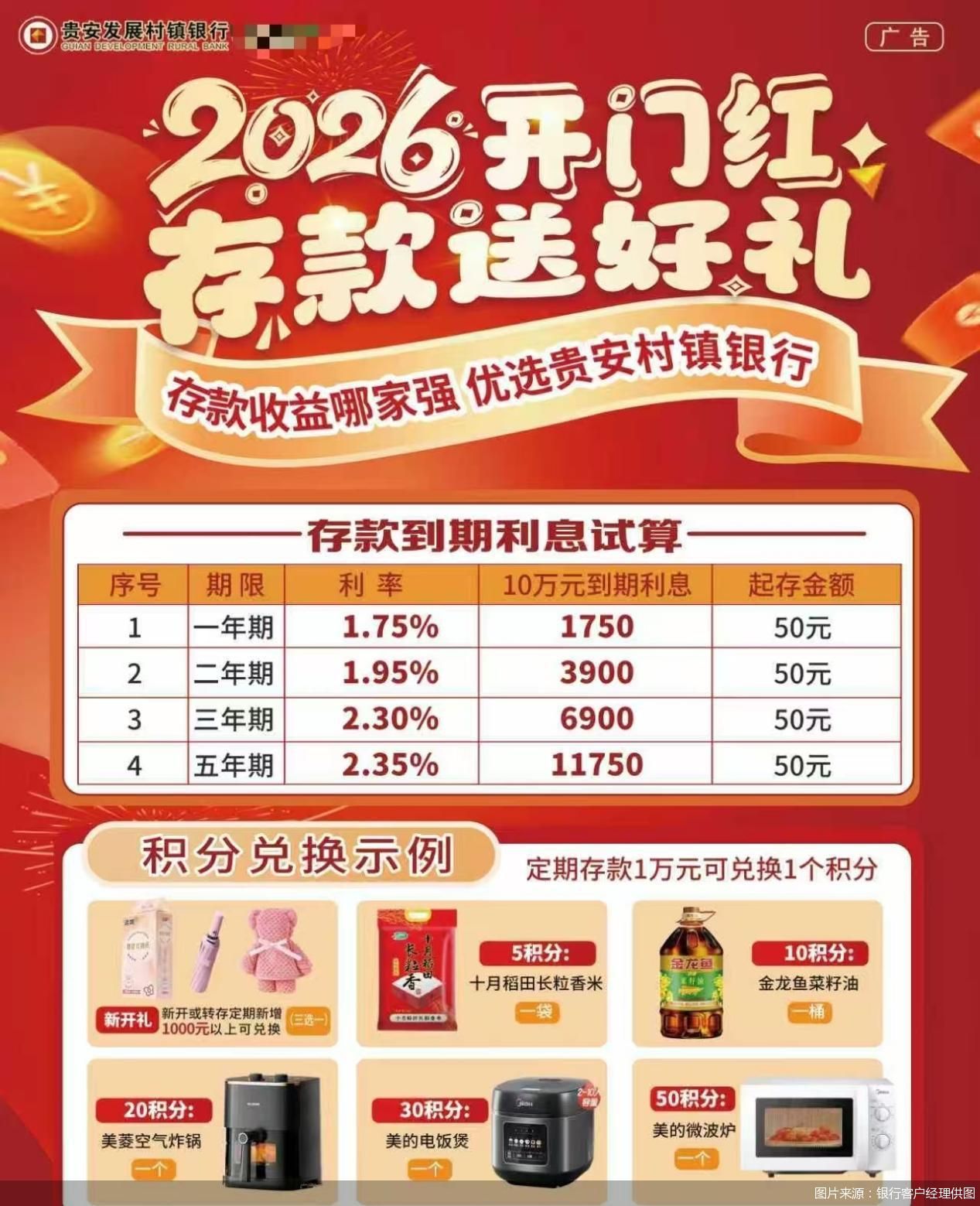
Core Viewpoint - The article discusses the resurgence of interest in high-interest deposits among savers, particularly in regional small and medium-sized banks, as traditional banks lower their deposit rates, creating a significant interest rate differential that attracts depositors [1][2]. Group 1: Deposit Rates and Trends - The current deposit rates in the banking industry have entered the "1 era," with state-owned banks offering a five-year fixed deposit rate of 1.3% [2][3]. - Some village and town banks in Guizhou province are offering higher rates, such as 2.3% for three-year deposits and 2.35% for five-year deposits, which is over 1 percentage point higher than state-owned banks [1][3]. - A specific example shows that depositing 100,000 yuan for five years at these rates could yield 11,750 yuan in interest, compared to 6,500 yuan from state-owned banks [3][4]. Group 2: Marketing Strategies and Customer Behavior - The "opening red" marketing campaigns by village banks are designed to attract depositors, with promotional activities including loyalty points for deposits [3][4]. - Customers are actively traveling to Guizhou to take advantage of these higher rates, indicating a renewed interest in cross-province deposit strategies [2][5]. - The marketing tactics of these banks are seen as a response to pressure on their liabilities, rather than a sustainable long-term strategy [5][6]. Group 3: Risks and Considerations - Analysts caution that the high-interest rates offered by village banks may not be sustainable and are often part of a temporary promotional strategy [5][6]. - Depositors should consider the potential costs of traveling for slightly higher rates and the challenges of accessing services from banks that only operate locally [8]. - There are concerns about compliance and potential unethical practices in marketing, as some banks may offer additional incentives that violate regulations [7][8].


五年期利率2.35%,比大行高1个百分点左右!村镇银行能否吸引“存款特种兵”薅息差
Bei Jing Shang Bao· 2026-02-25 14:14
Core Viewpoint - The banking industry is experiencing a shift as deposit rates have entered the "1 era," leading to a resurgence of interest in high-yield deposits, particularly from regional small and medium-sized banks, despite the overall decline in deposit rates across major banks [2][10]. Group 1: Deposit Rates and Products - Some village and town banks in Guizhou Province are offering attractive deposit rates, with three-year rates at 2.3% and five-year rates at 2.35%, significantly higher than the 1.3% offered by major state-owned banks [1][3]. - For a deposit of 100,000 yuan in a five-year term at a village bank, the interest earned would be 11,750 yuan, compared to only 6,500 yuan at a major bank, highlighting a more than 1 percentage point advantage [1][3]. - The minimum deposit amount for these high-yield products is as low as 50 yuan, making them accessible to a wider range of customers [3][9]. Group 2: Marketing Strategies and Customer Engagement - The marketing campaigns of these village banks, such as the "opening red" activities, include not only competitive interest rates but also additional benefits like point redemption for goods, which further attract customers [3][9]. - Customer engagement through social media and direct communication from bank staff has been noted, with some customers sharing their experiences of traveling to Guizhou to take advantage of these offers [2][9]. Group 3: Industry Trends and Analyst Insights - Analysts suggest that the high deposit rates offered by village banks are a response to pressure on their liabilities rather than a sustainable long-term strategy, indicating that these rates may not last beyond the initial promotional period [10][11]. - The current trend shows a divergence in banking strategies, with larger banks adopting a more conservative approach while smaller banks are aggressively raising deposit rates to attract customers [11][12]. - Regulatory scrutiny is increasing, with authorities prohibiting banks from using unconventional methods to attract deposits, which may impact the sustainability of high-yield offerings in the future [12][13].
新春将至,多家银行阶段性上调存款利率
Mei Ri Shang Bao· 2026-02-10 22:19
Core Viewpoint - The recent trend of small and medium-sized banks increasing deposit interest rates is a strategic move to attract depositors, particularly ahead of the Lunar New Year, contrasting with the actions of larger state-owned banks [1][2][4] Group 1: Deposit Rate Adjustments - Hunan Xinhui Rural Commercial Bank has raised its deposit rates, offering 1.3%, 1.4%, and 1.75% for one-year, two-year, and three-year deposits starting from 30,000 yuan, respectively [1] - Other banks, such as Guangxi Zhaoping Rural Commercial Bank and Guizhou Xifeng Rural Commercial Bank, have introduced special deposit products with rates reaching up to 2.1% for five-year deposits [2][3] - The adjustments are characterized by high minimum deposit thresholds, often starting from 20,000 yuan, and are limited in availability, targeting local large-scale idle funds [3] Group 2: Market Context and Strategy - The current environment shows a narrowing net interest margin for banks, with the average dropping to 1.42%, below the regulatory threshold of 1.8% [4] - Analysts suggest that the recent rate hikes are a temporary measure by smaller banks to secure deposits during a critical lending period, rather than a sign of a broader trend in interest rate reversal [4][5] - The adjustments are primarily seen in city commercial banks and rural banks, while larger state-owned banks have largely maintained their rates [4][6] Group 3: Competitive Landscape - The competition among smaller banks has intensified, with many launching unique deposit products and promotional activities to attract customers [2][3] - Some banks have also introduced additional benefits for depositors, such as rewards for maintaining average monthly balances [3] - Despite the upward adjustments by some banks, the overall trend in the industry remains towards lower deposit rates, as evidenced by recent cuts from other institutions [6]
多家中小银行,调整存款利率
Zhong Guo Zheng Quan Bao· 2026-01-06 12:31
Core Viewpoint - The recent adjustments in deposit interest rates by several small and medium-sized banks indicate a shift towards differentiated and phased rate changes, moving away from the previous trend of uniform rate cuts [1][4]. Group 1: Interest Rate Adjustments - On January 5, 2023, the three-year deposit product with an interest rate of 2.2% was officially withdrawn, and all fixed deposit rates were reduced by 20 basis points [1]. - Various small and medium-sized banks, including Suzhou Commercial Bank and others, have announced adjustments to their deposit rates, with some banks lowering rates while others are increasing them [2][3]. - For instance, Puyang Zhongyuan Village Bank reduced its three-month, six-month, and two-year deposit rates by 30 basis points, while the three-year rate remained unchanged [2]. Group 2: Competitive Strategies - Some banks are adopting a strategy of increasing deposit rates to attract customers, with Wu Ding Xingfu Village Bank raising its one-year and two-year rates by 10 basis points [2]. - The trend of differentiated adjustments reflects a strategic choice by small and medium-sized banks to manage their liabilities more effectively amid competitive pressures and high funding costs [4]. - Analysts suggest that the current mixed adjustment pattern is a response to the ongoing pressure on net interest margins and the need for banks to attract depositors sensitive to interest rates [4].
新年伊始多家中小银行调整存款利率
Zheng Quan Ri Bao· 2026-01-05 16:49
Core Viewpoint - In early 2026, several small and medium-sized banks have begun adjusting their deposit interest rates, with some banks lowering rates while others are increasing them to attract deposits during the marketing season [1][2][3]. Group 1: Rate Adjustments - Puyang Zhongyuan Village Bank has reduced its deposit rates by up to 30 basis points for various term deposits starting January 1, 2026 [2]. - Anhui Xin'an Bank announced a decrease in its two-year fixed deposit rate from 2.35% to 2.25%, a reduction of 10 basis points, effective January 16, 2026 [2]. - Some banks, like Suixian Deshang Village Bank, have increased their one-year and three-year fixed deposit rates by 5 and 3 basis points respectively, indicating a mixed approach to rate adjustments [3]. Group 2: Market Dynamics - The adjustments in deposit rates reflect the varying strategies of banks based on their operational conditions and market competition, as noted by industry experts [4]. - The current marketing season has prompted some banks to raise deposit rates to enhance their appeal for attracting deposits, viewed as a temporary marketing strategy [4]. - Experts predict that the net interest margin pressure will persist, leading banks to continue managing their funding costs, with a long-term downward trend in deposit rates expected [4][5]. Group 3: Future Outlook - The net interest margin for small and medium-sized banks is anticipated to remain under pressure, with a cautious and orderly approach to deposit rate adjustments expected in 2026 [5]. - A significant simultaneous reduction in deposit rates across different types of banks is unlikely, with a trend towards differentiated and gradual adjustments [5].
香港基金公会邹建雄:美国减息预期利好 投资者加快部署债券和股票基金
Zhi Tong Cai Jing· 2025-11-26 06:33
Core Viewpoint - The market anticipates a downward trend in U.S. interest rates, prompting investors to actively prepare for purchasing high-rated global bond funds, while some are also considering investments in equity funds [1] Group 1: Market Trends - The expectation of declining U.S. interest rates is creating a favorable investment environment [1] - Recent years have seen a surge in bank deposits due to high fixed deposit rates, as investors adopted a risk-off strategy [1] - The anticipated interest rate cuts by the Federal Reserve are expected to encourage more aggressive market participation from investors [1] Group 2: Investment Behavior - Current investment in equity funds remains relatively low compared to bonds and other investment sectors [1] - Net sales figures for equity funds are still volatile, indicating that the performance of equity funds has not fully reflected the positive factors associated with the expected interest rate cuts [1]
高股息资产成避风港!银行股大面积拉升,银行含量近半的价值ETF(510030)逆市收红!
Xin Lang Ji Jin· 2025-11-14 11:49
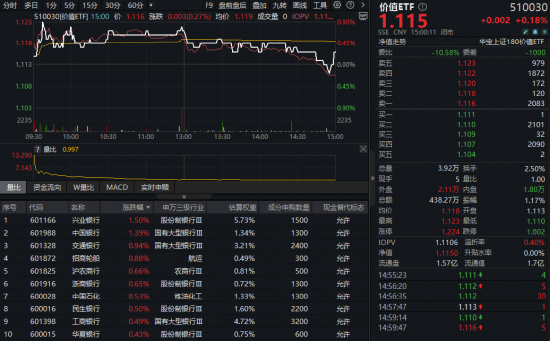
Core Viewpoint - The market experienced a pullback on November 14, but high dividend stocks, particularly in the banking sector, showed resilience, with the value ETF (510030) gaining 0.18% despite the overall market decline [1][3]. Market Performance - The value ETF (510030) fluctuated positively throughout the day, reaching a peak increase of 0.9% before closing up 0.18% [1]. - Key stocks contributing to this performance included Industrial Bank and Bank of China, both rising over 1%, along with other stocks in the shipping and petrochemical sectors [1]. Banking Sector Insights - Recent data from the central bank indicated that by the end of October, the balance of deposits in both domestic and foreign currencies reached 332.92 trillion yuan, marking an 8.3% year-on-year increase [3]. - Several small and medium-sized banks have recently adjusted their deposit products, including the removal of certain long-term deposit offerings, aimed at optimizing their liability structure and reducing costs [3]. Investment Strategy - Analysts suggest that the banking sector's high dividend yield will become increasingly attractive as market investment styles rebalance, particularly favoring state-owned banks and regional banks with strong recovery potential [3][6]. - The value ETF (510030) is heavily weighted towards the banking sector, which constitutes 47.5% of the index as of October 2025 [3]. Valuation Metrics - As of November 14, the price-to-book ratio of the value ETF's underlying index was 0.86, indicating a relatively reasonable valuation compared to historical levels [5]. - The current valuation places the index at the 46.27 percentile over the past decade, suggesting a favorable long-term investment opportunity [5]. Market Trends - The fourth quarter is typically a period of style shifts in the market, with a tendency for low valuation and value styles to gain traction [6]. - The financial sector, particularly banks, is expected to benefit from a continued focus on high dividend strategies amidst a backdrop of moderate economic recovery [6].
利率 - 当低存款利率遇上定存到期高峰
2025-06-11 15:49
Summary of Conference Call Records Industry Overview - The records focus on the banking industry in China, particularly the trends in deposit rates and the behavior of depositors in response to macroeconomic conditions [1][2][3]. Key Points and Arguments 1. **Economic Activity and Deposit Behavior** - The decline in economic activity has led to reduced consumer spending and corporate investment willingness. Despite falling deposit rates, the macroeconomic situation has not significantly improved, resulting in a low-risk appetite among residents who prefer fixed-term deposits [1][2]. 2. **Impact of Deposit Rates on Fixed-Term Deposits** - Current fixed-term deposit rates in China are around 1%. Historical data from Japan indicates that fixed-term deposits only significantly decline when rates fall below 0.5%. Therefore, the trend towards fixed-term deposits is expected to continue despite lower rates [1][3]. 3. **Future Trends in Fixed-Term Deposits** - A large volume of three-year fixed-term deposits is set to mature in 2025, with an estimated total of 89 trillion yuan. It is anticipated that most of these funds will be reinvested into new fixed-term products due to limited improvement in fundamentals and the attractiveness of other investment channels [5][12]. 4. **Factors Influencing Deposit Base Growth** - The growth of the deposit base is influenced by several factors: the effectiveness of monetary easing, declining risk appetite among residents, poor performance of other asset classes, and profits remitted by the central bank to enterprises and residents [7][8]. 5. **Long-Term Deposit Preferences** - Residents, particularly those with lower risk tolerance, such as older individuals, are more inclined to choose longer-term fixed deposits. This preference is reflected in the current inversion of interest rates between three to five-year terms and one-year terms [5][6]. 6. **Asymmetric Rate Adjustments** - There is an asymmetric adjustment in interest rates across different terms, with larger adjustments seen in three and five-year terms. This is a response to the current market environment and changing risk preferences [6]. 7. **Historical Context of Deposit Trends** - The increase in fixed-term deposit ratios since 2018 is attributed to declining economic activity, with both residents and enterprises opting for fixed deposits as a safer investment. This trend has persisted despite fluctuations in the broader economic environment [9][10]. 8. **Lessons from Japan's Low-Rate Environment** - Japan's experience shows that even in a prolonged low-rate environment, the overall savings scale does not significantly decrease. This suggests that in a weak economy with limited investment options, individuals will continue to save rather than invest elsewhere [11]. 9. **Banking Sector Implications** - The maturity of fixed-term deposits will have some impact on banks' asset allocation strategies, but the overall effect is expected to be limited. A portion of maturing deposits may be converted to demand deposits, but this does not necessarily translate into a shift towards other business areas [12]. Other Important Insights - The records highlight the importance of understanding depositor behavior in the context of macroeconomic conditions and interest rate trends. The insights drawn from Japan's experience may provide valuable guidance for navigating similar challenges in the Chinese market [11].
雷军回应小米重回手机出货量第一;多地延长房贷年限最高至68岁…
Sou Hu Cai Jing· 2025-04-29 01:43
Group 1 - Xiaomi's smartphone shipment reached 13.3 million units in Q1 2025, a 40% year-on-year increase, regaining the top position in market share at 19% after ten years [1] - The company attributes its success to government subsidies and a strategic focus on integrated products across vehicles and home appliances [1] Group 2 - Seres is applying for a Hong Kong IPO, projecting a revenue of 145.1 billion yuan in 2024, representing a 305.5% year-on-year growth, with a gross margin of 23.8% and a net profit of 5.9 billion yuan [3] - The IPO aims to raise funds, with 70% allocated for R&D, 20% for marketing and overseas sales, and 10% for operational expenses [3] Group 3 - Douyin has introduced regulations to combat "malicious marketing accounts," targeting ten types of violations and implementing a "health score" system for account management [4] Group 4 - Pop Mart's app topped the US App Store shopping chart, with significant demand in various international locations, leading to a market capitalization of 231.39 billion HKD, surpassing luxury brand Kering [5] Group 5 - Several small and medium-sized banks have lowered their fixed deposit rates, with some rates falling below those of larger banks, indicating a trend of interest rate inversion for different deposit terms [6] Group 6 - In Q1 2025, China's gold ETF holdings increased by 23.47 tons, a 327.73% year-on-year growth, bringing the total holdings to 138.21 tons by the end of March [8]