
引江济淮工程

Search documents
引江济淮“活水”来 皖北群众将告别“咸苦水”
Xin Hua She· 2025-12-31 07:27
Core Viewpoint - The completion of the second phase of the Yangtze River to Huaihe River water diversion project in Anhui Province marks a significant step towards improving water quality and availability in the northern Anhui region, addressing long-standing water resource shortages and health concerns related to groundwater contamination [1][2]. Group 1: Project Overview - The second phase of the Yangtze River to Huaihe River project includes a total water conveyance length of 658.7 kilometers, with nine projects specifically aimed at providing surface water to northern Anhui cities such as Fuyang, Bozhou, Bengbu, Huaibei, and Suzhou [1]. - The project aims to replace groundwater sources with higher quality surface water, thereby improving the drinking water quality for local residents [1]. Group 2: Regional Impact - The project is expected to enhance regional water resource allocation, ensure water security for key areas such as agricultural and energy bases, and promote local economic development [1]. - The completion of this water diversion project will play a crucial role in the national water network, economic circulation, and disaster prevention and relief efforts, providing essential infrastructure for the comprehensive revitalization of northern Anhui [2].
引江济淮9座船闸全面建成
Xin Lang Cai Jing· 2025-12-19 16:22
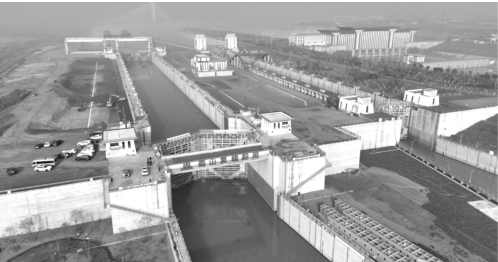
Core Viewpoint - The completion of the Shushan double-line ship lock project marks a significant milestone in the water transport infrastructure of Anhui Province, enhancing the capacity and efficiency of the Jiang-Huai Canal [3][4]. Group 1: Project Completion and Significance - The Shushan double-line ship lock has successfully passed acceptance inspection and is ready for trial operation, completing all nine locks of the Jiang-Huai project [3]. - This project is crucial as it addresses the highest technical difficulties and the largest water level drop along the Jiang-Huai Canal, effectively doubling the traffic capacity at the Shushan hub [4][5]. Group 2: Technical Challenges and Innovations - The construction faced significant geological challenges, including expansive soil and disintegrating rock, which had previously hindered similar projects [5]. - Innovative solutions were implemented, such as using modified soil for stabilization and advanced temperature control methods during concrete pouring [5][6]. Group 3: Environmental and Economic Impact - The Shushan double-line ship lock features a unique "provincial water lock" system that allows for water recycling between the two locks, significantly reducing water consumption [6][7]. - The project is expected to boost the annual cargo volume of the Jiang-Huai Canal to 200 million tons by 2030, representing 28% of the province's total water transport, and saving approximately 6 billion yuan in logistics costs annually [8].

一条“河”改写一座“城”
Ren Min Wang· 2025-11-17 08:20
Core Viewpoint - The opening of the Jianghuai Canal marks a significant turning point for the water transportation industry in Fuyang, enhancing its operational efficiency and expanding its service capabilities [2][3]. Group 1: Business Expansion - Fuyang Port, previously limited to bulk cargo like building materials and grain, is now able to handle containerized goods, allowing for a wider range of products such as furniture and appliances to be transported via water [3]. - The new container shipping routes have transformed Fuyang's business model, enabling companies to utilize containers instead of chartering entire ships, thus catering to smaller shipments [3]. Group 2: Infrastructure Development - The Jianghuai Canal project, initiated in December 2016, integrates water supply, shipping, and ecological benefits, creating a second waterway parallel to the Grand Canal [2]. - Ongoing infrastructure projects, such as the Fuyang double-line ship lock expected to be completed by 2027, aim to enhance the navigational capacity of the Sha Ying River [3]. - The construction of the Nanzhao Port will address the lack of large port facilities on the Huai River, supporting Fuyang's ambition to become a national logistics hub [3]. Group 3: Transportation Efficiency - The Jianghuai Canal significantly reduces transportation distances: Fuyang to Hefei is shortened by approximately 680 kilometers, saving around 5 days; to Tongling by 510 kilometers, saving 3.5 days; to Nanjing by 219 kilometers, saving 1.5 days; and to Shanghai by 57 kilometers, saving 0.5 days [2]. - The port's throughput has seen rapid growth, with a projected volume of 5.86 million tons in 2024, surpassing last year's figures within the first eight months of the current year [3].