
弹劾程序

Search documents
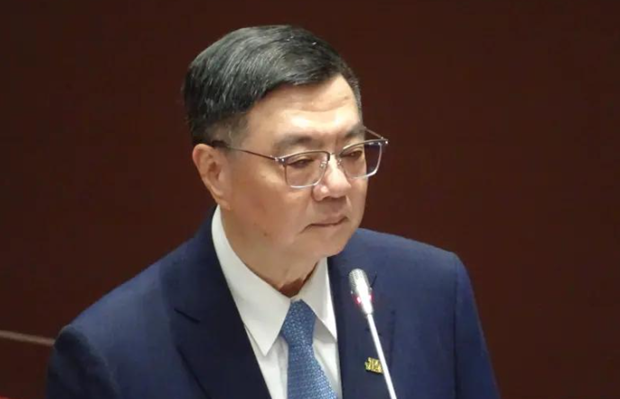
卓荣泰拒副署“财划法”,国民党和民众党民代赴台监察机构陈情要求“弹劾”
Xin Lang Cai Jing· 2025-12-23 08:46
Core Viewpoint - The Taiwanese government is facing political turmoil as the head of the administrative agency, Chuo Rong-tai, refuses to sign the amendment to the "Fiscal Revenue and Expenditure Allocation Act" and has not allocated the budget for the 2026 fiscal year according to the legislative body's approved law, leading to calls for his impeachment from opposition parties [1][3]. Group 1 - The Kuomintang (KMT) and the People First Party (PFP) representatives filed a complaint with the supervisory agency, demanding the impeachment of Chuo Rong-tai for his refusal to sign the budget and execute the law passed by the legislative body [1][3]. - The complaint states that Chuo Rong-tai's actions exceed administrative authority by not allocating the budget for laws that should have been published or executed, resulting in significant dereliction of duty [3]. - The KMT representative, Weng Hsiao-ling, emphasized that Chuo's behavior constitutes a major failure, while another representative, Hsu Chiao-hsin, pointed out that the failure to allocate the budget for military personnel salary increases is also a reason for impeachment [3]. Group 2 - Following Chuo Rong-tai's refusal to sign the "Fiscal Revenue and Expenditure Allocation Act," the KMT and PFP initiated impeachment procedures against Lai Ching-te, the leader of the ruling Democratic Progressive Party (DPP), with proposals submitted to the legislative body [3]. - The legislative body's procedural committee held a meeting where the opposition successfully voted to include the impeachment motion against Lai Ching-te in the agenda for the session on December 26 [3]. - Additionally, a public online petition for the impeachment of Lai Ching-te gained significant traction, with participation skyrocketing from 700,000 to 1.2 million within five hours, and surpassing 8.17 million by the evening of December 22 [4].

蓝白弹劾赖清德,美国武装赖清德
经济观察报· 2025-12-22 10:26
Group 1 - The core viewpoint of the article suggests that the Kuomintang (KMT) and the Taiwan People's Party (TPP) should take more aggressive actions against Lai Ching-te, rather than merely initiating an impeachment process that is unlikely to succeed [1][9] - The KMT and TPP have launched an impeachment procedure against Lai Ching-te in the Legislative Yuan, with over 6 million signatures collected in support from the public within 24 hours, reflecting significant public sentiment [3][4] - The impeachment process requires more than half of the Legislative Yuan members to propose it, which the KMT and TPP can achieve, but they lack the necessary two-thirds majority to pass the resolution [4][5] Group 2 - The article highlights that the impeachment process is more of a publicity campaign aimed at raising awareness of Lai Ching-te's actions and boosting the KMT and TPP's political standing, rather than a feasible legal action [7] - A significant arms sale from the U.S. to Taiwan, amounting to approximately $11.1 billion, is noted as the largest military sale to Taiwan to date, which the Lai administration has welcomed as a sign of strong U.S.-Taiwan relations [8] - The article emphasizes the importance of understanding China's potential countermeasures in response to U.S. arms sales to Taiwan, as well as the implications for cross-strait military dynamics [10][11]
台海观澜|蓝白弹劾赖清德,美国武装赖清德
Jing Ji Guan Cha Bao· 2025-12-22 09:42
Group 1 - The Kuomintang (KMT) and the People’s Party (PP) have initiated impeachment proceedings against Lai Ching-te, reflecting a significant political move in Taiwan amidst ongoing controversies related to the "Fiscal Revenue and Expenditure Division Act" [2][3] - A public petition for Lai's impeachment garnered over 6 million signatures within 24 hours, indicating substantial public sentiment against him, despite the petition lacking legal weight [2] - The likelihood of successfully impeaching Lai is low due to procedural requirements, including the need for a two-thirds majority in the Legislative Yuan, which the KMT and PP do not currently possess [3] Group 2 - The impeachment effort appears to be more of a publicity campaign aimed at raising the profile of the KMT and PP rather than a genuine attempt to remove Lai from office [4] - Concurrently, the U.S. announced a significant arms sale to Taiwan valued at approximately $11.1 billion, marking the largest such sale to date, which the Taiwanese government welcomed as a sign of strong U.S.-Taiwan relations [5] - Taiwan's defense budget is projected to exceed 3% of GDP next year, with aspirations to reach 5% by 2030, indicating a commitment to enhancing its defense capabilities [5] Group 3 - The political dynamics surrounding the impeachment and U.S. arms sales are likely to provoke responses from China, which has historically reacted strongly to U.S. military support for Taiwan [7][8] - Understanding China's potential countermeasures and the implications of U.S. arms sales on cross-strait military balance is crucial for assessing the future of Taiwan's security environment [8][9]
国民党和民众党联手提案弹劾赖清德,要过几关?
Xin Lang Cai Jing· 2025-12-20 12:56
Core Viewpoint - The Chinese Nationalist Party (KMT) and the Taiwan People's Party (TPP) have announced plans to impeach Lai Ching-te, following the Democratic Progressive Party's (DPP) refusal to endorse a recently passed financial law, which has sparked significant public outcry in Taiwan [1][2]. Group 1: Impeachment Proposal - KMT and TPP representatives held a press conference to propose the impeachment of Lai Ching-te, citing his comments on the opposition's actions as "dictatorship" [1]. - The KMT and TPP have initiated a joint condemnation motion and have requested the Taiwan Supervisory Institution to impeach the head of the Executive Yuan, Tsai Ing-wen, appointed by Lai [1]. - A total of 62 representatives from both parties are involved, with 53 attending the press conference to announce the impeachment process [1]. Group 2: Public Sentiment and Political Dynamics - Over 5 million people have participated in an online petition to impeach Lai, indicating significant public support for the action [2]. - A recent poll shows that 43% of the public disapproves of the DPP's refusal to endorse the financial law, surpassing the percentage of supporters [2]. - KMT Chairperson Cheng Li-wen criticized Lai for failing to deliver governance results and accused him of using judicial means for political purges [2]. Group 3: Legislative Process and Requirements - The impeachment proposal requires a majority of 1/2 of the total representatives to propose and a 2/3 majority to pass, with the current opposition holding 62 seats, which does not meet the 2/3 threshold [3]. - The impeachment process mandates that the reasons for impeachment be detailed in writing and submitted to the Legislative Yuan's Procedure Committee for agenda scheduling [3]. - The Legislative Yuan will invite Lai to explain his position during the review process, eliminating any excuses for avoidance [3].
弹劾程序终止?莎拉弹劾案被退回菲律宾众议院
Huan Qiu Shi Bao· 2025-06-10 22:52
Group 1 - The Philippine Senate voted 18-5 to return the impeachment articles against Vice President Sara Duterte to the House of Representatives, indicating that this does not equate to dismissing or terminating the case [1] - Some senators believe that returning the case to the House effectively terminates the impeachment process, as it allows for further deliberation without a definitive resolution [2] - Legal experts express concerns that this action may set a poor precedent, allowing politically sensitive impeachment cases to be passed back and forth between legislative bodies, potentially leading to endless debates [2] Group 2 - The impeachment complaint against Vice President Sara Duterte was formally filed in February, citing allegations of misuse of confidential funds and threats against President Marcos and First Lady Lisa [2] - According to the Philippine Constitution, for an impeachment complaint to be effective, it requires a two-thirds majority vote from the Senate after being transferred from the House [2]