影院+

Search documents
2025年全年电影票房518.32亿元,同比增长21.95%
Bei Jing Ri Bao Ke Hu Duan· 2026-01-20 13:52
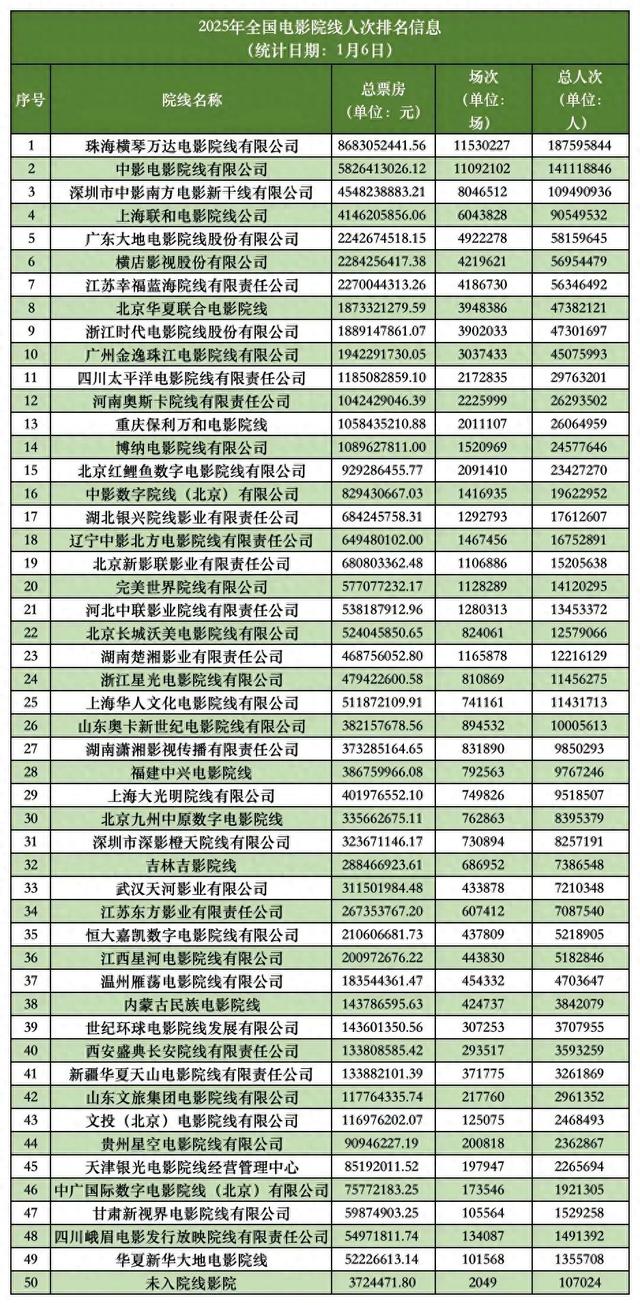
Core Insights - The Chinese cinema market is experiencing a significant recovery in 2025, with total box office revenue reaching 51.832 billion yuan and total audience attendance at 1.238 billion, representing year-on-year growth of 21.95% and 22.57% respectively [1] - The development of cinema chains in China is characterized by the keywords "caution" and "transformation," with a focus on strategic adjustments and refined operations to consolidate competitive advantages [1][2] - The industry is shifting from quantity-focused expansion to enhancing operational efficiency and profitability, with a growing emphasis on differentiated experiences and technological upgrades [6][8] Group 1: Market Performance - In 2025, the total number of cinemas built reached 1,065, an increase of 39 from the previous year, indicating sustained investor confidence in the market [6] - The average ticket price for films in 2025 was 41.8 yuan, continuing a two-year decline, while the average ticket price for premium formats like IMAX and CINITY rose to 56.3 yuan [10] - The top three cinema chains accounted for 36.76% of the market share, up from 33.81% the previous year, reflecting increased market concentration [2][3] Group 2: Strategic Adjustments - Wanda Cinemas, the leading cinema chain, reported a box office of 8.683 billion yuan in 2025, holding a market share of 16.75%, despite a strategic shift to focus on direct operations rather than franchise models [5][6] - China Film's cinema chain saw a significant increase in new cinema openings, with 148 new cinemas launched in 2025, up from 103 the previous year [8] - The industry is witnessing a trend of "quantity reduction and quality increase," with a decrease in the number of cinema investment companies to 529, while the number of companies generating over 100 million yuan in box office revenue increased [6][8] Group 3: Technological Advancements - The number of special effect theaters surpassed 10,000, generating a total box office of 12.67 billion yuan, with a year-on-year growth of 48.5% [10] - The average audience attendance for special effect theaters reached 24.6, significantly higher than the 8.7 for regular theaters, indicating a preference for high-quality viewing experiences [10] - Virtual reality cinemas are being actively developed, with several locations opening in 2025, showcasing the industry's commitment to innovative viewing experiences [13][15] Group 4: Audience Engagement and Content Strategy - The industry is moving towards a more diversified content strategy, with cinemas increasingly hosting special screenings, community events, and localized film releases to engage different audience segments [19][20] - Successful case studies include the "Danish Film Master Exhibition" at Shanghai Cinema, which achieved a 99.24% average attendance rate across multiple screenings [17] - The integration of cinema with community culture and local events is becoming a common strategy to enhance audience engagement and loyalty [19][20] Group 5: "Cinema+" Business Model - The "Cinema+" model is gaining traction, with cinemas exploring collaborations with various sectors such as dining, retail, and gaming to create multifaceted entertainment experiences [23][25] - Wanda's collaboration with popular gaming IPs during the National Day holiday led to a 50% increase in customer traffic, demonstrating the effectiveness of cross-industry partnerships [25] - Cinemas are evolving into cultural spaces that offer a blend of viewing, socializing, and consumption, moving away from traditional single-function models [28][29]

影院新玩法激活消费潜力!“影院+”新模式拓展电影新质生产力
Yang Shi Xin Wen Ke Hu Duan· 2026-01-09 14:19
Core Insights - The Chinese film industry is experiencing a transformation with advancements in viewing technology and diversified entertainment experiences, leading to a record box office of 730 million yuan during the New Year holiday [1] Group 1: Upgraded Viewing Experience - The number of LED screens in domestic cinemas has reached the highest globally, with the CINITY LED projection system becoming the preferred format for major films due to its high resolution and immersive sound [2] - The first virtual reality cinema in Beijing, 798 Super Dimension, has opened, offering systematic VR experiences that break traditional content output models [2] - The largest XR cinema in China, located in Guiyang, is creating new cultural consumption scenarios using virtual reality technology [2] - Upcoming XR projects like "Dreaming Back to Tang Dynasty" and "Wandering Mountain Little Monster" are set to redefine entertainment experiences [2] Group 2: Cinemas as Entertainment Complexes - Modern cinemas are evolving into entertainment complexes with themed lounges, interactive areas, and creative retail spaces, moving beyond traditional movie screenings [3] - The "Super Entertainment Space" strategy is being implemented nationwide, allowing cinemas to diversify revenue streams beyond ticket sales [3] - Collaborations with brands like 52toys and themed spaces linked to popular IPs are attracting younger audiences and enhancing the cinema experience [3] - The first anime-themed cinema in Shanghai and the immersive game space "Mirra" in Beijing are examples of innovative cinema concepts [3] Group 3: Multi-Consumption Ecosystem - The Chinese film industry is shifting from a single box office economy to a multi-faceted consumption ecosystem, with initiatives like "Film + Tourism" being launched in various regions [4] - In Huzhou, ticket stubs provide discounts on scenic spots, dining, and shopping, enhancing the overall consumer experience [5] - The "Follow the Movie Tour" initiative in Anshan offers free outdoor films alongside cultural performances and local product exhibitions, creating unique viewing experiences [6]
金逸影视(002905) - 002905金逸影视业绩说明会、路演活动信息20250509
2025-05-09 10:30
Financial Performance - In 2024, the company reported a revenue of ¥1,012,421,117.93, with a net loss of ¥90,354,207.61 due to industry recovery falling short of expectations and high fixed costs [3][4][11] - In Q1 2025, following the success of the film "Nezha: Birth of the Demon Child," the company achieved a revenue of ¥505,596,225.68 and a net profit of ¥106,452,480.17, marking a year-on-year growth of 493.15% [4][7][11] Market Context - The total box office for the Chinese film market in 2024 was ¥42.502 billion, a decrease of 22.6% compared to 2023, with 1.01 billion viewers, down 22.3% [9] - The company's direct-operated cinemas generated a box office of ¥936 million, ranking 5th among national film investment companies, while its cinema line achieved ¥1.639 billion, ranking 9th [9][14] Strategic Initiatives - The company plans to enhance profitability through various strategies, including optimizing cinema networks, expanding non-ticket revenue streams, and exploring the "Cinema+" model [8][13][14] - Future projects will focus on activating cinema spaces for diverse events, such as live broadcasts of sports and cultural performances [6][8] Industry Challenges and Opportunities - The company faces risks including public health emergencies, increased competition, and reliance on upstream film production [7][11] - The successful release of "Nezha: Birth of the Demon Child" during the Spring Festival (January 28 - February 4) generated a record box office of ¥9.51 billion and 187 million viewers, indicating a potential recovery for the industry [10][11] Future Outlook - The company aims to leverage its established brand and market position to capitalize on the anticipated recovery in the film industry, focusing on content innovation and technological advancements [10][12]