忒修斯之船悖论

Search documents
觉得AI内容恶心?这是好事啊
虎嗅APP· 2025-12-22 11:08
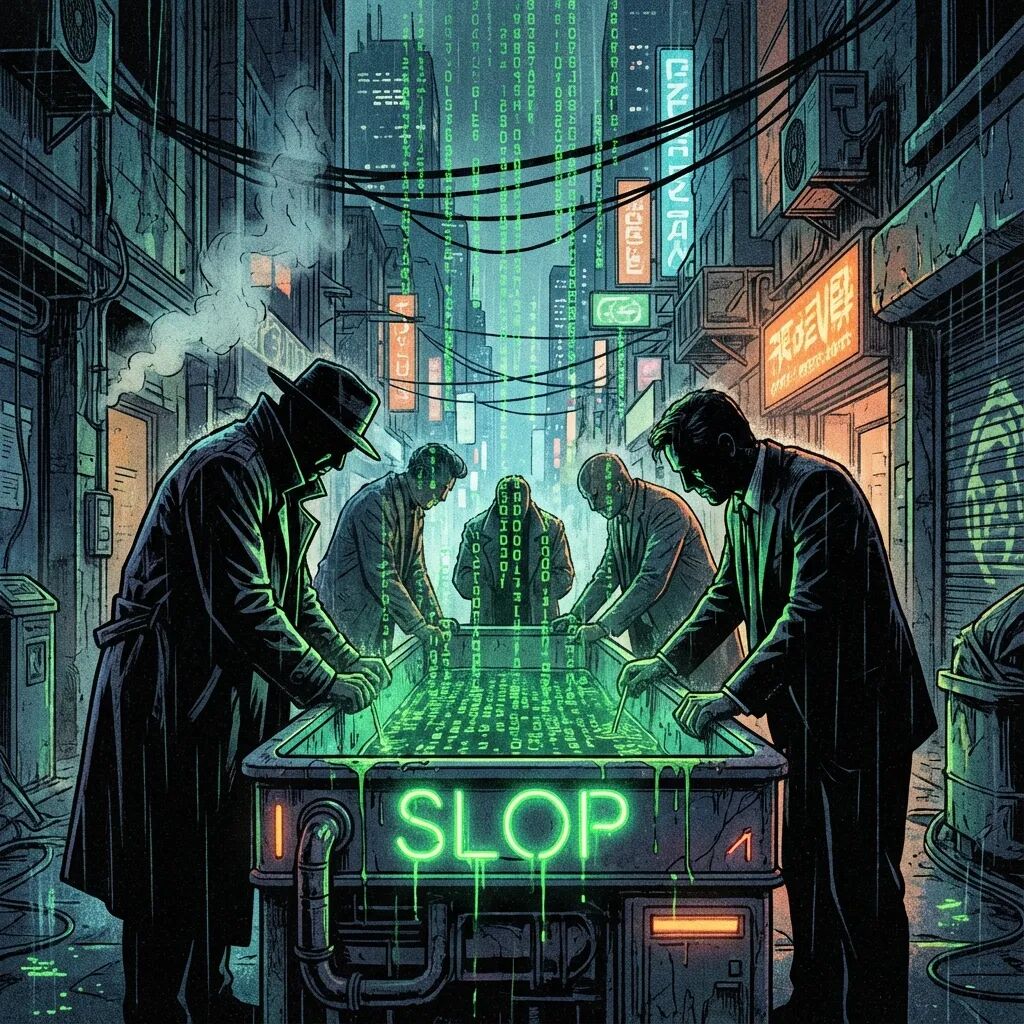
Core Viewpoint - The article critiques the proliferation of low-quality AI-generated content, referred to as "Slop," which lacks depth and authenticity, and warns against the dangers of accepting such content uncritically [4][5][9]. Group 1: The Nature of AI-Generated Content - "Slop" is defined as low-quality, soulless content produced in bulk by AI, which is set to become a prominent term in 2025 [4]. - The article highlights the discomfort many experience when encountering AI-generated content, leading to the rise of "AI identification experts" who can discern such content [6][8]. - The author acknowledges the utility of AI in writing but emphasizes that the output must not be repulsive or devoid of substance [9][10]. Group 2: The Psychological and Cultural Implications - The concept of "Hive Mind" is introduced, illustrating a world where individuals lose their uniqueness and critical thinking in favor of uniformity and comfort, akin to the fictional character Unity from "Rick and Morty" [12][14]. - The article draws parallels between AI-generated content and historical examples of deceptive practices, such as the "Swill Milk Scandal," where harmful substances were masked to appear appealing [17][18]. - The importance of the feeling of "disgust" is discussed as a natural defense mechanism against consuming low-quality content, which serves as a behavioral immune system [18][19]. Group 3: The Call for Individual Agency - The article posits that in an age where content creation is cheap and abundant, the act of refusal—choosing not to engage with certain content—becomes a significant assertion of individuality [24][25]. - It emphasizes the value of maintaining one's identity and critical faculties in the face of overwhelming AI-generated content, advocating for the right to reject what is deemed unworthy [25][26].


觉得 AI 内容恶心?这是好事啊
3 6 Ke· 2025-12-22 02:20
Core Viewpoint - The article discusses the phenomenon of low-quality AI-generated content, referred to as "Slop," which lacks depth and authenticity, leading to a sense of discomfort among readers [1][3][4]. Group 1: AI Content Generation - AI writing is seen as a useful tool for navigating the overwhelming amount of information in today's society, but it must not produce content that is off-putting or lacks substance [3][4]. - The rise of "AI Slop" reflects a trend where content is generated to meet algorithmic standards rather than genuine human expression, resulting in a homogenized and superficial output [1][7]. Group 2: Psychological and Philosophical Implications - The discomfort associated with AI-generated content is likened to a biological response, serving as a defense mechanism against algorithmic homogenization [4][13]. - The article draws parallels between the current digital landscape and historical events, such as the "Swill Milk Scandal," to illustrate the dangers of consuming content that appears appealing but is fundamentally flawed [9][10]. Group 3: The Importance of Rejection - The act of rejecting low-quality content is framed as a crucial aspect of maintaining individual identity in an age where content creation is overly simplified and commodified [16][17]. - The article emphasizes that in a world flooded with AI-generated material, the choices of what to reject are more defining of personal identity than the choices of what to consume [16][17].