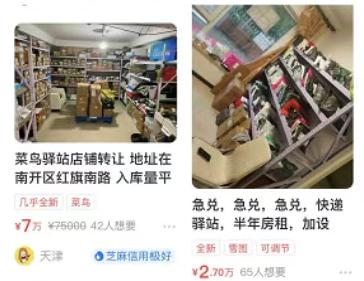
快递驿站转型

Search documents
增量不增收 部分地区快递驿站现“转让、关停”
Xin Lang Cai Jing· 2026-02-11 20:52
Core Viewpoint - The rapid expansion of express delivery stations in China is facing significant challenges, leading to a rise in closures and transfers as profitability declines amid intense competition and operational difficulties [1][2][4]. Group 1: Industry Overview - The express delivery station industry has grown alongside the rapid development of e-commerce, with over 240,000 express company outlets and more than 420,000 rural logistics service stations in China [2]. - Despite the growth in business volume, many delivery stations are experiencing operational difficulties, with numerous owners seeking to transfer or close their businesses due to increased competition and reduced profitability [3][4]. Group 2: Operational Challenges - Many delivery station operators report that the influx of competing stations has diluted their package volumes, making it increasingly difficult to maintain profitability [3][5]. - Complaints from consumers regarding service quality, such as packages being left at stations instead of delivered to homes, have increased, highlighting the operational challenges faced by delivery stations [2][3]. Group 3: Financial Performance - The average revenue per package for delivery stations has decreased significantly, with the average price per delivery dropping from 28.55 yuan in 2007 to 7.55 yuan currently [4][6]. - Operators are facing a "loss-leader" situation where they are forced to lower prices to compete, resulting in profit margins being severely squeezed [6]. Group 4: Market Regulation and Future Directions - Regulatory bodies are increasing oversight of the express delivery market to combat "involution" and ensure fair competition, with measures aimed at preventing below-cost pricing practices [6][7]. - Experts suggest that delivery stations should evolve from mere package transfer points to community service hubs, offering additional services to enhance customer engagement and profitability [8].
大撤退,快递驿站,越来越难做了
3 6 Ke· 2025-12-30 23:17
Core Insights - The express delivery station industry, once seen as a low-barrier path to wealth, is now facing significant challenges, with many stations struggling to find buyers for transfer [1][3] - Data shows that over half of the 187,000 express delivery stations in China are operating at a loss, with the average lifespan dropping from 2.3 years to just 11 months [2] Group 1: Industry Challenges - Most express delivery stations are not only unprofitable but are also incurring losses, primarily relying on delivery and shipping fees for revenue [6] - Delivery fees have decreased significantly due to intense competition, dropping from 0.5-0.8 yuan per item to as low as 0.2 yuan in highly competitive areas [7] - The average price for domestic express delivery has fallen to 7.52 yuan per item, a 7.7% decrease compared to the previous year [8] Group 2: Cost Structure - Fixed costs for express delivery stations are substantial, including rent (2,000-3,000 yuan per month for a small storefront) and labor costs (3,000-5,000 yuan per month for staff) [9] - Additional costs such as notification fees and system usage fees can add several thousand yuan to monthly expenses, making profitability difficult [10] Group 3: Consumer and Company Relations - Express delivery stations are caught in the middle, facing complaints from consumers due to issues like unauthorized package drop-offs, leading to a 43% increase in related complaints [12] - Delivery companies impose various penalties on stations, creating an unbalanced relationship where stations are financially penalized for issues beyond their control [13][14] Group 4: Market Saturation and Competition - The industry is experiencing saturation, with many stations competing for the same customer base, leading to a race to the bottom in pricing [16] - In many county-level cities, 95% have multiple delivery stations, resulting in fierce competition that drives down profits for all [16] Group 5: Attempts at Diversification - Many station owners have attempted to diversify their services, such as adding retail or community group buying, but these efforts often result in minimal returns and additional challenges [19] - The majority of users visit stations solely to pick up packages, with over 80% spending less than three minutes on-site, making retail efforts largely ineffective [19] Group 6: Future Outlook - Despite the challenges, the demand for last-mile delivery remains strong, with express delivery volumes expected to continue growing, indicating that express delivery stations are unlikely to disappear entirely [21]