
快速路网建设

Search documents
杭州快速路总里程突破520公里
Mei Ri Shang Bao· 2026-01-20 03:32
Core Insights - The opening of the Tongcheng Elevated Road (Xiaoshao Road to Nanxiu Road) significantly enhances the connectivity between Hangzhou South Station and Xiaoshan Airport, marking a milestone as the total length of Hangzhou's expressway network surpasses 520 kilometers [1][2] Group 1: Infrastructure Development - The Tongcheng Elevated Road is part of Hangzhou's rapid road network, specifically the "two rings, five verticals, eight horizontals, and eight connections" framework, and serves as a key component of the north-south elevated road system [1] - The newly opened section from Xiaoshao Road to Nanxiu Road is 2.5 kilometers long and is a crucial part of the third phase of the Tongcheng Avenue expressway project, which has a total mainline length of 3.23 kilometers designed for six lanes in both directions [1] - The project employs innovative construction techniques, including the "composite structure pier" method, which is a first in domestic municipal engineering and is being developed into an industry standard [1] Group 2: Traffic Efficiency and Economic Impact - The completion of the elevated road will eliminate traffic barriers between the old town of Xiaoshan and the southern areas, allowing citizens to reach Hangzhou South Station in 5 minutes and connect to the airport expressway in 10 minutes, significantly improving commuting efficiency [2] - The combination of elevated and ground auxiliary roads will effectively alleviate surface traffic pressure and reduce congestion, enhancing the overall travel experience [2] - Future phases of the project will extend towards Suqian and integrate with the East Extension of the Asia-Pacific Road, creating a comprehensive and efficient road network that facilitates the rapid flow of talent, capital, and technology, thereby supporting high-quality economic development in Xiaoshan [2]
青岛:快速路网越织越密 城市“经脉”更畅通
Xin Hua Wang· 2025-12-21 01:42
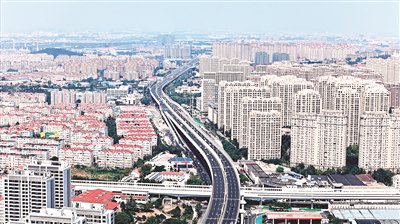
Core Viewpoint - Qingdao has significantly improved its urban road network through city renewal initiatives, focusing on enhancing connectivity and traffic efficiency, which supports economic and social development [2][3][4]. Group 1: Urban Road Network Development - Since the beginning of the 14th Five-Year Plan, Qingdao has concentrated on four key areas: rapid network formation, three-dimensional nodes, main road improvements, and secondary road connectivity [2]. - The completion rate of the rapid road network in the eastern urban area has increased from 47.3% to 73.6%, indicating a well-structured "four vertical and five horizontal" rapid road system [2]. - Major rapid road projects, including the Chongqing Elevated Road, have been completed, significantly reducing travel times across the city [3]. Group 2: Key Infrastructure Projects - The Liyang Road Rapid Road integrates multiple transportation modes, enhancing connectivity and reducing travel time from 40 minutes to approximately 15 minutes during non-peak hours [2]. - The Chongqing Elevated Road has reduced peak travel time from 50 minutes to under 20 minutes, greatly improving north-south connectivity in the city [3]. - Over 20 major arterial roads have been constructed, expanding the road network and alleviating traffic congestion in critical areas [4]. Group 3: Traffic Management and Efficiency - The construction of key interchanges, such as the Jinjialing Interchange, has improved the road network's capacity and traffic flow, addressing congestion at major junctions [4][5]. - The city has successfully completed the opening of 124 previously unconnected roads, enhancing the overall efficiency of the road network and improving citizens' travel experiences [5].

烟台最大互通立交建成通车
Qi Lu Wan Bao· 2025-08-15 07:08
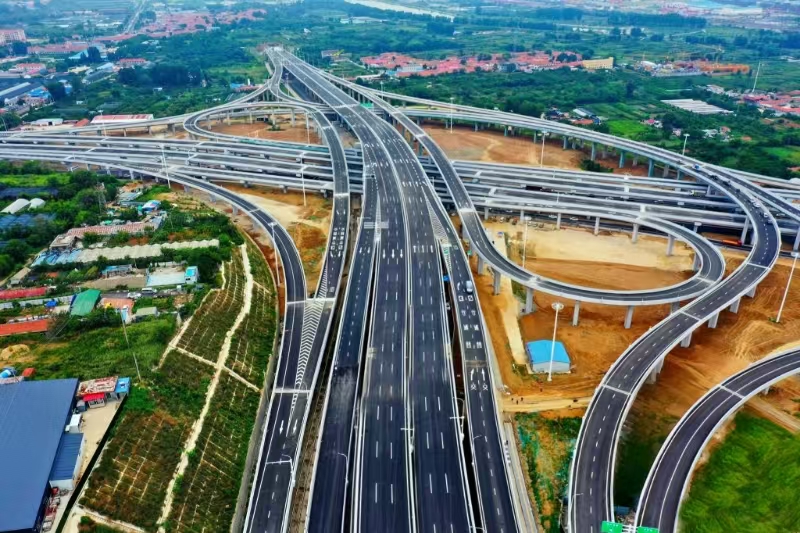
Core Viewpoint - The completion of the Port City West Street Interchange marks a significant breakthrough in the construction of Yantai's expressway network, enhancing traffic efficiency and supporting urban spatial optimization [1][5]. Group 1: Project Overview - The Port City West Street Interchange is designed in a cloverleaf shape, featuring a total length of 1.3 kilometers for the north-south main line and 2.1 kilometers for the east-west main line, with 8 turning ramps and 2 distribution roads [4]. - The interchange facilitates traffic conversion between the Derun Expressway and Port City West Street, with seamless connections to the main bridge [4]. Group 2: Construction Details - Construction began on October 1, 2022, with the China Railway Tenth Bureau overcoming various challenges, including safety pressures, high precision in lifting, and heavy traffic flow [5]. - The project utilized BIM+ technology to optimize construction plans and enhance resource allocation, resulting in the early completion of the interchange [5]. Group 3: Strategic Importance - The interchange serves as a crucial hub in Yantai's expressway network, contributing to the "two verticals and one horizontal" strategic layout, and is expected to inject strong momentum into the development of a modern, efficient, and eco-friendly transportation system [5].
苏州主城区与张家港再添一条快速路
Su Zhou Ri Bao· 2025-08-08 00:41
Core Points - The opening of the Dong Er Huan elevated road in Zhangjiagang significantly enhances north-south traffic efficiency in the city and provides a more convenient and efficient connection between Zhangjiagang and Suzhou [1][2] - The elevated road features a signal-free design, allowing for efficient and continuous vehicle flow, thus reducing delays caused by intersections [1] - The traffic volume at the intersection of Dong Er Huan and Su Yu Zhang Road is expected to increase following the road's opening, with additional routes being made available for public convenience [1] Summary by Sections - **Infrastructure Development** - The Dong Er Huan elevated road serves as the central axis of Zhangjiagang's "T" shaped urban expressway network [1] - It connects the northern and southern parts of the city, improving overall traffic conditions [2] - **Traffic Management** - The elevated road allows vehicles to enter and exit at designated ramps, facilitating smoother transit between key areas [1] - The road's design aims to alleviate congestion typically experienced on surface streets [1] - **Regional Connectivity** - The road links the Jin Feng section and the Su Yu Zhang highway, enhancing rapid transit between Zhangjiagang and Suzhou [2] - The project is crucial for improving road service levels and completing the regional expressway network [2]