
思政工作

Search documents
青春守“线”护团圆
Xin Lang Cai Jing· 2026-02-17 10:07
Group 1 - The article highlights the crucial role of young railway communication workers in ensuring the safety and efficiency of the railway communication network during the Spring Festival travel rush [1][3] - Liu Shuheng, a young worker at the Nanchang Communication Section, initially felt lost in his monotonous job but eventually excelled by taking on challenging tasks and contributing to the development of an emergency system that reduced fault handling time from hours to minutes [1] - Zhuang Zhiqin, a 24-year-old communication worker stationed at the Pingtan Strait Rail-Sea Bridge, overcame initial reluctance to stay in a challenging environment due to supportive measures from the organization, demonstrating commitment to ensuring communication safety during the Spring Festival [3] Group 2 - The Nanchang Communication Section has implemented various supportive initiatives to address the emotional needs of young workers, including creating "spiritual oxygen bars" and "youth ideological corners" to alleviate feelings of homesickness and anxiety [5] - Innovative methods such as original music videos and micro-films have been employed to engage young workers in ideological education, alongside activities like "Warm Winter Reunion" and "Cloud Reunion Meeting" to foster a sense of community and belonging [5] - The leadership emphasizes that the ideological work should resonate with the youth, adapting to their concerns and ensuring that the organization meets their needs [5]


芦岭矿三级网格让思政工作直抵一线
Zhong Guo Neng Yuan Wang· 2026-02-03 09:50
Core Viewpoint - The company has implemented a three-tier grid system to enhance employee welfare and safety, fostering a supportive environment for workers through proactive engagement and communication [1][2][3] Group 1: Employee Support Initiatives - The company has designated 18 grassroots party branch secretaries as "grid leaders" and transformed 147 team leaders into "grid members," enhancing the first line of observation and communication for employee needs [2] - The grid members utilize various methods to address employee concerns, such as creating a "people's sentiment map" to track personal and health information, ensuring tailored support for each worker [2] - The company has established both online and offline channels for employees to voice their concerns, including a weekly "talking session" to address issues directly, ensuring timely responses to safety and personal challenges [2] Group 2: Management and Communication Strategies - The company emphasizes the importance of integrating ideological and political work into daily operations, aiming to make services more accessible and relevant to employees [3] - The grid management approach has shifted employee perception from being mere observers to active participants, enhancing their sense of belonging and engagement within the organization [2] - Future plans include deepening grid management to further embed support services into the workplace, ensuring that employee needs are met effectively [3]
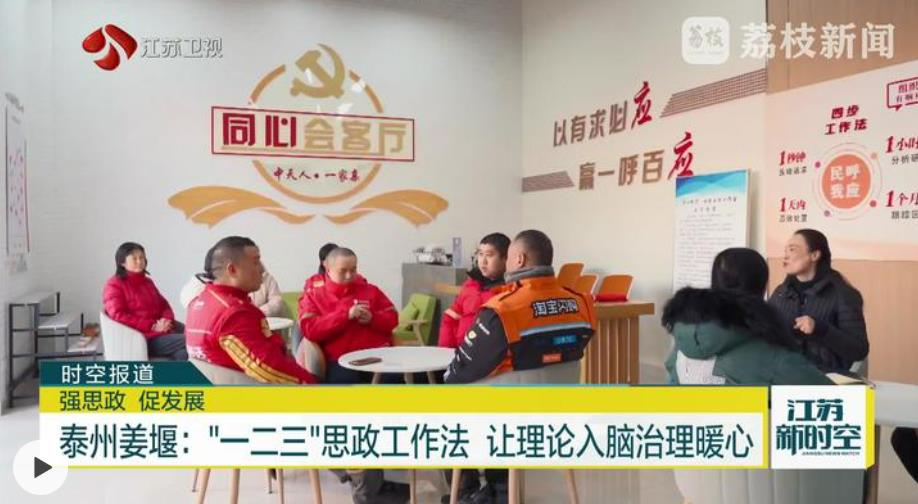
【强思政 促发展】泰州姜堰:“一二三”思政工作法 让理论入脑治理暖心
Xin Lang Cai Jing· 2026-01-17 13:35
Core Viewpoint - The article discusses the innovative approaches taken by the Zhongtian Community in Jiangyan District, Taizhou, to integrate political education with community needs, enhancing grassroots governance and citizen engagement through various initiatives [2][3][5]. Group 1: Community Engagement and Initiatives - The Zhongtian Community has implemented a "one-two-three" ideological work method, focusing on understanding community needs and utilizing both online and offline platforms to enhance governance [3]. - The "Zhongtian Lecture Hall," led by resident Chen Jin, combines policy education with art, making complex theories accessible to the community through relatable stories and visuals [5]. - The community has established a health station in response to resident suggestions, demonstrating a proactive approach to addressing local health needs [7]. Group 2: Educational and Governance Strategies - The community has created a matrix for ideological education that includes both online and offline components, such as the "Zhongtian Lecture Hall" and "Cloud Learning" classes [7]. - Various learning and discussion forums, like "corridor study meetings" and "consultation meetings," have been organized to foster community participation and address local issues [7][9]. - As of now, the Zhongtian Community has conducted 82 ideological theme learning sessions and recorded 8 episodes of the "Zhongtian has 'Reason'" micro-lecture series, successfully addressing over 20 community welfare issues [11].
浅谈数字信息化对思政工作的挑战和机遇
Zhong Guo Fa Zhan Wang· 2025-09-04 09:49
Core Viewpoint - Digital transformation is an irreversible trend across various industries, including political work, which requires adaptation to new technologies and methods to enhance effectiveness and engagement [1][2][4]. Group 1: Digital Transformation in Political Work - The rapid development of information technology necessitates a shift from traditional methods to digital tools in political work, which has been slow in some areas [1][3]. - Digital tools like employee self-service platforms can reduce repetitive tasks and improve efficiency, while big data analysis helps tailor services to employee needs [1][4]. - The integration of big data, cloud computing, and IoT provides new management methods and enhances real-time data collection and monitoring capabilities [2][4]. Group 2: Challenges and Opportunities - Digital transformation presents both opportunities and challenges for political work, including the need for continuous investment in technology and infrastructure [2][4]. - The internal drivers for digital transformation include improving work efficiency and decision-making support, while external drivers involve policy guidance and evolving social demands [2][4]. - Data security and privacy protection are critical challenges that must be addressed during the digital transformation process [4]. Group 3: Skills and Competencies - The skill requirements for political workers have significantly increased, necessitating proficiency in data analysis and information processing [5]. - Political workers can leverage data analysis to better understand employee sentiments and needs, leading to more effective political education strategies [5]. - The establishment of a digital mindset and the integration of technology into political work are essential for creating a new model that enhances effectiveness and relevance [5].