思维链模式

Search documents
AI做题够准吗?是智能助手还是教学隐患?
2 1 Shi Ji Jing Ji Bao Dao· 2025-12-03 09:23
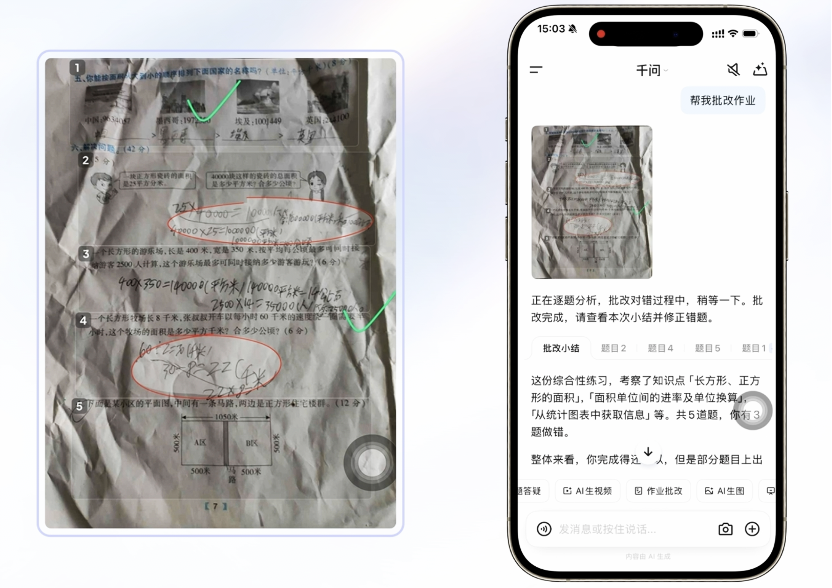
Core Viewpoint - The integration of generative AI in education is sparking debates about its reliability and potential risks, similar to past concerns over calculator dependency in classrooms [1][8]. Group 1: AI's Role in Education - Generative AI is increasingly being used by students for tasks such as homework assistance, leading to questions about its accuracy and the potential for creating dependency [1][4]. - Teachers are utilizing AI for lesson preparation and grading, but there are concerns about AI providing incorrect answers, which could mislead students [1][5]. - The education sector is witnessing a shift from simple answer retrieval to a focus on teaching processes and critical thinking, as emphasized by recent guidelines from the Ministry of Education [4][5]. Group 2: Technological Advancements - The industry is focusing on improving AI's ability to accurately recognize complex inputs, such as messy handwriting and intricate diagrams, which is crucial for effective classroom integration [2][6]. - The latest AI models, like Qwen3-Learning, are designed to enhance the learning experience by mimicking human teaching styles and providing structured knowledge presentation [6][8]. - The evolution of AI in education is moving towards a model that emphasizes understanding and reasoning rather than just providing answers, which could help address gaps in teaching resources [6][9]. Group 3: Teacher-AI Relationship - Despite advancements, AI is not seen as a replacement for teachers; rather, it is viewed as a tool that can significantly assist in grading and lesson planning [8][9]. - Teachers express that while AI can reduce their workload, it cannot replace the nuanced understanding and intervention that human educators provide [9][10]. - The historical context suggests that while technology changes how knowledge is acquired, the foundational understanding remains essential for effective learning [10].

AI做题够准吗?是智能助手还是教学隐患?
21世纪经济报道· 2025-12-03 09:12
Core Viewpoint - The article discusses the integration of generative AI in education, highlighting both its potential benefits and concerns regarding its accuracy and impact on students' learning processes [1][6]. Group 1: AI's Role in Education - Generative AI is increasingly being used by students for tasks such as homework assistance, leading to debates about its reliability and the potential for creating dependency [1][6]. - Teachers express concerns that AI can provide incorrect answers with confidence, which may mislead students and hinder their critical thinking skills [1][6]. - The Ministry of Education emphasizes the importance of critical use of AI, advising against copying AI-generated answers to maintain personal thought and creativity [6][8]. Group 2: AI's Technical Capabilities - The ability of AI to recognize complex inputs, such as messy handwriting and intricate diagrams, is seen as a crucial factor for its effective use in classrooms [2][5]. - Recent updates to AI tools, like Qwen 3-Learning, focus on improving the understanding of complex questions and providing structured knowledge presentation, mimicking human teaching styles [5][7]. - The transition from simple answer searching to process-oriented teaching reflects a significant evolution in AI educational products, aiming to enhance students' thinking abilities [6][7]. Group 3: Teacher-AI Relationship - While AI can assist in grading and generating reports, educators believe it cannot fully replace teachers, as human oversight and intervention are essential in the learning process [7][8]. - AI tools can significantly reduce teachers' workload, particularly in grading, but the need for human interaction and guidance remains critical for effective education [7][8]. - The ongoing evolution of AI in education raises questions about ensuring that students focus on the learning process rather than merely seeking answers [7][8].