成长循环

Search documents
新年Flag总是倒?也许是你被“完美计划”骗了
3 6 Ke· 2026-01-28 00:24
Core Insights - The article discusses the challenges of setting and achieving personal goals in the context of societal pressures and individual aspirations [1][2][3][4][5]. Group 1: Goal Setting Theories - Caroline Adams Miller critiques existing goal-setting frameworks, particularly the SMART criteria, suggesting they may encourage low aspirations without sufficient guidance [2][3]. - Miller's work is based on goal-setting theory (GST) which emphasizes that effective goals should be challenging and specific, and can be categorized into performance and learning goals [3]. - The BRIDGE framework proposed by Miller includes six steps for effective goal setting, focusing on brainstorming, evaluating relationships, and defining excellence [3]. Group 2: Alternative Approaches - Anne-Laure Le Cunff's "Tiny Experiments" advocates for a more fluid approach to goal achievement, emphasizing qualitative experiences over rigid timelines [4][5]. - Le Cunff introduces the "Triple Check" method to identify procrastination causes by asking if the task is suitable, exciting, and feasible [5]. - Dan Heath's "Reset" suggests finding leverage points to achieve disproportionate returns on effort, emphasizing the importance of understanding systems to improve outcomes [5].
落差效应:成就带来的情绪后果
3 6 Ke· 2025-05-17 00:04
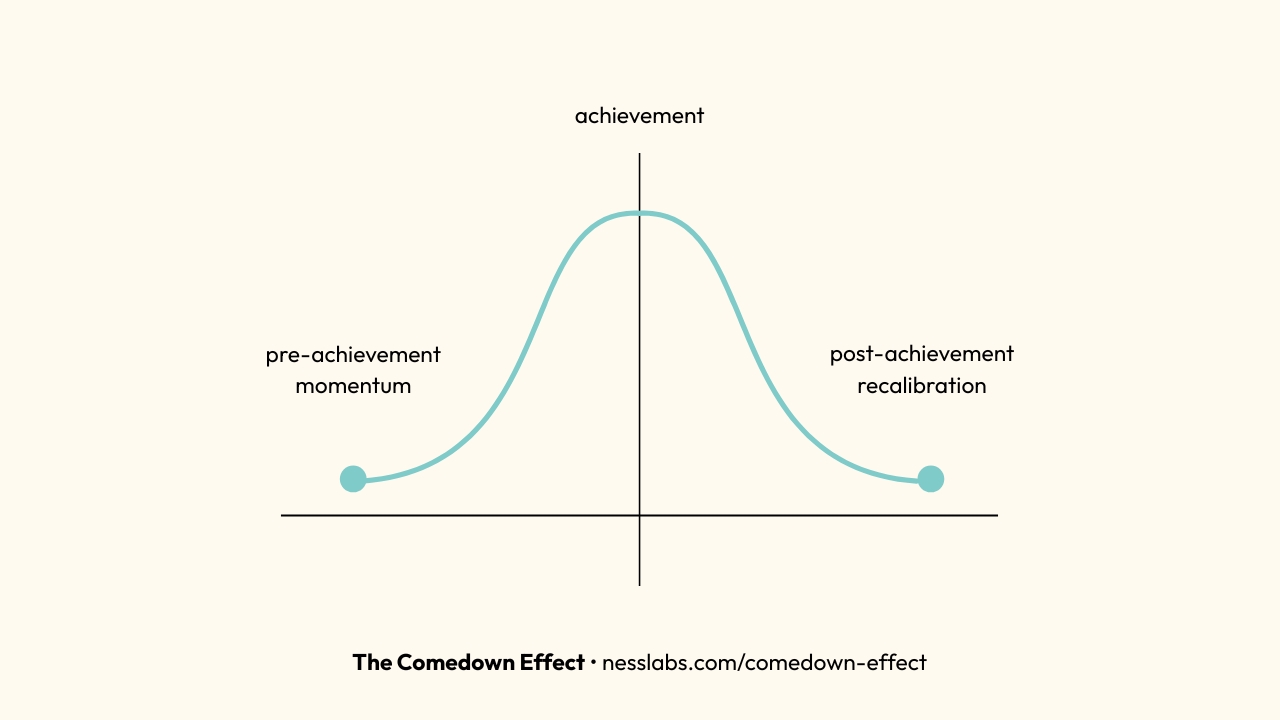
Core Insights - The article discusses the phenomenon known as the "post-achievement gap," which refers to the emotional void experienced after reaching a significant milestone or completing a challenging task [1][2][3] Group 1: Emotional Consequences of Achievement - The "post-achievement gap" is largely driven by the brain's dopamine system, which regulates motivation and reward processing. Contrary to popular belief, dopamine's primary role is not pleasure but anticipation [4] - Many individuals experience a sense of "emptiness" after completing a significant task, as the work that once occupied their thoughts and lives suddenly comes to an end [5] - Public achievements add another layer to the "post-achievement gap," as individuals may seek external validation to measure their work's value, leading to a temporary high followed by a low [6] Group 2: Strategies for Managing the Post-Achievement Gap - The article outlines five strategies to manage the natural emotional adjustment following significant achievements: 1. Create a critical ritual to mark the project's end, such as a special dinner or gathering with friends and colleagues [7] 2. Integrate experiences by dedicating time to reflect on events and feelings shortly after project completion, which aids in memory consolidation [8] 3. Start a low-risk, unrelated small experiment to satisfy the brain's craving for novelty and progress [9] 4. Seek internal validation by focusing on personal growth and learning rather than external success metrics [9] 5. Explore future goals without making immediate commitments, allowing for a healthy continuity in the brain's reward system [9]