执行难破解

Search documents
2025年全国县级综治中心推动化解矛盾纠纷976.4万件——法治护航经济社会高质量发展
Xin Lang Cai Jing· 2026-01-17 05:22
Group 1 - The article highlights the effective operation of the property execution clue transfer center, which has successfully converted over 2 million yuan in "paper rights" into "real money" for small and micro enterprises [1] - The judicial system is enhancing the enforcement of laws to support high-quality economic and social development, thereby improving people's sense of gain, happiness, and security [1] - The Supreme People's Court is conducting research to strengthen the execution system and address the challenges of enforcement, while the Supreme People's Procuratorate and the Ministry of Public Security are implementing regulations to enhance human rights protections in judicial processes [1] Group 2 - In the past year, judicial authorities have focused on serving and safeguarding economic and social development, including regional judicial cooperation and the implementation of the Private Economy Promotion Law [2] - A recent public sentencing in Sanya, Hainan, of seven defendants for smuggling reflects the judicial system's commitment to combating smuggling and supporting the construction of the Hainan Free Trade Port [2] - The number of criminal cases related to "tax evasion through purchasing" in Hainan has decreased by 9.5%, with the case value and tax amounts dropping by 45.6% and 47%, respectively [2] Group 3 - Judicial authorities are working with relevant departments to mitigate risks in key sectors such as finance, real estate, and education, while also addressing risks associated with emerging technologies [3] - The concept of equal protection for private enterprises has gained traction, with significant improvements in the precision of legal protections and the establishment of better institutional mechanisms [3] - Various local judicial authorities are implementing measures to optimize the business environment, with over 600 million yuan in overdue payments collected for enterprises in Shandong province since 2025 [3] Group 4 - The promotion of information technology and standardization in judicial processes is enhancing the efficiency of conflict resolution, allowing for better service delivery to the public [4] - In 2025, county-level comprehensive governance centers resolved approximately 9.764 million disputes, with 31 provinces establishing unified information platforms for conflict resolution [4] Group 5 - The establishment of standardized comprehensive governance centers aims to provide a platform for public service, ensuring that all requests are managed and resolved legally, thereby streamlining the dispute resolution process [5]
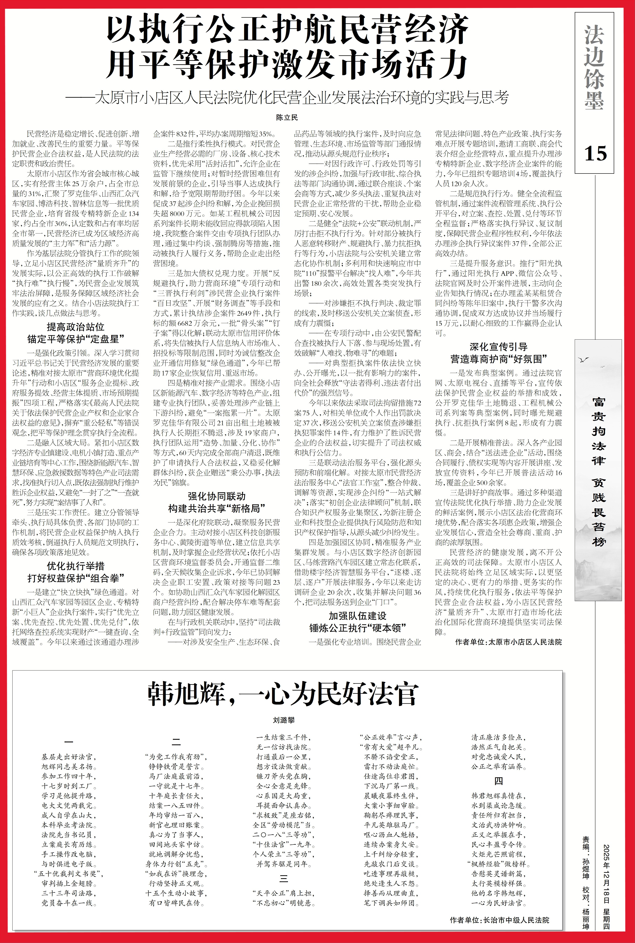
【山西市场导报】以执行公正护航民营经济 用平等保护激发市场活力——太原市小店区法院优化民营企业发展法治环境的实践与思考
Xin Lang Cai Jing· 2025-12-18 14:27
Core Viewpoint - The news emphasizes the importance of protecting the legal rights of private enterprises in the context of economic development, highlighting the role of the judiciary in facilitating a favorable business environment and ensuring fair execution of legal judgments [3][4][13]. Group 1: Economic Contribution of Private Enterprises - The private economy is a crucial force for stable growth, innovation promotion, job creation, and improvement of people's livelihoods [3]. - In the Xiaodian District of Taiyuan, there are over 250,000 business entities, accounting for 31% of the total in the city, with a significant number of high-quality private enterprises [3][4]. - The district has cultivated 134 provincial-level specialized and innovative enterprises, representing about 30% of the city's total, leading in both recognition and market share [3]. Group 2: Judicial Support for Private Enterprises - The Xiaodian District Court aims to address the challenges of "difficult execution" and "slow execution" through fair and efficient judicial practices, thereby providing a legal safeguard for the development of private enterprises [4][5]. - The court has implemented a "fast track" for execution cases involving key enterprises, significantly reducing the average case processing time by 35% [5]. - A flexible execution model has been adopted, allowing enterprises to continue using essential assets under supervision, and facilitating settlements for companies facing temporary difficulties [6]. Group 3: Collaborative Efforts and Mechanisms - The court has established a collaborative mechanism with local government and administrative bodies to enhance service for private enterprises, addressing issues such as employee placement and policy alignment [8]. - A joint mechanism with law enforcement has been created to combat non-compliance with court orders, enhancing the effectiveness of execution [8][9]. - The court has actively engaged in community outreach, providing legal services directly to enterprises and addressing their concerns [9][10]. Group 4: Training and Capacity Building - The court has conducted specialized training for its personnel on common legal issues faced by private enterprises, enhancing their ability to handle cases effectively [10][12]. - A comprehensive supervision mechanism has been established to ensure transparency and accountability in the execution process [12]. Group 5: Promoting a Supportive Legal Environment - The court has focused on publicizing successful cases of legal protection for private enterprises, thereby fostering a culture of respect for business and legal rights [13]. - Efforts have been made to create a favorable atmosphere for private enterprises through legal education and outreach activities [13].