失信惩戒与信用修复

Search documents
最高法:严厉打击恶意规避执行、逃避执行行为
2 1 Shi Ji Jing Ji Bao Dao· 2026-01-26 14:25
Core Insights - The Supreme People's Court has effectively addressed execution difficulties through cross-execution strategies, as highlighted in a recent press conference [1] Group 1: Execution and Credit Repair - In the past year, 2.3398 million individuals were newly added to the list of untrustworthy persons, while 2.6696 million individuals successfully returned to the market through credit repair, marking the seventh consecutive quarter where credit repair instances exceeded new additions to the untrustworthy list [1] - A total of 18.6518 million individuals complied with their obligations due to the pressure of untrustworthiness penalties [1] Group 2: Enforcement Measures - The Supreme People's Court, in collaboration with the Supreme People's Procuratorate and the Ministry of Public Security, issued guidelines to combat malicious evasion of execution, resulting in the prosecution of 4,461 individuals for refusing to execute judgments and rulings last year [1] - The court maintains a stringent stance against untrustworthy behavior, emphasizing the importance of precise punishment for untrustworthiness and the normalization of credit repair [1]
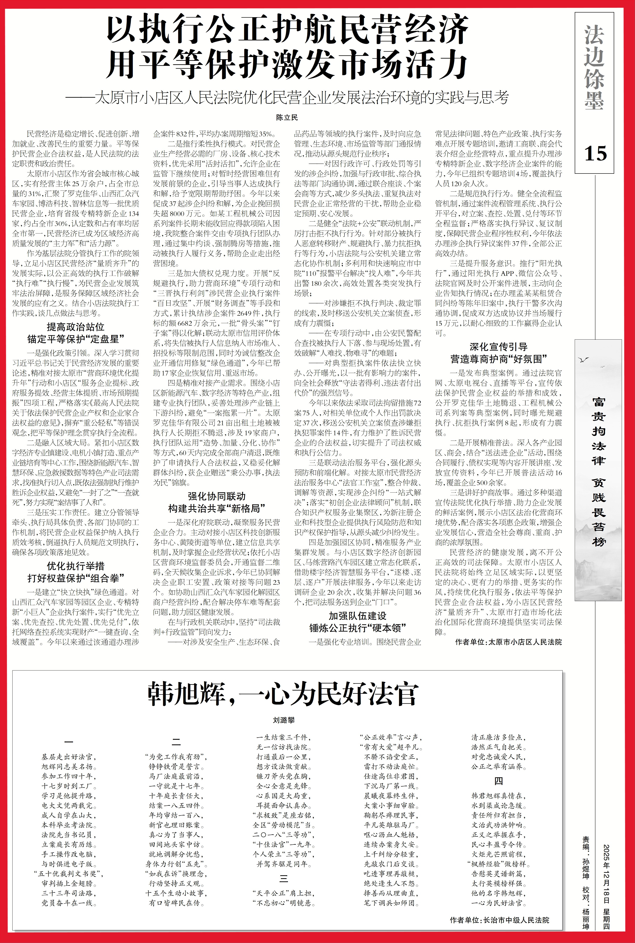
【山西市场导报】以执行公正护航民营经济 用平等保护激发市场活力——太原市小店区法院优化民营企业发展法治环境的实践与思考
Xin Lang Cai Jing· 2025-12-18 14:27
Core Viewpoint - The news emphasizes the importance of protecting the legal rights of private enterprises in the context of economic development, highlighting the role of the judiciary in facilitating a favorable business environment and ensuring fair execution of legal judgments [3][4][13]. Group 1: Economic Contribution of Private Enterprises - The private economy is a crucial force for stable growth, innovation promotion, job creation, and improvement of people's livelihoods [3]. - In the Xiaodian District of Taiyuan, there are over 250,000 business entities, accounting for 31% of the total in the city, with a significant number of high-quality private enterprises [3][4]. - The district has cultivated 134 provincial-level specialized and innovative enterprises, representing about 30% of the city's total, leading in both recognition and market share [3]. Group 2: Judicial Support for Private Enterprises - The Xiaodian District Court aims to address the challenges of "difficult execution" and "slow execution" through fair and efficient judicial practices, thereby providing a legal safeguard for the development of private enterprises [4][5]. - The court has implemented a "fast track" for execution cases involving key enterprises, significantly reducing the average case processing time by 35% [5]. - A flexible execution model has been adopted, allowing enterprises to continue using essential assets under supervision, and facilitating settlements for companies facing temporary difficulties [6]. Group 3: Collaborative Efforts and Mechanisms - The court has established a collaborative mechanism with local government and administrative bodies to enhance service for private enterprises, addressing issues such as employee placement and policy alignment [8]. - A joint mechanism with law enforcement has been created to combat non-compliance with court orders, enhancing the effectiveness of execution [8][9]. - The court has actively engaged in community outreach, providing legal services directly to enterprises and addressing their concerns [9][10]. Group 4: Training and Capacity Building - The court has conducted specialized training for its personnel on common legal issues faced by private enterprises, enhancing their ability to handle cases effectively [10][12]. - A comprehensive supervision mechanism has been established to ensure transparency and accountability in the execution process [12]. Group 5: Promoting a Supportive Legal Environment - The court has focused on publicizing successful cases of legal protection for private enterprises, thereby fostering a culture of respect for business and legal rights [13]. - Efforts have been made to create a favorable atmosphere for private enterprises through legal education and outreach activities [13].


依法严惩网暴伤企违法行为,最高法破解民营经济发展难题提出25条意见
Sou Hu Cai Jing· 2025-08-08 04:12
Core Viewpoint - The Supreme People's Court issued guidelines to support the healthy development of the private economy in China, addressing challenges faced by private enterprises and providing stronger legal protections [2][3]. Group 1: Legal Framework and Market Access - The guidelines emphasize the implementation of a "non-prohibition, non-entry" policy and a unified negative list for market access, particularly in sectors like construction, real estate, and natural monopolies [2]. - It highlights the need for fair adjudication in cases involving monopolistic disputes in the technology sector, distinguishing between normal exercise of intellectual property rights and anti-competitive behavior [2]. Group 2: Financial Support and Regulation - The guidelines aim to alleviate financing difficulties for private enterprises by regulating financial institutions' practices regarding loan conditions and illegal lending activities [3]. - It calls for strict penalties against illegal lending practices and encourages a more orderly private financing environment to help private enterprises overcome "difficult and expensive financing" issues [3]. Group 3: Internal Governance and Corruption - The guidelines propose measures to combat internal corruption within private enterprises and facilitate resolution of disputes among shareholders through legal means [3]. - It stresses the importance of holding controlling shareholders accountable for actions that may harm the enterprise, such as misappropriation of funds and improper guarantees [3]. Group 4: Labor Rights and Consumer Protection - The guidelines reinforce the protection of labor rights, stating that any agreement to not pay social insurance is invalid, thus supporting workers' claims for compensation [4]. - It introduces punitive compensation for food and drug violations and aims to regulate prepayment consumption disputes to protect consumer rights while promoting honest business practices [4]. Group 5: Enforcement and Credit System - The guidelines outline strict enforcement against online violence and defamation of private enterprises, emphasizing the protection of their reputation and legal rights [5]. - Recent data shows a significant decrease in the number of individuals listed as untrustworthy, indicating improvements in compliance and credit restoration efforts [5][6].