抗病毒药物研发

Search documents
面对尼帕病毒,别急着炒作“有效药物”
Guan Cha Zhe Wang· 2026-01-28 09:37
Core Viewpoint - The emergence of the Nipah virus in India has raised concerns due to its high mortality rate and proximity to countries with open flights, leading to significant public interest and media coverage regarding potential treatments [1][2]. Group 1: Nipah Virus Overview - Nipah virus (NiV) is classified under the family Paramyxoviridae and has a high mortality rate ranging from 40% to 75% [5][6]. - The virus was first identified in Malaysia in 1998 and is primarily transmitted through direct contact with infected animals or their bodily fluids [6][7]. - Previous outbreaks have shown limited scale due to the virus's transmission characteristics, which are not as efficient as airborne viruses [5][6]. Group 2: Treatment and Research - The drug VV116, previously approved for COVID-19 treatment, has been suggested as a potential candidate for Nipah virus, although its efficacy against NiV remains unproven [2][8]. - VV116 has shown antiviral activity in animal models, but its effectiveness in humans and against Nipah virus specifically requires further clinical validation [10][12]. - The media's portrayal of VV116 as an "effective drug" has led to market fluctuations, highlighting the impact of misinformation on public perception and stock prices [13][15]. Group 3: Public Health Response - Public health experts emphasize that while Nipah virus poses a threat, its transmission is manageable with existing healthcare capabilities, particularly in monitoring and controlling outbreaks [7][8]. - The Chinese healthcare system is noted for its strengths in contact tracing and infection control, which are crucial in managing potential Nipah virus cases [7][8].


致死率高!印度暴发尼帕病毒,中国团队发现有效药物
Ge Long Hui· 2026-01-27 07:04
Core Insights - The Nipah virus outbreak in West Bengal, India, has raised international concern due to its high mortality rate, which can reach 40%-75% [1][2]. Group 1: Virus Overview - Recent reports indicate five cases of Nipah virus infection in West Bengal, including several healthcare workers, leading to nearly 100 individuals being quarantined [2]. - The Nipah virus is zoonotic, primarily carried by fruit bats, and can be transmitted to humans through contaminated food or direct human-to-human contact [2]. - Symptoms of infection include fever, headache, drowsiness, confusion, and coma, with a mortality rate of 40%-75% for infected individuals [2][3]. Group 2: Historical Context - Since 2001, India has experienced multiple outbreaks of the Nipah virus, with a total of 754 confirmed cases and 435 deaths reported across five countries, including India and Bangladesh, as of May 2024 [3]. Group 3: International Response - Thailand and Nepal have enhanced health monitoring and quarantine measures for travelers from India, while China has included the Nipah virus in its entry monitoring protocols [4]. Group 4: Research and Development - A Chinese research team has discovered a potential antiviral drug, VV116, which has shown significant efficacy against the Nipah virus in animal studies [5][7]. - VV116, an oral nucleoside antiviral, has demonstrated the ability to increase survival rates in infected animals and reduce viral load in target organs [7]. Group 5: Diagnostic Tools - Several companies in China have developed and launched Nipah virus PCR testing kits, enhancing the capacity for monitoring and controlling the outbreak [10][11]. - Companies like Zhijiang Bio and Shuoshi Bio have provided testing kits to customs and disease control agencies to aid in epidemic monitoring [10][11]. Group 6: Market Reaction - Following the news of the Nipah virus outbreak, the A-share market saw a surge in vaccine and in vitro diagnostic (IVD) sectors, with several stocks hitting the daily limit up, although there was a significant pullback the following day [12].

中科院武汉病毒研究所:发现对尼帕病毒有效的药物
Nan Fang Du Shi Bao· 2026-01-27 04:41
Core Viewpoint - The research teams from Wuhan Institute of Virology have discovered that the oral nucleoside drug VV116 exhibits high efficacy in inhibiting the Nipah virus, providing new hope for the treatment of this high-mortality infectious disease [1][3][4]. Group 1: Research Findings - VV116 (Dihydroremdesivir) is a novel oral nucleoside antiviral drug that has been approved for the treatment of COVID-19 in Uzbekistan and China [3]. - The study published in the journal Emerging Microbes & Infections confirms that VV116 shows significant antiviral activity against the Nipah virus, including both Malaysian strain NiV-M and Bangladeshi strain NiV-B [3]. - In a lethal dose infection model using golden hamsters, VV116 administered at a dose of 400 mg/kg body weight increased the survival rate of the animals to 66.7% and significantly reduced viral loads in target organs such as the lungs, spleen, and brain [3]. Group 2: Public Health Implications - The Nipah virus has a high mortality rate of 40%-70% and has been a growing public health concern since its first outbreak in Malaysia in 1998, with increasing frequency and geographical spread of outbreaks in India and Bangladesh from 2023 to 2026 [2][4]. - The World Health Organization (WHO) has classified the Nipah virus as a regional threat of highest priority due to its wide host range and high fatality rate, with no approved drugs or vaccines currently available [2]. - VV116 not only serves as a potential preventive medication for high-risk groups such as healthcare workers and laboratory personnel but also provides a ready option for addressing current and future Nipah virus outbreaks [4].

武汉病毒研究所:发现对尼帕病毒有效药物
Xin Lang Cai Jing· 2026-01-27 04:11
Group 1 - The research team from Wuhan Institute of Virology, Shanghai Institute of Materia Medica, and Wangshan Wangshui Biopharmaceutical Co., Ltd. published significant findings confirming the antiviral activity of oral nucleoside drug VV116 against Nipah virus, providing new hope for the prevention and treatment of this high-mortality emerging infectious disease [1][8] - VV116 has been validated for its therapeutic potential against Nipah virus, serving as a preventive medication for high-risk groups such as healthcare workers and laboratory personnel, and offering a ready drug option for current and future Nipah virus outbreaks [1][8] Group 2 - Wangshan Wangshui Biopharmaceutical Co., Ltd. is a wholly-owned subsidiary of Suzhou Wangshan Wangshui Biopharmaceutical Co., Ltd., which is listed on the Hong Kong Stock Exchange [3][10] - The stock price of Wangshan Wangshui surged over 14% in early trading, reaching a historical high of 112.7 HKD per share, with a trading volume of 2,615 million HKD [3][10] - The company focuses on innovative drug development in the fields of viral infections, neuropsychiatry, and reproductive health, with a comprehensive system covering drug discovery to commercialization [10][11] - Currently, Wangshan Wangshui has two innovative drugs in the commercialization stage, five candidates in clinical trials, and three candidates in preclinical research [10][11] - VV116 is a broad-spectrum antiviral oral nucleoside RNA-dependent RNA polymerase inhibitor, already approved for COVID-19 indications in China and Uzbekistan [10][11] Group 3 - In December 2025, Wangshan Wangshui announced a licensing and collaboration agreement with Ascletis Pharma, granting exclusive rights for the development, manufacturing, and commercialization of VV116 for respiratory syncytial virus (RSV) and human metapneumovirus (HMPV) infections in Greater China [6][13]
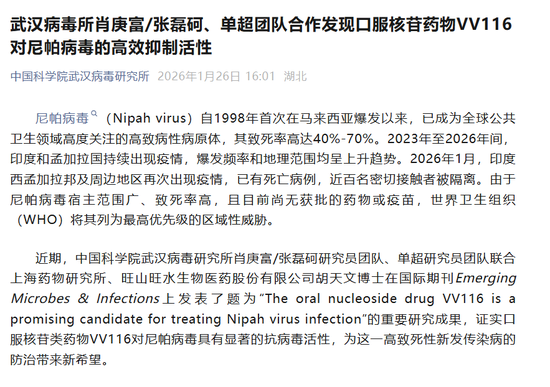
旺山旺水新冠口服药有抑制尼帕病毒潜力,但距离应用还很远
Di Yi Cai Jing· 2026-01-27 03:54
Core Insights - The emergence of Nipah virus cases in West Bengal, India, with a mortality rate exceeding 40%, has raised significant concerns [1] - The research published by the Wuhan Institute of Virology indicates that the oral nucleoside drug VV116 shows promising antiviral activity against Nipah virus, providing new hope for treatment [1][2] Group 1: Drug Development - VV116 is a novel oral nucleoside antiviral drug that has been approved for COVID-19 treatment in Uzbekistan and China [3] - In vitro studies demonstrate that VV116 and its active metabolites significantly inhibit Nipah virus, including Malaysian strain NiV-M and Bangladeshi strain NiV-B [3] - In a lethal dose infection model in golden hamsters, VV116 at a dosage of 400 mg/kg increased survival rates to 66.7% and significantly reduced viral loads in target organs such as the lungs, spleen, and brain [3] Group 2: Market Reaction - Following the announcement of VV116's potential against Nipah virus, the stock of its parent company, Wangshan Wangshui (02630.HK), surged over 10% on January 27 [4] - Despite the positive market reaction, VV116 is still in the preclinical research stage and requires human clinical trials, regulatory approval, and market launch before it can be used as a treatment [4] Group 3: Historical Context - Nipah virus is not a new virus, having caused outbreaks in Malaysia, Singapore, India, and Bangladesh since 1998 [4] - The lack of effective vaccines and therapies for Nipah virus over the years is attributed to insufficient funding for research and relatively low case numbers, despite its high mortality rate [4]
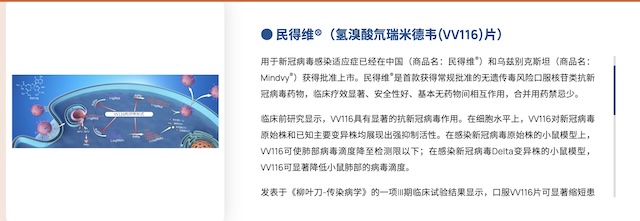
旺山旺水-B一度涨超14%创新高 有研究发现VV116对尼帕病毒有治疗潜力
Zhi Tong Cai Jing· 2026-01-27 02:56
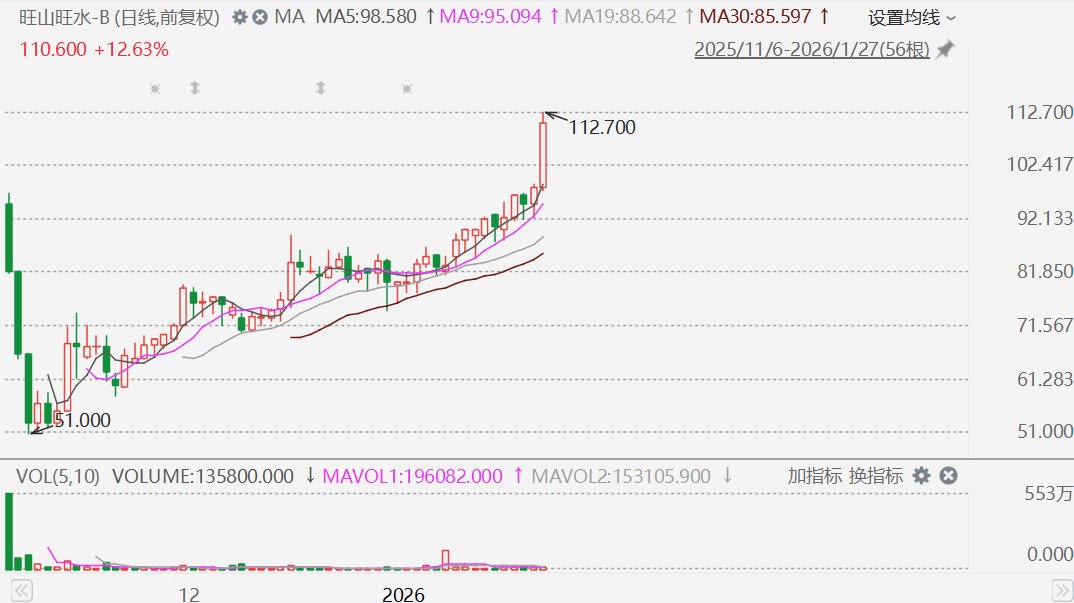
Core Viewpoint - The stock of Wangshan Wangshui-B (02630) surged over 14%, reaching a new high of 112.7 HKD, following the announcement of significant research findings related to the antiviral drug VV116 against Nipah virus [1] Company Summary - Wangshan Wangshui was established in 2013, focusing on three main therapeutic areas: neuropsychiatry, reproductive health, and viral infections [1] - The company announced a licensing and collaboration agreement with Ascletis Pharma in December, granting exclusive rights for the development, manufacturing, and commercialization of VV116 for respiratory syncytial virus (RSV) and human metapneumovirus (HMPV) infections in Greater China [1] Industry Summary - Recent research published by the Wuhan Institute of Virology confirmed that the oral nucleoside drug VV116 has significant antiviral activity against the Nipah virus, providing new hope for the prevention and treatment of this highly fatal emerging infectious disease [1] - The findings suggest that VV116 could serve as a preventive medication for high-risk groups such as healthcare workers and laboratory personnel, offering a ready option for addressing current and future Nipah virus outbreaks [1]
港股异动丨旺山旺水拉升涨近15%创上市新高,口服核苷药物VV116被证实对尼帕病毒有显著抗病毒活性
Ge Long Hui· 2026-01-27 02:50
Core Viewpoint - The stock of Wangshan Wangshui-B (2630.HK) surged nearly 15% to reach a historical high of HKD 112.7, with a market capitalization exceeding HKD 18.9 billion, following the announcement of significant research on the oral nucleoside drug VV116 for treating Nipah virus infection [1][2]. Group 1: Company Developments - Wangshan Wangshui Biopharmaceutical Co., Ltd. has collaborated with researchers from the Wuhan Institute of Virology and the Shanghai Institute of Materia Medica to publish important findings on VV116, demonstrating its significant antiviral activity against the Nipah virus [1]. - The research indicates that VV116 could serve as a preventive medication for high-risk groups such as healthcare workers and laboratory personnel, providing a ready option for addressing current and future Nipah virus outbreaks [1]. Group 2: Product Information - The oral nucleoside drug VV116 was developed collaboratively by the Shanghai Institute of Materia Medica and Junshi Biosciences, with ownership held by Shanghai Wangshi Biopharmaceutical Technology Co., Ltd. and production entrusted to Shanghai Diseno Biopharmaceutical Co., Ltd. [2]. - Wangshi Biopharmaceutical is a joint subsidiary of Junshi Biosciences' subsidiary Shanghai Juntao Biopharmaceutical Technology Co., Ltd. and Suzhou Wangshan Wangshui Biopharmaceutical Co., Ltd. [2].
旺山旺水-B(02630)与先声药业(02096)就VV116新适应症订立许可协议
Zhi Tong Cai Jing· 2025-12-03 08:47
Core Viewpoint - The collaboration between 旺山旺水-B and 先声药业 aims to accelerate the clinical development and commercialization of VV116 for new indications, specifically targeting RSV and HMPV infections in Greater China [1][2]. Group 1: Licensing Agreement - 旺山旺水-B has entered into a licensing agreement with 先声药业 for exclusive rights to develop VV116 for RSV and HMPV infections in Greater China [1]. - The partnership leverages the strengths of both companies in research, production, and commercialization to benefit more patients [1]. Group 2: Product Overview - VV116 is an oral nucleoside prodrug that received conditional approval from the National Medical Products Administration (NMPA) in January 2023 for treating mild to moderate COVID-19, with plans for full approval by January 2025 [1]. - VV116 has shown broad-spectrum antiviral activity against various RNA viruses, including RSV, demonstrating good inhibition effects [1]. Group 3: Clinical Trials and Safety - A Phase II clinical trial for VV116 as a treatment for RSV in infants has been completed, leading to its designation as a breakthrough therapy by NMPA [2]. - Preclinical studies indicate significant antiviral effects of VV116 in vitro and in animal models, along with improvements in lung pathology [2]. - Clinical pharmacokinetic studies show good oral absorption and linear pharmacokinetics, with no significant impact from infant formula on its main metabolites [2]. - Overall safety of VV116 in clinical studies is reported to be good, with no severe adverse events noted [2].
旺山旺水-B与先声药业就VV116新适应症订立许可协议
Zhi Tong Cai Jing· 2025-12-03 08:36
Core Viewpoint - The company has entered into a licensing agreement with Ascletis Pharma Inc. for the exclusive rights to develop and commercialize VV116 for RSV and HMPV infections in Greater China, aiming to accelerate clinical development and commercialization to benefit more patients [1][2]. Group 1: Licensing Agreement - The company grants Ascletis exclusive licensing rights for VV116 in the treatment of RSV and HMPV infections in Greater China [1]. - This collaboration leverages the strengths of both companies in research, production, and commercialization [1]. Group 2: Product Overview - VV116 is an oral nucleoside prodrug that received conditional approval from the National Medical Products Administration (NMPA) in January 2023 for treating mild to moderate COVID-19 infections, with plans for full approval by January 2025 [1]. - VV116 exhibits broad-spectrum antiviral activity, showing effective inhibition against various RNA viruses, including RSV [1]. Group 3: Clinical Trials and Safety - A Phase II clinical trial for VV116 as a treatment for RSV in infants has been completed, leading to its designation as a breakthrough therapy by the NMPA [2]. - Preclinical studies indicate significant antiviral effects of VV116 in vitro and in animal models, along with improvements in lung pathology [2]. - Clinical pharmacokinetic studies demonstrate good oral absorption and linear pharmacokinetics, with no significant impact from infant formula on its main metabolites [2]. - Overall safety in clinical studies is reported to be good, with no severe adverse events noted [2].
Cidara Therapeutics (NasdaqCM:CDTX) M&A Announcement Transcript
2025-11-17 14:02
Summary of Merck & Co. Investor Call on Cidara Therapeutics Acquisition Company and Industry - **Company**: Merck & Co. (NasdaqCM:MRK) - **Acquisition Target**: Cidara Therapeutics (NasdaqCM:CDTX) - **Industry**: Pharmaceuticals, specifically focusing on antiviral treatments and infectious diseases Core Points and Arguments 1. **Acquisition Announcement**: Merck announced the acquisition of Cidara Therapeutics for $21.50 per share, totaling approximately $920 million, expected to close in Q1 2026, pending shareholder and regulatory approvals [17][18][19] 2. **Strategic Fit**: The acquisition aligns with Merck's strategy to enhance its portfolio in infectious diseases, particularly with the addition of CD388, a long-acting antiviral agent aimed at preventing influenza [4][5][6] 3. **CD388 Overview**: CD388 is a first-in-class investigational antiviral designed to provide season-long protection against influenza strains A and B, with a significant unmet medical need in high-risk populations [9][10][15] 4. **Market Opportunity**: The potential market for CD388 is estimated at over $5 billion, targeting approximately 110 million individuals in the U.S. at higher risk for influenza complications [5][15][16] 5. **Clinical Data**: CD388 demonstrated 76% efficacy in preventing influenza-like illness in a phase 2 study, with low immunogenicity and good tolerability [10][11] 6. **Regulatory Pathway**: The phase 3 trial is focused on high-risk individuals, with an interim analysis planned after the first flu season to assess the need for sample size adjustments [11][12] 7. **Financial Impact**: The acquisition will result in a charge of approximately $9 billion to R&D expenses, impacting EPS by about $0.30 in the first year [18][19] 8. **Manufacturing Plans**: Merck plans to transition manufacturing to U.S.-based facilities over time, moving away from reliance on WuXi-manufactured products [22][23] Additional Important Content 1. **Public Health Need**: Influenza poses a significant public health threat, with the CDC reporting up to 82 million infections, 1.3 million hospitalizations, and 130,000 deaths in the 2024-2025 season [7][8] 2. **Current Vaccine Limitations**: Existing flu vaccines have variable efficacy, particularly in high-risk populations, highlighting the need for innovative solutions like CD388 [8][9] 3. **Commercial Strategy**: Merck's existing infrastructure will facilitate the launch of CD388, targeting high-risk patients already within healthcare systems [56][73] 4. **Pricing Strategy**: Initial pricing research suggests a potential price point of up to $600 for CD388, aiming to provide significant protection to those inadequately covered by traditional vaccines [57][73] 5. **Future Opportunities**: Merck remains open to pursuing additional M&A opportunities in therapeutic areas such as oncology, immunology, and cardiometabolic diseases, maintaining a focus on significant unmet needs [41][42] This summary encapsulates the key points discussed during the investor call regarding Merck's acquisition of Cidara Therapeutics and the strategic implications for both companies in the context of the antiviral market.