挂靠

Search documents
一些建筑行业农民工来信反映,工资被拖欠——解决农民工欠薪 如何对症下药
Ren Min Ri Bao· 2026-02-03 07:32
Core Viewpoint - The article highlights the ongoing issue of wage arrears faced by migrant workers, particularly in the construction industry, and discusses the systemic problems leading to these delays in payment [1][2]. Current Situation - Many migrant workers, especially in the construction sector, report not receiving their wages on time, with some cases of significant arrears, such as a worker owed over 90,000 yuan [3][4]. - The construction payment model often involves workers receiving minimal living expenses during the project, with full wages settled at the end of the project, which increases the risk of wage arrears [3][4]. - A specific case in Hubei province illustrates how poor project sales and insufficient funds from developers lead to wage delays for workers [4][5]. Causes of Wage Arrears - The "funding chain inversion" model in construction means that developers often require contractors to advance funds, which can lead to a cascading effect of unpaid wages down to the workers [5]. - Issues such as illegal subcontracting and inadequate enforcement of wage protection regulations contribute to the persistence of wage arrears [6][7]. Regulatory Challenges - Although regulations like the "Regulations on the Payment of Wages to Migrant Workers" exist, their implementation is often lacking, leading to continued wage disputes [6][7]. - The responsibility for wage payment is often unclear due to multiple layers of subcontracting, making it difficult for workers to identify who is liable for their wages [7][8]. Difficulties in Wage Recovery - Many migrant workers do not have formal contracts, making it challenging to prove their employment and wage agreements when seeking to recover unpaid wages [10][11]. - The lack of effective labor inspection and enforcement mechanisms further complicates the situation, as many workers are unaware of their rights and the processes for legal recourse [12][13]. Solutions and Recommendations - Recent efforts have been made to address wage arrears, including government initiatives to provide advance payments to workers [13][14]. - Recommendations include shortening the wage payment cycle, enhancing labor inspection enforcement, and increasing awareness of legal aid options for migrant workers [15][16].
一些建筑行业农民工来信反映 工资被拖欠——解决农民工欠薪 如何对症下药(金台视线)
Ren Min Ri Bao· 2026-02-01 22:13
Core Viewpoint - The article highlights the ongoing issue of wage arrears faced by migrant workers, particularly in the construction industry, and explores the reasons behind this problem and potential solutions [1][2][5]. Current Situation - Many migrant workers, especially in the construction sector, report not receiving their wages on time, with significant amounts owed. For instance, a worker named Wang Ming claims to be owed over 90,000 yuan, with a total of 725 million yuan owed to 127 workers on a specific project [2][3]. - The construction industry often employs a funding model where workers are paid minimal living expenses during the project, with full wages settled at the end of the project, leading to frequent wage delays [2][4]. Reasons for Wage Arrears - The "funding chain inversion" model in construction projects places the financial risk on migrant workers. Developers often require contractors to advance funds, which can lead to a situation where if the developer fails to pay, the contractors cannot pay the workers [4][5]. - Issues such as illegal subcontracting and inadequate enforcement of regulations contribute to the failure to protect workers' wages. The existing regulations, such as the "Regulations on the Payment of Wages to Migrant Workers," are not effectively implemented [5][6]. Challenges in Wage Recovery - Many migrant workers do not have formal contracts, making it difficult to prove their employment and wage agreements. This lack of documentation hampers their ability to claim unpaid wages [9][10]. - Labor inspection and enforcement are insufficient, with a lack of personnel to monitor compliance with wage payment regulations. This results in a high cost of wage recovery for workers [10][11]. Potential Solutions - To address wage arrears, it is suggested to shorten the wage payment cycle for migrant workers, allowing for more frequent payments based on the nature of the work [13][14]. - Strengthening labor inspection and enforcement capabilities is crucial, along with increasing awareness among migrant workers about their rights and available legal aid [12][14].
今起施行!最高法发布司法解释 为竞业限制划边界
Yang Shi Xin Wen· 2025-09-01 11:55
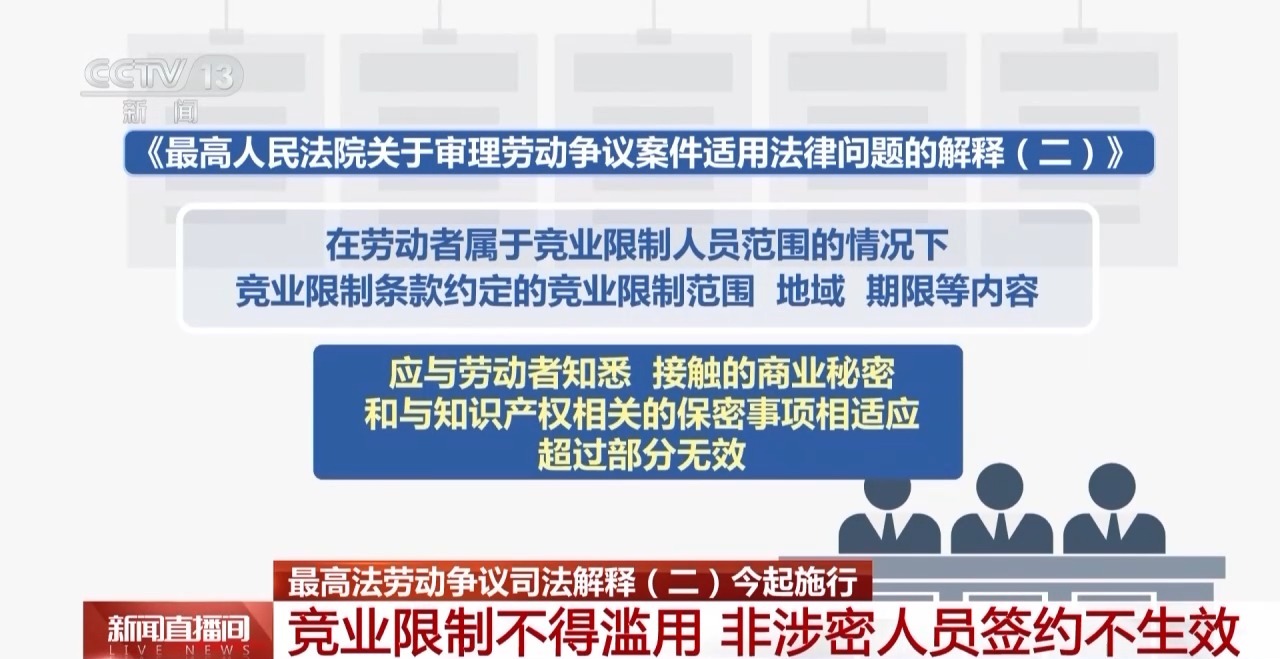
Group 1 - The core viewpoint of the news is that the new judicial interpretation by the Supreme People's Court regulates non-compete agreements to prevent abuse and protect workers' rights, particularly for those who do not have access to confidential information [1][4][5] - Non-compete agreements are valid only for employees who have access to the company's trade secrets, and if an employee does not have such access, the agreement is not enforceable [2][7] - The interpretation specifies that the scope, region, and duration of non-compete clauses must align with the trade secrets known to the employee, and any excessive terms will be deemed invalid [9] Group 2 - The judicial interpretation clarifies the criteria for recognizing "continuous signing of two fixed-term labor contracts," ensuring that employees can request an indefinite-term contract after two consecutive fixed-term contracts [10][12] - It addresses the issue of subcontracting and mixed employment, establishing that both the contractor and the subcontractor are responsible for labor rights, thereby protecting workers from being denied their rights due to shifting responsibilities [13][16] - The interpretation emphasizes the importance of retaining evidence of employment and payment to support workers' claims in case of disputes, highlighting the need for documentation such as work IDs and payment records [20]