混同用工

Search documents
混同用工“东家”如何认?劳动者有选择权
Xin Lang Cai Jing· 2026-01-21 18:31
Core Viewpoint - The article discusses the legal implications of "mixed employment" practices where multiple related companies manage the same employee, highlighting a recent court case that clarifies the responsibilities of these companies under new legal interpretations [1][2][6]. Group 1: Legal Framework - The Supreme People's Court's new interpretation (Interpretation II) provides a legal basis for recognizing labor relations and responsibilities in cases of mixed employment [2][6]. - The new rules specify that if an employee has contracts with multiple related companies, they can choose which company to hold accountable for labor rights violations [6][7]. Group 2: Case Summary - The case involves an employee, Xiao Wu, who had contracts with three different companies and sought compensation after her contract was terminated due to one company's dissolution [1][4]. - The first-instance court ruled that the two companies involved were jointly responsible for unpaid vacation wages, but denied compensation for unlawful termination, leading to an appeal by Xiao Wu [1][4][5]. Group 3: Implications for Companies - Companies are advised to standardize their employment practices and ensure compliance with labor laws to avoid legal disputes arising from mixed employment situations [7]. - The new interpretation aims to prevent companies from evading responsibilities by designating weaker entities as employers, thus protecting employees' rights [7].
今起施行!最高法发布司法解释 为竞业限制划边界
Yang Shi Xin Wen· 2025-09-01 11:55
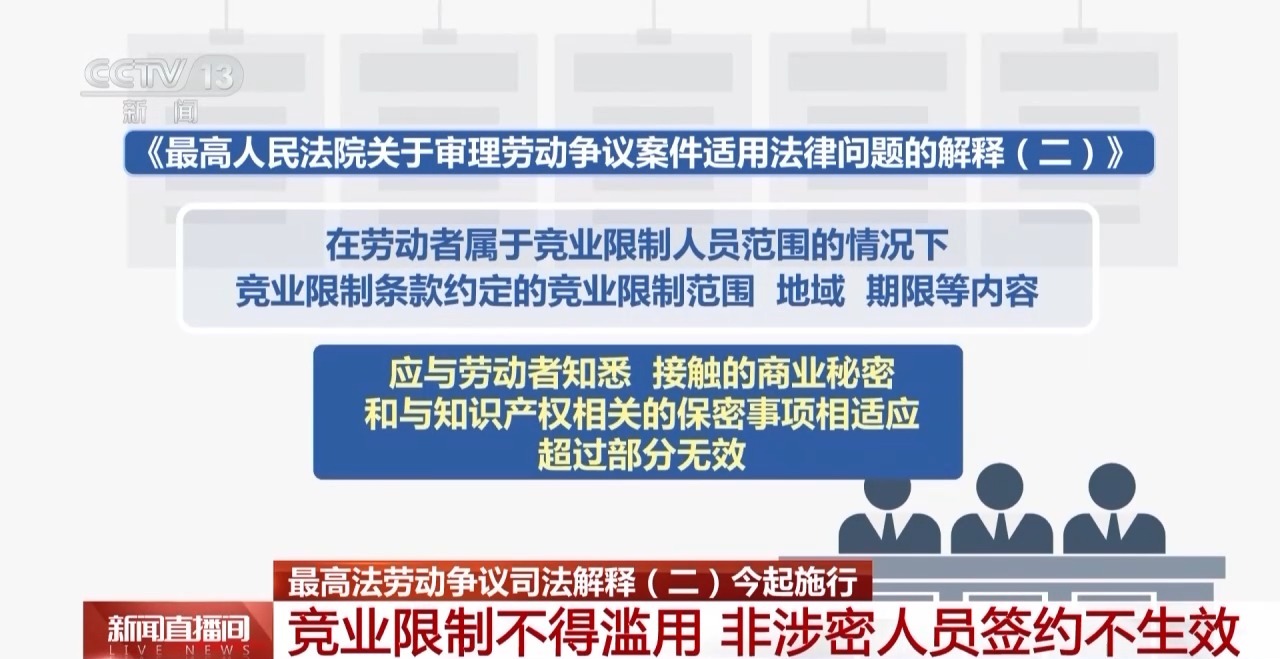
Group 1 - The core viewpoint of the news is that the new judicial interpretation by the Supreme People's Court regulates non-compete agreements to prevent abuse and protect workers' rights, particularly for those who do not have access to confidential information [1][4][5] - Non-compete agreements are valid only for employees who have access to the company's trade secrets, and if an employee does not have such access, the agreement is not enforceable [2][7] - The interpretation specifies that the scope, region, and duration of non-compete clauses must align with the trade secrets known to the employee, and any excessive terms will be deemed invalid [9] Group 2 - The judicial interpretation clarifies the criteria for recognizing "continuous signing of two fixed-term labor contracts," ensuring that employees can request an indefinite-term contract after two consecutive fixed-term contracts [10][12] - It addresses the issue of subcontracting and mixed employment, establishing that both the contractor and the subcontractor are responsible for labor rights, thereby protecting workers from being denied their rights due to shifting responsibilities [13][16] - The interpretation emphasizes the importance of retaining evidence of employment and payment to support workers' claims in case of disputes, highlighting the need for documentation such as work IDs and payment records [20]