推理视觉语言模型

Search documents
英伟达拿出推理版VLA:Alpamayo-R1让自动驾驶AI更会动脑子
机器之心· 2025-12-02 00:17
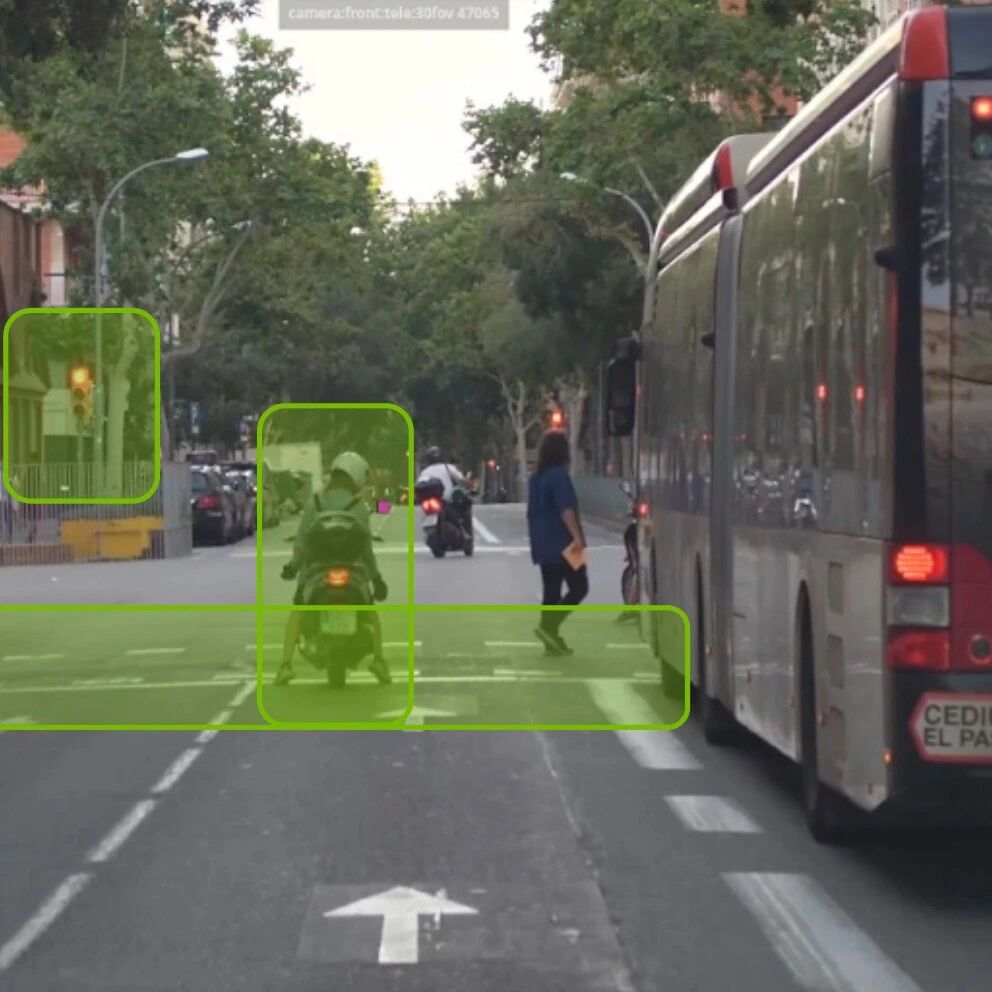
Group 1 - The core challenge in autonomous driving is not just perception but understanding the reasoning behind actions taken by the model [1] - Traditional end-to-end systems struggle with rare but critical scenarios, leading to potential accidents [1][2] - NVIDIA's Alpamayo-R1 introduces a reasoning capability that allows vehicles to infer causal relationships before making decisions [1][6] Group 2 - Alpamayo-R1 features a new dataset called Chain of Causation (CoC), which includes not only actions taken but also the reasons for those actions [2][3] - The model employs a diffusion-based trajectory decoder to generate feasible driving trajectories under real-time constraints [5] - A multi-stage training strategy is utilized, starting with basic mapping from vision to action, followed by supervised fine-tuning on CoC data, and concluding with reinforcement learning for optimization [6][15] Group 3 - The performance of Alpamayo-R1 shows significant improvements, particularly in long-tail scenarios where traditional models often fail [6][20] - The model's input consists of multi-camera and temporal observations, allowing for integrated multi-modal semantic understanding [8] - The CoC dataset employs a human-machine collaborative annotation mechanism, resulting in improved planning accuracy and reduced error rates [10][11] Group 4 - The training process of Alpamayo-R1 is divided into three phases: supervised fine-tuning, CoC supervision, and reinforcement learning-based post-training optimization [15][17] - The model incorporates a multi-dimensional reward mechanism to enhance reasoning accuracy and action consistency [17] - The design of AR1 represents a shift from "black box" to "white box" in autonomous driving, enabling the model to explain its decisions [19][20] Group 5 - The significance of Alpamayo-R1 lies not only in performance enhancement but also in establishing a closed loop between AI reasoning and physical actions [20][21] - The model aims to ensure safety and build trust in autonomous driving by providing explanations for its decisions [21]