支付牌照长期有效

Search documents
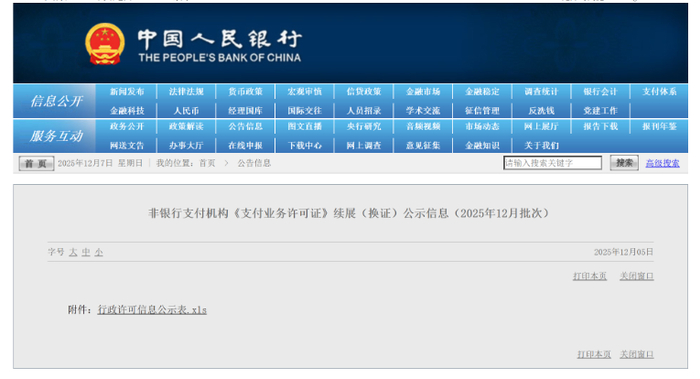
长期支付牌照再增1家
2 1 Shi Ji Jing Ji Bao Dao· 2025-12-08 08:28
Core Viewpoint - The People's Bank of China has issued a long-term payment license to Chuanhua Payment Co., marking a significant regulatory shift in the payment industry towards long-term licenses instead of the previous five-year renewal system [1][5]. Group 1: Company Overview - Chuanhua Payment, established in April 2015, has a history of compliance and was recognized as a typical representative of "risk disposal derivative institutions" in the payment industry [3]. - The company underwent a significant ownership change in March 2025, when its 100% stake was sold for 315 million yuan to Shanghai Xunhui Information Technology Co., a cross-border payment enterprise [3][4]. - The acquisition allows Shanghai Xunhui to enhance its global licensing matrix and integrate domestic payment capabilities, facilitating cross-border fund flows [4]. Group 2: Regulatory Changes - The new regulatory framework, effective from May 1, 2024, will eliminate the five-year renewal requirement for payment licenses, transitioning to a long-term validity model [5]. - This change aims to improve the coordination and maturity of the financial regulatory system, aligning more closely with banking regulations [5]. Group 3: Industry Trends - The third quarter of 2025 saw significant growth in non-cash payment transactions, with 1,685.08 billion transactions amounting to 150.34 trillion yuan, indicating a recovery in consumer spending and digital payment acceleration [7]. - Electronic payment transactions were particularly strong, with 775.54 billion transactions totaling 82.30 trillion yuan, highlighting the dominance of online payment methods [7][8]. - The rise of industry chain payments is a new highlight, with companies like China Telecom's Yipay reporting an 86% increase in transaction scale and over 150 partnerships with state-owned enterprises [8][9]. Group 4: Market Dynamics - The payment industry is experiencing structural differentiation, with digital payment methods like QR code payments growing, while traditional card payment volumes are declining [10]. - For instance, the transaction amount for bank cards fell by 13.72% year-on-year in the third quarter, reflecting ongoing regulatory pressures and intensified market competition [10].