
储值账户运营Ⅰ类

Search documents
第三方支付行业收到新年首张千万元级罚单
Zheng Quan Ri Bao· 2026-01-20 16:47
Core Viewpoint - Yinsheng Payment has been fined over 15.84 million yuan for multiple violations, marking the first instance of a fine exceeding 10 million yuan in the third-party payment industry in 2026 [1] Group 1: Company Violations and Penalties - Yinsheng Payment was penalized for violating merchant management, clearing management, and account management regulations, resulting in a total fine of approximately 15.84 million yuan [1] - The company's chairman, Chen, was held accountable for these violations and received a warning along with a fine of 610,000 yuan [1] - This is not the first significant penalty for Yinsheng Payment; in March 2025, the company was fined approximately 3.24 million yuan for similar violations, and in March 2022, it faced a fine of about 22.45 million yuan for failing to comply with customer identity verification and transaction reporting requirements [2] Group 2: Industry Regulatory Environment - The payment industry has seen over 130 fines issued in 2025, including several exceeding 10 million yuan, indicating a trend of increasing regulatory scrutiny [2] - The regulatory environment is shifting towards a "precise classification and differentiated policy" approach, emphasizing strong regulation and zero tolerance for violations [3] - The "double penalty system" has become a fundamental enforcement principle, holding both institutions and responsible individuals accountable [3] Group 3: Challenges in Compliance - Common issues in the industry include a disconnect between governance and business operations, inadequate risk monitoring systems, and the rising costs of compliance versus pressure on profit margins [3] - The payment industry faces systemic governance issues, as highlighted by repeated violations despite significant penalties [2][3] Group 4: Future Regulatory Focus - Future regulatory priorities include differentiated management based on risk assessment, enhanced monitoring of cross-institutional and cross-border transactions, and stricter management of reserve funds and accounts [4] - There will be a focus on anti-money laundering obligations and the regulation of innovative financial technologies to ensure compliance and security [4]
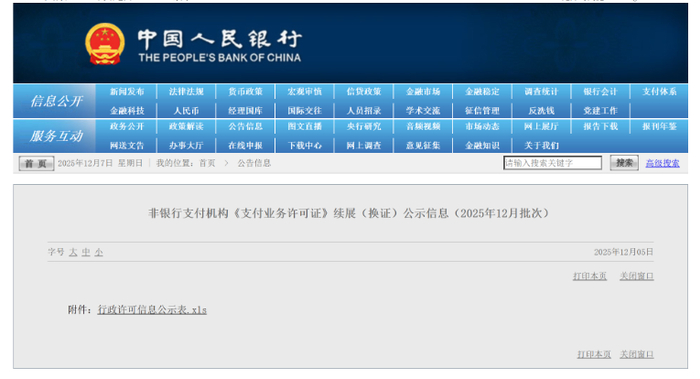
长期支付牌照再增1家
2 1 Shi Ji Jing Ji Bao Dao· 2025-12-08 08:28
Core Viewpoint - The People's Bank of China has issued a long-term payment license to Chuanhua Payment Co., marking a significant regulatory shift in the payment industry towards long-term licenses instead of the previous five-year renewal system [1][5]. Group 1: Company Overview - Chuanhua Payment, established in April 2015, has a history of compliance and was recognized as a typical representative of "risk disposal derivative institutions" in the payment industry [3]. - The company underwent a significant ownership change in March 2025, when its 100% stake was sold for 315 million yuan to Shanghai Xunhui Information Technology Co., a cross-border payment enterprise [3][4]. - The acquisition allows Shanghai Xunhui to enhance its global licensing matrix and integrate domestic payment capabilities, facilitating cross-border fund flows [4]. Group 2: Regulatory Changes - The new regulatory framework, effective from May 1, 2024, will eliminate the five-year renewal requirement for payment licenses, transitioning to a long-term validity model [5]. - This change aims to improve the coordination and maturity of the financial regulatory system, aligning more closely with banking regulations [5]. Group 3: Industry Trends - The third quarter of 2025 saw significant growth in non-cash payment transactions, with 1,685.08 billion transactions amounting to 150.34 trillion yuan, indicating a recovery in consumer spending and digital payment acceleration [7]. - Electronic payment transactions were particularly strong, with 775.54 billion transactions totaling 82.30 trillion yuan, highlighting the dominance of online payment methods [7][8]. - The rise of industry chain payments is a new highlight, with companies like China Telecom's Yipay reporting an 86% increase in transaction scale and over 150 partnerships with state-owned enterprises [8][9]. Group 4: Market Dynamics - The payment industry is experiencing structural differentiation, with digital payment methods like QR code payments growing, while traditional card payment volumes are declining [10]. - For instance, the transaction amount for bank cards fell by 13.72% year-on-year in the third quarter, reflecting ongoing regulatory pressures and intensified market competition [10].

东方电子支付:9.505%股权挂牌,估值1.48亿
Sou Hu Cai Jing· 2025-08-26 07:41
Core Insights - The article discusses the ongoing auction of equity stakes in domestic third-party payment companies, specifically focusing on Oriental Electronic Payment, which has a portion of its shares listed for transfer [1] Group 1: Company Overview - Oriental Electronic Payment is offering 9.505% of its equity for sale, with a total valuation of 1.48 billion yuan based on the minimum transfer prices of 3.8776 million yuan for 2.62% and 10.1898 million yuan for 6.885% [1] - The company was established in 2008 and obtained its first payment business license from the central bank in 2011, with its license set to expire on May 2, 2026, requiring an increase in capital to 200 million yuan for renewal [1] Group 2: Financial Performance - For 2024, Oriental Electronic Payment is projected to generate revenue of 8.88 million yuan, with a net loss of 8 million yuan; in the first half of 2025, revenue is expected to be 3.76 million yuan, with a net loss of 5.27 million yuan [1] - The company's total assets amount to 132 million yuan, with owner equity at 93 million yuan [1] Group 3: Industry Context - The article highlights a trend where small and medium-sized payment institutions are selling their licenses or equity stakes due to increased compliance costs and a rationalization of license values, leading to a concentration of resources among larger players [1] - The profitability of payment institutions has declined, making it difficult for smaller firms to operate, resulting in a lack of buyers for sold licenses; for instance, a 100% stake in Bangfu Bao was listed for 438 million yuan in January 2024 but did not sell [1] - Experts suggest that payment institutions are increasingly reliant on traditional acquiring services, with a low proportion of value-added services, shifting the valuation logic towards profitability and compliance risks [1]
