支付行业合规监管

Search documents
今年首家支付机构退场支付牌照持续“减量”
Zheng Quan Ri Bao· 2026-02-03 16:41
Core Insights - The number of third-party payment licenses in China is continuously decreasing, with the recent cancellation of JuBao Payment's license marking the first exit from the market in 2026 [1][2] - The reduction in payment licenses is attributed to structural reshuffling and regulatory upgrades within the industry, rather than merely a decrease in the number of institutions [1][4] Group 1: JuBao Payment's License Cancellation - JuBao Payment, established in 2011, was the first company in Henan to obtain a central bank payment business license, initially authorized for prepaid card issuance and acceptance [2] - The company announced the termination of its payment business due to economic factors, providing users with options for redeeming or exchanging their prepaid cards [2] - The redemption process is set to occur from February 1 to April 30, 2026, after which Jianye Payment will handle related services [2] Group 2: Industry Trends and Analysis - Since the first batch of third-party payment licenses was issued in May 2011, a total of 271 licenses have been granted, with 162 remaining as of February 2, 2026, indicating a significant reduction [4] - Over 80% of the canceled licenses were for prepaid card businesses, reflecting a trend where users prefer more convenient and secure online payment methods, leading to a shrinking application scenario for prepaid cards [4][5] - Experts predict that the number of payment licenses will continue to decline in 2026 due to stricter regulations, increased market competition, and the exit of institutions with serious compliance issues [5][6] Group 3: Future Industry Directions - The core trend for the payment industry in 2026 is shifting from competition for traffic to focusing on value cultivation, with a more established C-end payment market [6] - Institutions are advised to abandon the "license arbitrage" mindset and upgrade their compliance systems to strategic assets while exploring niche markets like cross-border payments and industrial internet [6]
又见千万元罚单!银盛支付涉多项违规,董事长连带受罚
Shen Zhen Shang Bao· 2026-01-19 10:53
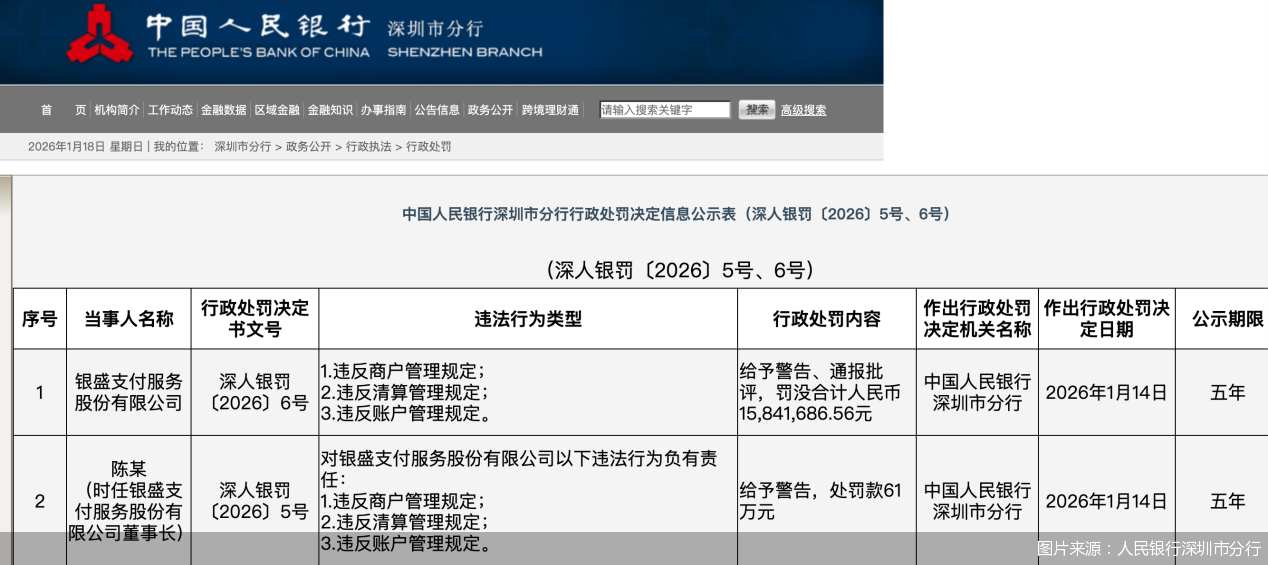
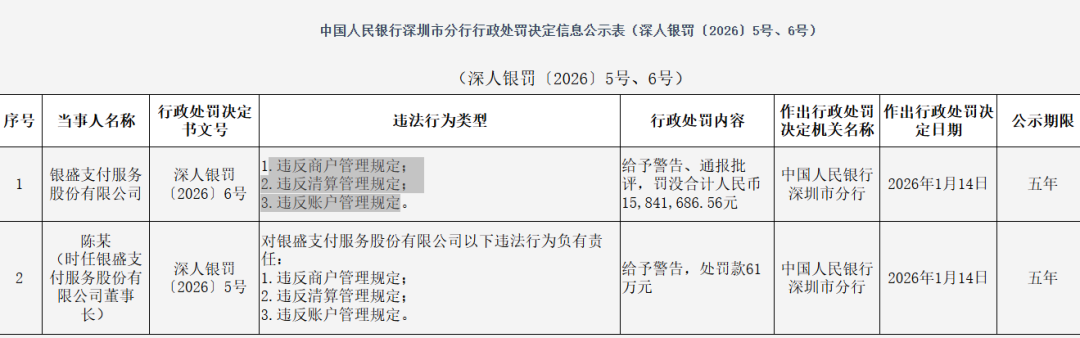
支付行业迎来新年首张千万级罚单。据中国人民银行深圳市分行行政处罚决定信息公示表显示,银盛支付服务股份有限公司(以下简称"银盛支付") 因"违反商户管理规定、违反清算管理规定、违反账户管理规定",被处以警告、通报批评,同时罚没合计人民币约为1584.17万元。与此同时,时任银盛 支付董事长陈某因对上述违法行为负有责任,被给予警告处分并处罚款61万元。 | 序号 | 当事人名称 | 行政处罚决定 | 违法行为类型 | 行政处罚内容 | | 作出行政处罚 作出行政处罚决 | 公示期限 | | --- | --- | --- | --- | --- | --- | --- | --- | | | | 书文号 | | | 决定机关名称 | 定日期 | | | | 银盛支付服务 股份有限公司 | 深人银罚 (2026) 6号 | 1. 违反商户管理规定: 2. 违反清算管理规定; | 给予警告、通报批 评,罚没合计人民币 | 中国人民银行 深圳市分行 | 2026年1月14日 | 五年 | | | | | 3. 违反账户管理规定。 | 15.841.686.56元 | | | | | 2 | 陈某 (时任银盛支 | | ...

银盛支付被罚超1584万元,系第三次认领千万级别罚单
Bei Jing Shang Bao· 2026-01-18 10:12
Core Viewpoint - The first significant penalty in the payment sector for the new year has been issued to Yinseng Payment Service Co., Ltd., highlighting ongoing regulatory scrutiny in the industry [1][3]. Company Summary - Yinseng Payment has received a total fine of approximately 15.84 million RMB for three violations: merchant management, clearing management, and account management [1][2]. - The company's chairman, Chen, has also been penalized with a warning and a fine of 610,000 RMB for his responsibility in the violations [1][2]. - Yinseng Payment was granted a payment license by the People's Bank of China in May 2011 and completed its latest license renewal in August 2024, allowing it to operate nationwide in specific payment services [2]. Industry Summary - The payment industry has seen several penalties issued in 2026, with Yinseng Payment's fine being the first of its kind this year, indicating a trend of strict regulatory enforcement [3]. - The regulatory environment is characterized by a dual penalty system, holding both institutions and responsible individuals accountable, which is expected to enhance compliance in anti-money laundering and merchant management practices across the industry [3][4]. - Yinseng Payment has faced multiple penalties over the years, with significant fines issued annually since 2017, except for 2023, indicating a persistent compliance challenge within the company [4]. - The trend of million-level fines has become common in the payment industry, reflecting the increasing importance of compliance and regulatory requirements [4].