
政策逆周期调节

Search documents
宽基ETF迎千亿元流出 主题赛道更“吸金”
Xin Lang Cai Jing· 2026-01-23 15:50
Core Viewpoint - The recent trend in the ETF market shows a significant outflow of funds from broad-based ETFs, while thematic ETFs, particularly in sectors like semiconductors and electric grid equipment, are attracting substantial investments [1][4]. Group 1: Fund Flows in Broad-based ETFs - Over 300 billion yuan has flowed out of broad-based ETFs, including those tracking the CSI 300 index, as of January 21 [1][2]. - In the week from January 14 to January 21, ten broad-based ETFs experienced net outflows exceeding 10 billion yuan, totaling 314.64 billion yuan [2]. - The CSI 300-related ETFs saw a reduction in scale of approximately 175.14 billion yuan during the same week, with significant outflows from major funds like Huatai-PB CSI 300 ETF, which decreased by about 72.78 billion yuan [2][3]. Group 2: Timing and Reasons for Fund Outflows - The majority of fund outflows occurred on January 15, 16, and 19, accounting for 77.1% of the total outflow for the week [3]. - Analysts attribute the outflows to a combination of a large market base leading to increased fund movement and profit-taking behavior following previous market gains [3]. Group 3: Performance of Thematic ETFs - Thematic ETFs, particularly in sectors like semiconductors, electric grid equipment, and precious metals, have shown strong inflows, with semiconductor ETFs attracting 8.43 billion yuan in the week ending January 21 [4][5]. - Specific funds such as the electric grid equipment ETF saw net inflows of 8.29 billion yuan, indicating a shift in investor preference towards sector-specific investments [4]. Group 4: Market Outlook - Analysts suggest that the recent outflows from broad-based ETFs do not signal a market downturn but rather reflect a healthy market adjustment [5][6]. - The current market environment is characterized by a positive policy stance and enhanced stability, with expectations of a short-term consolidation phase while maintaining a long-term upward trend [6].
沪指探底回升再收十字星,止跌企稳了吗?
Sou Hu Cai Jing· 2026-01-21 01:01
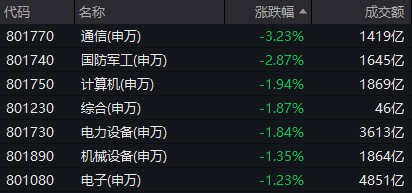
Market Overview - On January 20, the A-share market experienced adjustments, with the Shanghai Composite Index briefly falling below 4100 points before closing at 4113.65, a slight decrease of 0.01% [1] - The Shenzhen Component Index and the ChiNext Index also saw declines, closing down 0.97% and 1.79% respectively [1] Sector Performance - According to Wind data, previously strong sectors such as telecommunications, computers, and electronics led the market decline on January 20 [2] - The telecommunications sector fell by 3.23% with a trading volume of 141.9 billion, while the defense and military industry dropped by 2.87% with a volume of 164.5 billion [3] - The computer sector decreased by 1.94% with a trading volume of 186.9 billion, and the electronics sector fell by 1.23% with a volume of 485.1 billion [3] Market Dynamics - Analysts attribute the market adjustment to two main factors: the impact of counter-cyclical policy adjustments and a shift in market style [5] - Recent trading days have shown a significant decrease in trading volume, with three out of the last four days recording less than 3 trillion in trading volume [5] - The market is experiencing a "high-low switch," with funds moving towards traditional sectors as earnings forecasts for listed companies are set to peak [5] Technical Analysis - The Shanghai Composite Index formed a doji candlestick pattern, indicating potential stabilization, but the market remains cautious with a focus on defensive strategies [5] - Analysts suggest that as long as the index does not fall below 4080 points, there is a likelihood of a resumption of upward momentum [6] - The average price-to-earnings ratios for the Shanghai Composite and ChiNext are currently above their three-year median levels, indicating suitability for medium to long-term investments [6] Earnings Season Impact - As earnings forecasts enter a peak disclosure period, the correlation between stock prices and earnings is expected to increase significantly [7] - The market may undergo structural adjustments based on fundamentals, with previous hot sectors facing earnings validation while some low-priced, high-quality stocks may attract new capital [7]

宏观数据预测专题:三季度宏观经济形态怎么看?
Tianfeng Securities· 2025-08-04 15:17
1. Report Industry Investment Rating No information provided in the given content. 2. Core View of the Report - The economy in the first half of 2025 showed resilience, with the real GDP growing by 5.3% year-on-year, 0.3 percentage points higher than the same period last year and the whole year of last year, reflecting the effect of counter - cyclical policy adjustment. The report predicts economic indicators for July 2025 and the third quarter, expecting a slight slowdown in economic growth in the third quarter, with GDP expected to grow by 4.9% year - on - year. The main supports for economic growth in the second half of the year are expected to come from consumption and infrastructure investment, while exports and the real estate market may pose uncertainties [1][13][81]. 3. Summary According to the Table of Contents 3.1 Industrial Added Value - Expected year - on - year growth in July: 6.0%. In July, the economic sentiment declined, with the manufacturing PMI at 49.3%, down 0.4 pct from the previous month. Production and demand both declined, with the production index at 50.5% and the new order index at 49.4%. The price index rebounded. The production PMI dropped 0.5 pct to 50.5%, and the procurement volume index dropped 0.7 pct to 49.5%, indicating a marginal decline in production enthusiasm and economic sentiment. It is expected that the industrial added value growth rate in the third quarter may slow down compared to the second quarter [2][14][21]. 3.2 Social Retail Sales - Expected year - on - year growth in July: 5.1%. High - frequency data shows that real - estate post - cycle consumption is under pressure, but automobile sales increased by 9% year - on - year from July 1 - 27, and service consumption is expected to recover. The July service PMI was 50.0%, slightly down 0.1 pct from the previous month but still in the expansion range. It is expected that social retail sales will maintain a relatively high growth rate in the third quarter, with expected year - on - year growth of 5.1%, 4.8%, and 5.4% from July to September [3][29][31]. 3.3 Fixed - Asset Investment - Expected cumulative year - on - year growth in July: 2.7%. In infrastructure, the cumulative year - on - year growth of infrastructure investment declined in July, with the construction PMI dropping 2.2 pct to 50.6%, and the new special bond issuance accelerating. In real estate, investment growth remained weak, with new home sales and land transactions below seasonal levels, and demand remaining weak despite price rebounds in some commodities. In manufacturing, investment maintained resilience. Although domestic and external demand was weak, the manufacturing production and operation activity expectation index rose to 52.6%, indicating increased confidence among manufacturing enterprises [6][36][46]. 3.4 Trade 3.4.1 Exports - Expected year - on - year growth in July: 6.8%. After the Sino - US trade negotiations in June, the policy environment risk for exports decreased. In July, the weekly average of port cargo throughput and container throughput was higher than the same period last year. Exports to ASEAN countries remained strong, while exports to the US declined. It is expected that the export growth rate in the third quarter will be 5.6%, slightly lower than the 6.2% in the second quarter [50][61]. 3.4.2 Imports - Expected year - on - year growth in July: 0.0%. The import sub - index of the manufacturing PMI in July was 47.8%, the same as the previous month, interrupting two consecutive months of upward trends. The import container freight rate index increased slightly year - on - year. It is expected that the import growth rate will turn positive in the third quarter, with expected growth rates of 0.0%, 1.4%, and 0.4% from July to September [7][64][65]. 3.5 Inflation 3.5.1 CPI - Expected year - on - year growth in July: - 0.2%. In July, pork prices fluctuated at a low level, while vegetable prices rebounded. Considering the increase in oil prices and seasonal factors, the CPI may be negative. It is expected that the CPI will be - 0.2%, - 0.3%, and - 0.1% from July to September [8][68]. 3.5.2 PPI - Expected year - on - year growth in July: - 3.2%. In July, most commodity prices rebounded, with the PPI showing "improved month - on - month and narrowing year - on - year decline." The price increase was mainly due to supply - side policies rather than demand expansion. It is expected that the PPI will be - 3.2%, - 2.5%, and - 1.8% from July to September [8][70][71]. 3.6 GDP - Expected year - on - year growth in the third quarter: 4.9%. In July, the manufacturing PMI declined unexpectedly, with seasonal disturbances and weak demand. The expansion momentum slowed down. It is expected that the economic growth in the third quarter will decline slightly compared to the second quarter, with a year - on - year growth of about 4.9%. The annual GDP is expected to achieve a growth target of about 5% [81]. 3.7 Social Financing and Credit 3.7.1 Credit - Expected new credit in July: 38 billion yuan. July is a traditional off - peak month for credit, and the bill rate dropped significantly, indicating insufficient real - economy financing demand. It is expected that corporate short - term loans will decrease less year - on - year by 22 billion yuan, corporate long - term loans will increase by 18 billion yuan year - on - year, household short - term loans will decrease less year - on - year by 16.56 billion yuan, household long - term loans will increase by 1 billion yuan year - on - year, and bill financing will increase by 43 billion yuan, with a year - on - year decrease of 13 billion yuan [84][86][95]. 3.7.2 Social Financing - Expected new social financing in July: 162 billion yuan. It is expected that government bond net financing will be about 115 billion yuan, corporate bond net financing will be about 19 billion yuan, and non - standard financing will be - 24 billion yuan. The corresponding year - on - year growth rate of social financing stock is expected to be 9.1%, higher than that in June. The M2 year - on - year growth rate in July is expected to be basically the same as that in June, at 8.3% [96][102][106].