
教育智能化转型

Search documents
教育智能化转型提速
Xin Lang Cai Jing· 2026-01-04 22:08
Core Insights - Digital technology is reshaping the education system, with artificial intelligence evolving from a single tool to a core element driving the entire teaching process, impacting admissions, evaluations, employment services, and campus governance [2][3] - The launch of the National Education Big Data Center and the National Smart Education Public Service Platform marks a significant milestone in implementing the education digitalization strategy, focusing on integration, intelligence, and internationalization [2][4] Group 1: National Education Big Data Center - The National Education Big Data Center breaks down data silos, enabling real-time monitoring of key indicators such as resource allocation, teacher distribution, student development, and teaching quality [3] - It supports differentiated teaching and personalized guidance by deeply analyzing students' learning processes and developmental needs [3][5] - The center is interconnected with 32 provincial education departments and over a thousand universities, forming a central data-sharing hub in the education sector [4] Group 2: National Smart Education Public Service Platform - The smart platform integrates AI, data services, and algorithm modules into reusable components, facilitating rapid application development and reducing redundancy [3][4] - It provides data-driven teaching assistance for teachers and content support for students, promoting the widespread application of intelligent teaching methods [4] - The platform aims to enhance educational governance modernization and improve the precision of educational services through data sharing [4][5] Group 3: Future of Education - The transition to a "smart education" phase signifies a shift from isolated applications to systematic integration and comprehensive deepening of digital education [5] - The new governance model emphasizes dynamic awareness, precise analysis, and scientific forecasting of educational data, enhancing management efficiency and responsiveness [5] - The future of education is expected to be more equitable, high-quality, vibrant, and sustainable, with new forms and scenarios of teaching and learning emerging to support lifelong development [5]

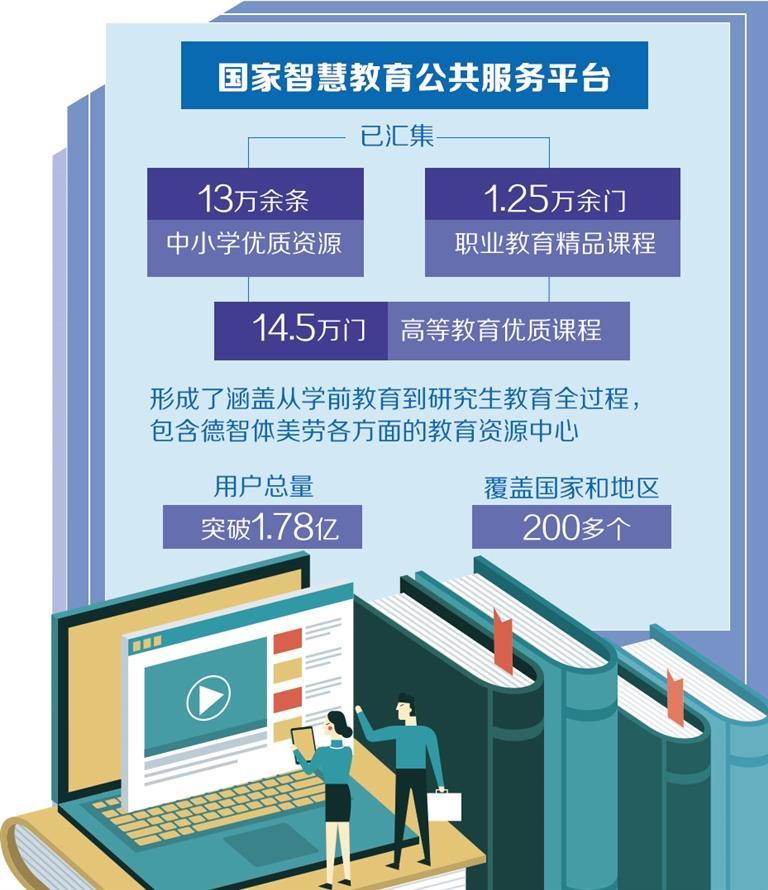
国家平台智能中台正式上线,将加速教育智能化转型进程
Xin Lang Cai Jing· 2025-12-30 06:40
Core Insights - The launch of the National Education Big Data Center and the National Platform Intelligent Middle Platform marks a significant milestone in advancing the digital transformation of education in China, shifting from pilot demonstrations to widespread application [1][4] Group 1: National Education Big Data Center - The National Education Big Data Center signifies a new phase of "coordinated management, orderly sharing, and deep empowerment" of educational data resources, breaking down data silos and enabling real-time monitoring of key indicators such as resource allocation and teaching quality [2][4] - It supports the scientific decision-making in education by transitioning governance from "experience-driven" to "data-driven" approaches, enhancing the overall efficiency and fairness of educational governance [2][4] - The center facilitates a reform in educational evaluation by providing in-depth analysis of students' learning processes and needs, thus supporting differentiated teaching and personalized guidance [2][4] Group 2: National Platform Intelligent Middle Platform - The National Platform Intelligent Middle Platform represents a critical upgrade in the infrastructure of educational platforms, enabling a systematic approach to intelligent education through standardized interfaces and modular packaging [3][4] - It allows for the rapid development and deployment of intelligent applications using low-code methods, thereby reducing barriers to application development and promoting resource efficiency [3][4] - The platform aims to foster an environment conducive to innovative educational practices, supporting the transformation of teaching and learning methods, and facilitating the transition from pilot projects to widespread intelligent teaching applications [3][4]