教育观念

Search documents
北大高材生陨落,跟踪210名天才儿童,97%沦为“牺牲品”
虎嗅APP· 2026-01-06 13:46
Core Viewpoint - The article discusses the misconception that early academic success guarantees future achievement, highlighting that many so-called "genius" children do not become top talents as adults. A significant study shows that 90% of world-class masters were not "child prodigies" [5][6]. Group 1: Research Findings - A recent study published in the journal "Science" analyzed data from over 34,000 top talents, revealing that 90% of those who reached the pinnacle of their fields were not identified as "genius" children [5][6]. - A groundbreaking study by Professor Joan Freeman tracked 210 gifted children over fifty years, finding that only 6 (3%) achieved conventional success, attributing this to the burdens of being labeled a "genius" and societal expectations [8][9]. Group 2: Psychological Impact - The pressure of being a "genius" can lead to mental health issues, with data indicating a 24.7% depression detection rate among students in key high schools, significantly higher than in regular schools [9]. - The article emphasizes that the societal expectation for gifted children to excel can hinder their ability to cope with failure, ultimately stifling their potential [9][10]. Group 3: Pathways to Success - The journey to becoming a top talent is often non-linear, with the article likening it to a "tortoise and hare" race, where those who maintain a steady pace without the pressure of early success often achieve greater long-term results [11][12]. - It is suggested that qualities such as resilience, social skills, and a broad perspective are crucial for success, which may not be reflected in early academic performance [12][13]. Group 4: Educational Philosophy - The article argues that education should not be viewed as a short-term project focused solely on early achievements, but rather as a long-term process that nurtures a child's overall development [13][15]. - Parents and educators are encouraged to foster an environment that allows children to explore their interests freely, rather than imposing strict performance metrics [16][18].


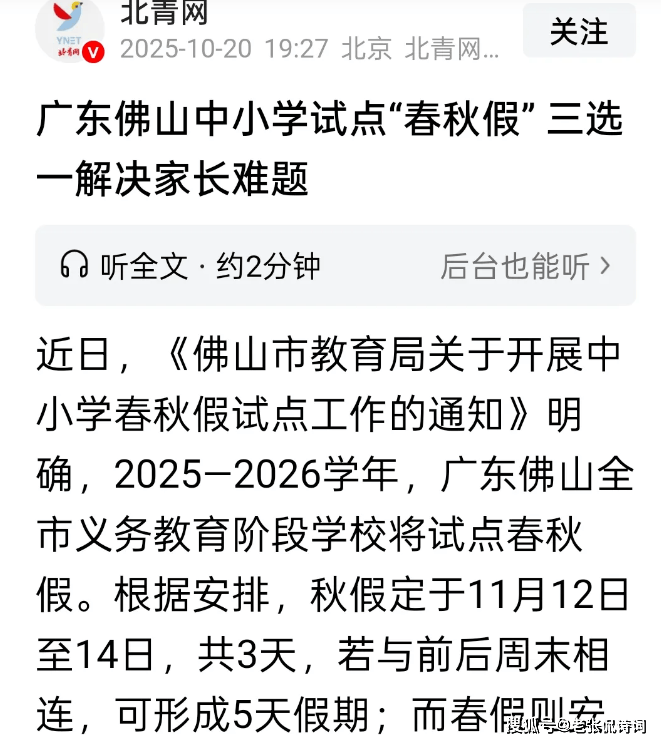
浙江广东都已公布,现在压力给到了山东!
Sou Hu Cai Jing· 2025-10-30 02:47
Group 1 - The economic development in provinces like Guangdong, Jiangsu, and Zhejiang is significantly ahead of Shandong, which is perceived as more sluggish in comparison [1][3] - Shandong's private enterprises are not developing as robustly as those in the other three provinces, and the influence of Confucian culture has led to a lack of innovation [3][5] - Other provinces have already announced specific arrangements for the spring break, while Shandong has yet to release any policy documents regarding this matter [3][5] Group 2 - The economic vitality and per capita economic performance in Guangdong, Jiangsu, and Zhejiang are much stronger, providing a solid material foundation for innovation [5] - Shandong is seen as following in the footsteps of other provinces, with initiatives like "Lu Chao" emerging in response to the popularity of "Su Chao" in Jiangsu, although its influence remains limited [7] - The lack of spring break arrangements in Shandong may be due to the high academic pressure on students, leading officials to be cautious about implementing such policies [7]