
数字人民币改革

Search documents
数字人民币新动向!农发行上海分行今起开办对公业务,“2.0”时代运营机构能否扩容?
Xin Lang Cai Jing· 2026-02-25 03:33
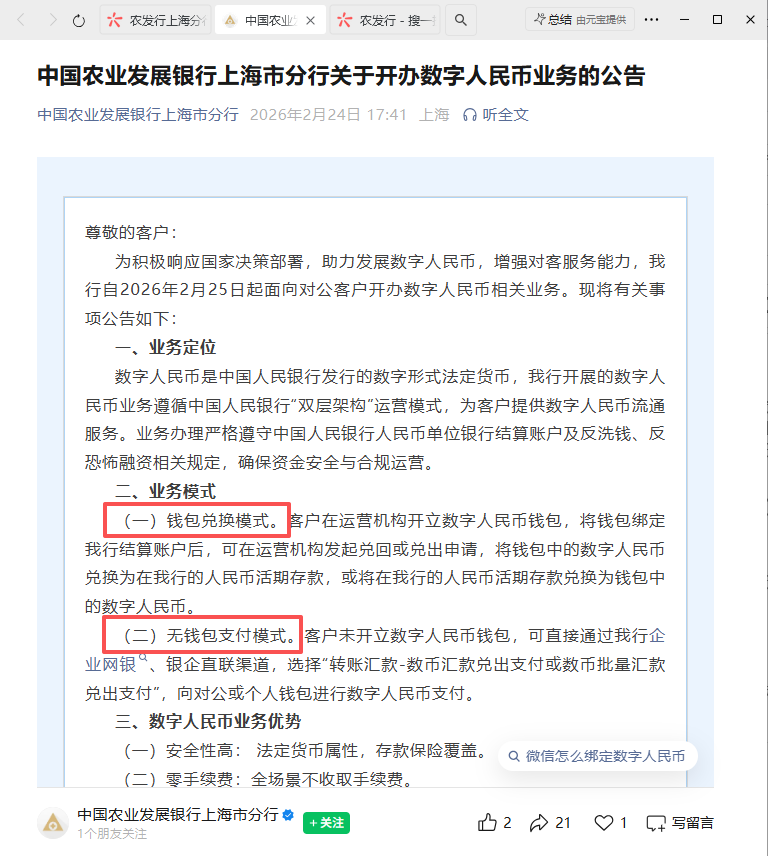
Core Viewpoint - The promotion of digital RMB is gaining momentum, with Agricultural Development Bank of China (ADBC) Shanghai Branch starting to offer digital RMB services to corporate clients from February 25, 2026 [1][7]. Group 1: Digital RMB Business Launch - ADBC Shanghai Branch announced the initiation of digital RMB services for corporate clients, adhering to the "dual-layer" operational model set by the People's Bank of China [8]. - The bank's digital RMB services will comply with regulations regarding bank settlement accounts and anti-money laundering measures to ensure fund security and compliance [8]. Group 2: Business Models - ADBC will implement two business models: 1. Wallet exchange model, allowing clients to open a digital RMB wallet linked to their settlement account for exchanges between digital RMB and RMB deposits [10]. 2. Non-wallet payment model, enabling clients without a digital RMB wallet to make payments directly through the bank's online banking services [10]. Group 3: Industry Response and Developments - Several joint-stock banks and city commercial banks are eager to become operational institutions for digital RMB, with some already preparing personnel for this transition [4][12]. - The current operational framework for digital RMB includes the central bank and a limited number of designated banks, which has restricted broader participation from other commercial banks [11][13]. - There is a strong push from banks to communicate with relevant authorities to expand the list of operational institutions for digital RMB, especially as it enters its "2.0 era" with interest-bearing capabilities [12].


1月新法新规:噪音扰民最高处十日拘留,个人取现超5万无需登记
Xin Lang Cai Jing· 2026-01-01 00:15
Group 1: Law and Regulation Changes - The revised Public Security Administration Punishment Law will regulate issues such as animal attacks and noise disturbances, with penalties including up to ten days of detention and fines of up to 1,000 yuan for severe noise disturbances [2] - The new Value-Added Tax (VAT) Law will come into effect, impacting millions of businesses and individuals, with VAT revenue projected to be approximately 6.57 trillion yuan in 2024, accounting for 38% of total tax revenue [3] - The revised National Common Language and Writing Law will promote the use of standard Chinese language and characters across various sectors, including public services and advertising [4] Group 2: Environmental and Technological Regulations - The National Park Law will prioritize hiring local residents for ecological protection roles and encourage public participation in conservation efforts [5] - The revised Cybersecurity Law will enhance monitoring and regulation of artificial intelligence risks, supporting the development of key technologies and ethical standards [6][7] - The new electric vehicle energy consumption standards will enforce stricter limits, improving energy efficiency and supporting the transition to low-energy vehicles [11] Group 3: Housing and Financial Regulations - The new policy on personal housing sales will impose a 3% VAT on properties sold within two years of purchase, while properties sold after two years will be exempt from VAT [12] - The People's Bank of China will implement a new digital currency framework, allowing interest to be paid on digital yuan wallet balances, marking a shift towards digital deposit currency [13][14] - The new financial regulations will eliminate the requirement for individuals to register cash withdrawals over 50,000 yuan, streamlining the process based on risk assessment [16]
深度解读“数字人民币”:发展现状和未来机遇
2025-12-26 02:12
Summary of Digital Renminbi Conference Call Industry Overview - The conference call focuses on the development and future opportunities of the digital renminbi (e-CNY) in China, highlighting its current status, challenges, and potential reforms. Key Points and Arguments Current Development Status - As of June 2025, the trial transaction amount of digital renminbi has reached 12.4 trillion yuan, with a monthly transaction amount of 894.13 billion yuan in June 2025 [2][1] - The digital renminbi app has facilitated the opening of 218 million personal wallets, widely used in various scenarios such as tax payments, subsidies, retail payments, corporate settlements, government services, and public transportation [2][1] Challenges in Promotion - The issuance mechanism is not smooth, as the digital renminbi is positioned as M0, which limits direct issuance to the public and requires 100% reserve from operating institutions [3][4] - User stickiness is low, with insufficient unique advantages in core payment scenarios leading to infrequent usage compared to third-party payment tools [4][3] - The ecosystem is still underdeveloped, requiring more merchant access, payment terminal proliferation, and enhanced cooperation among financial institutions [4][5] Core Reforms Proposed - The core of the digital renminbi reform involves adjusting the currency level from M0 to M1, optimizing the management system, and establishing economic incentive mechanisms [5][6] - The reform aims to transform digital currency from cash substitutes to a part of the modern monetary system, allowing for more flexibility and innovation among market participants [5][6] Future Ecosystem Participants - Future participants in the digital renminbi ecosystem will include around 20 commercial banks, wallet operators, professional service providers, clearing systems, and end-users [6][5] Impact on Monetary Supply and Credit Activities - Currently, the digital renminbi has a negligible impact on overall monetary supply, with a monthly average balance of approximately 15 billion yuan compared to an M2 balance of about 300 trillion yuan [7][1] - The mechanism may have a contractionary effect on monetary supply, necessitating careful consideration of its potential tightening effects during large-scale promotion [7][1] Transaction-Level Issues - The design of the digital renminbi considers anonymity for user privacy, but this has led to challenges in financial integrity and increased risks of fraud [8][1] - To meet anti-money laundering requirements, a shift towards a strong real-name account system is necessary [8][1] Enhancing Operational Sustainability - To enhance the sustainability of operating institutions, several measures are proposed, including changing the M0 designation to M1, allowing interest on reserves, and enabling loan issuance through digital renminbi [9][1] - The establishment of a management committee and the separation of management and operation are also part of the strategy to improve efficiency [9][1] User Engagement and Experience - Current user engagement is low, with an average of 30 million active personal wallets per month, representing only 20% of total wallets opened [10][1] - To increase user engagement, enhancing user experience through innovative products and services is essential [11][1] Relationship with Other Digital Currencies - The digital renminbi is a central bank digital currency (CBDC) and differs significantly from stablecoins and virtual currencies, which are privately issued and considered illegal financial activities in China [10][1] Future Internationalization and Collaboration - The internationalization of the digital renminbi is a key strategic goal, aiming to reduce cross-border payment costs and enhance its role as an international reserve currency [16][1] - Collaboration with stablecoins is being explored to optimize global financial infrastructure and improve cross-border transaction efficiency [17][1] Additional Important Content - The digital renminbi's transition from M0 to M1 and eventually to M2 signifies its evolution from a payment tool to a more comprehensive financial instrument [13][1] - The potential impact on non-bank payment institutions like Alipay and WeChat Pay could reshape their roles in the payment ecosystem, creating both challenges and opportunities [14][1][15]