
数字基因

Search documents
把日常动作变成具身智能的终身教材
Xin Lang Cai Jing· 2026-02-27 07:05
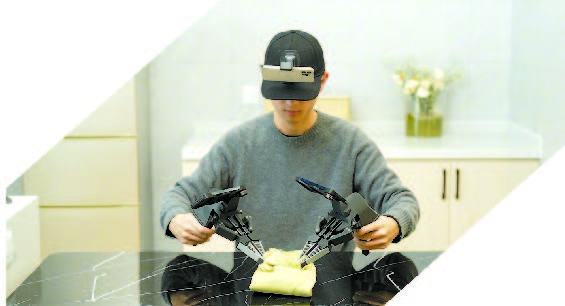
Group 1 - The core idea of the article emphasizes the importance of real-world interaction data for embodied intelligence, contrasting it with language models that utilize vast amounts of readily available text data [4][5] - Embodied intelligence requires extensive experience interacting with real objects to learn complex tasks, which presents challenges due to the high dimensionality and uncertainty of physical environments [4][5] - The traditional method of data collection in laboratories is costly and limited, necessitating a new approach to generate high-quality data from everyday interactions [5][6] Group 2 - The new paradigm developed by Qunche Intelligent, called "Pocket Machine Collection," allows ordinary people to contribute to data generation using a smartphone and a fixture, guided by a specialized app [5][6] - This approach aims to create a continuous flow of data from society, similar to how language models access data, thereby addressing the scarcity of interaction data for training robots [6] - The article discusses the need for effective learning frameworks, including imitation learning and reinforcement learning, to enable robots to understand physical rules and expand their capabilities safely [7][8] Group 3 - The concept of a "digital gene" is introduced, which abstracts objects into functional components, significantly reducing data construction costs and enabling functional transfer across different objects [7][8] - This functional-based world model allows robots to generalize their understanding and quickly deduce appropriate actions for unfamiliar objects, marking a significant advancement from mere imitation to comprehension [8] - The article concludes that the development of embodied intelligence requires a collaborative data ecosystem, a focus on functional digital models, and the integration of algorithms with real-world applications to serve human needs effectively [8]

WRC2025聚焦(5):自然仿生、行业痛点与AI能力升级
Haitong Securities International· 2025-08-13 04:04
Investment Rating - The report does not explicitly provide an investment rating for the industry or specific companies discussed Core Insights - The 2025 World Robot Conference (WRC) highlighted advancements in bionic design, agricultural automation, embodied intelligence AI capabilities, operational cognition optimization, and industrialization pathways [1][14] - Companies like FESTO, Tevel, iFLYTEK, Qiongtor Intelligence, and Auda Voice Medical showcased innovative solutions and technologies in robotics [1][14] Summary by Relevant Sections Bionic Design - FESTO has developed bionic flying robots, including the "BionicBee," which weighs a few grams, has a wingspan of 12 cm, and achieves a wingbeat frequency of 15-20 times per second, showcasing the integration of natural design with engineering [2][15] Agricultural Automation - Tevel addresses the low automation in fruit picking despite a 200% increase in global fruit output over the past 30 years, utilizing flexible gripping and AI decision-making to create a scalable robotic harvesting system [2][16] AI Capability Upgrades - iFLYTEK emphasizes the need for AI to possess capabilities such as autonomous execution, improved human-machine interaction, and global deployment support, integrating VR/AR with large models to enhance task execution [2][17] Operational Cognition - Qiongtor Intelligence introduced the "digital gene" concept to improve operational understanding in robotics, advocating for programmatic language over natural language to enhance generalization and robustness in task execution [3][18] Future Education - The report discusses the transformation of education through AI Agents, emphasizing the need for interdisciplinary skills and adaptability to work alongside AI systems, which is crucial for meeting the demands of the embodied intelligence era [5][21]