数字资产财库模式

Search documents
Strategy(MSTR.US)设14亿美元储备金护盘比特币 未来或尝试出借模式
Zhi Tong Cai Jing· 2025-12-03 07:14
Group 1 - The company has established a $1.4 billion reserve fund to provide flexibility for dividend payments and short-term debt repayments during market volatility, alleviating investor concerns about potential forced Bitcoin sales [1] - The reserve fund was raised through stock issuance, allowing for a buffer period of up to 21 months for dividend payments, potentially extending to two years without liquidating its $59 billion Bitcoin holdings [1] - The CEO emphasized the goal of perpetual dividend payments and the importance of avoiding forced sales of Bitcoin if the company's equity value falls below the asset value [1] Group 2 - Originally a software company, Strategy transformed into a Bitcoin investment firm in 2020, leading to a peak stock price increase of over 3500%, outperforming all stock indices [2] - Since reaching an all-time high in November 2024, the company's stock has declined by approximately 60%, attributed to a cooling interest in cryptocurrencies post-presidential elections and more companies adopting similar digital asset strategies [2] - The company's key valuation metric, mNAV, is currently around 1.17, raising concerns among investors about a potential negative shift, which could lead to the sale of some Bitcoin as a last resort [2] Group 3 - The broader digital asset treasury model is showing signs of strain, as the integration of cryptocurrency beliefs with public market channels faces challenges due to falling Bitcoin prices and reduced market risk appetite [3] - The previously effective leveraged market cycle of raising funds, purchasing cryptocurrencies, and profiting from trends is becoming unsustainable under current market pressures [3] Group 4 - On Tuesday, the company's stock rose nearly 6%, while Bitcoin prices increased by over 2%, reaching approximately $93,000 [4]

六周市值血洗6000亿 比特币跳水考验华尔街拥趸 "持币大户"最近还加码买入
Hua Er Jie Jian Wen· 2025-11-18 04:01
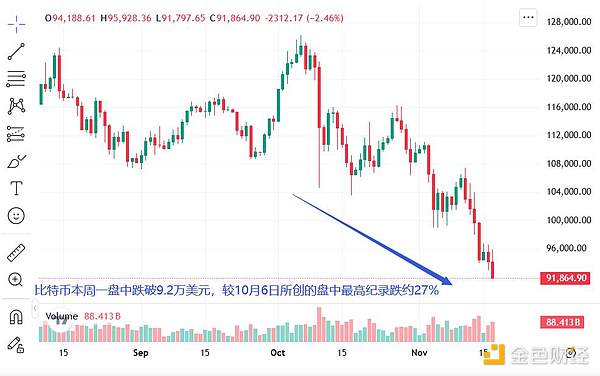
Core Viewpoint - Bitcoin is experiencing a significant downturn, erasing nearly all of its gains for the year despite support from Wall Street, policies, and institutional investments. The market capitalization has evaporated by approximately $600 billion in six weeks, raising concerns about the stability of the cryptocurrency market [1][4]. Group 1: Market Dynamics - As of the latest data, Bitcoin's market capitalization has decreased by about $600 billion since its peak on October 6, when it reached over $126,000 [1][4]. - The price of Bitcoin fell below $92,000, marking a nearly seven-month low and a drop of over $30,000 from its peak, representing a cumulative decline of approximately 27% [1][4]. - The market is facing a crisis of confidence, with retail investors and Wall Street questioning Bitcoin's viability as a long-term asset amid ETF fund outflows and macroeconomic risks [3][4]. Group 2: Institutional Behavior - MicroStrategy, a major Bitcoin holder, has increased its holdings by purchasing $835.6 million worth of Bitcoin, raising its total to approximately 649,870 coins valued at around $61.7 billion [1][9]. - The company's market capitalization has fallen to $59 billion, which is below the value of its Bitcoin holdings, indicating a rare discount status that challenges its financing model [3][9]. - The company's mNAV, a key valuation metric, has dropped from over 2.5 times to just 1.2 times, suggesting a failure of the premium mechanism that previously supported its financing [9][10]. Group 3: Market Sentiment and Future Outlook - The current market sentiment is extremely negative, with retail investors facing potential losses as Bitcoin approaches critical support levels [7][10]. - There is a growing concern that the historical four-year halving cycle may no longer apply, as the market dynamics have shifted with the influence of institutional buyers [6][10]. - Analysts predict that Bitcoin and most cryptocurrencies may continue to decline, with the market's reliance on emotional trading rather than fundamental factors [5][11].