数字隐私

Search documents
Zcash Rallies After Latest Relisting Announcement From Major Exchange
Yahoo Finance· 2025-11-23 19:46
Group 1 - Zcash (ZEC) surged over 12% to trade near $600 after OKX announced it would relist the token, making it the top-performing asset among major cryptocurrencies in the last 24 hours [1][2] - OKX's decision to resume spot trading for the ZEC/USDT pair marks a significant regulatory shift, as the exchange had previously delisted ZEC in 2023 due to compliance risks [2] - The resurgence of Zcash is linked to its strong performance compared to Bitcoin, which has struggled to reclaim the $90,000 level [1][2] Group 2 - The new SEC leadership is encouraging platforms to reintegrate privacy protocols, reflecting a post-election regulatory thaw [3] - There is a philosophical debate on Wall Street regarding the future of digital privacy, with concerns that the rise of privacy coins like Zcash could fragment the broader crypto narrative [4][5] - Some asset managers view Zcash as a necessary complement to Bitcoin, driven by rising demand for confidentiality amid surveillance risks [6]
有四成网页在近十年内消失,但一张裸照能活到永远
3 6 Ke· 2025-10-16 09:57
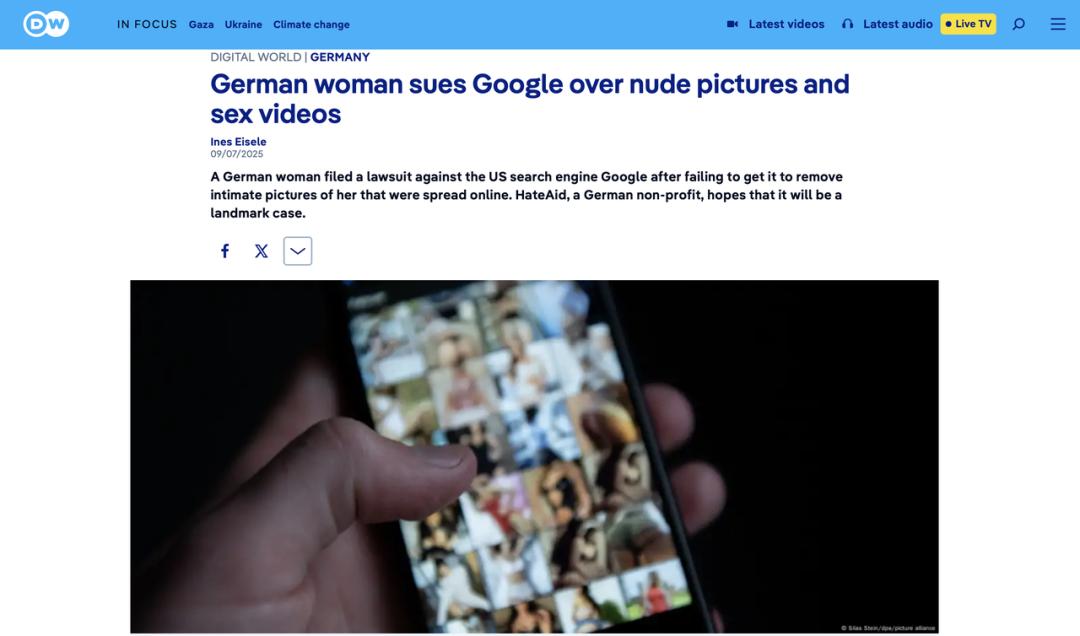
Core Viewpoint - The article discusses a real-life case of a German couple whose private videos were stolen and disseminated online, leading them to sue Google for the removal of related search results, highlighting the challenges of digital privacy and the permanence of online content [2][10][12]. Group 1: Incident Overview - A couple's private videos were stolen from their secure cloud storage and uploaded to various websites, leading to widespread distribution [5][6]. - The wife, Laura, discovered the issue when searching her name on Google, finding her private images in the search results, which caused her severe psychological distress [6][7]. - The couple attempted various methods to remove the content, including legal action and contacting websites, but found it ineffective as the content kept reappearing [9][10]. Group 2: Legal and Technical Challenges - The couple filed a lawsuit against Google in September 2025, seeking the complete removal of all related web traces, supported by the non-profit organization HateAid [10][11]. - A key legal question is whether Google, as a search engine, has the obligation to delete or block access to such content, as it does not host the content itself [13][14]. - The European GDPR law provides individuals with the "right to be forgotten," allowing them to request the removal of sensitive information under specific conditions, but this does not guarantee complete removal from the internet [14][15]. Group 3: Digital Permanence and Privacy - The article highlights the paradox of the internet, where some content can disappear due to "digital decay," while sensitive content often remains accessible indefinitely [20][25]. - Research indicates that a significant percentage of web pages become inaccessible over time, yet sensitive content tends to be preserved and circulated [20][23]. - The design of the internet promotes redundancy and distribution of information, which can lead to the persistence of harmful content despite attempts to remove it [25][30].