数学发现

Search documents
陶哲轩力推AlphaEvolve:解决67个不同数学问题,多个难题中超越人类最优解
3 6 Ke· 2025-11-07 07:40
Core Insights - The article discusses the introduction of AlphaEvolve, a powerful new tool for mathematical discovery, co-authored by Bogdan Georgiev and Terence Tao [1][5]. Group 1: AlphaEvolve's Capabilities - AlphaEvolve was tested on 67 mathematical problems across various fields, including combinatorial mathematics, geometry, mathematical analysis, and number theory [3]. - The system outperformed traditional tools in scalability, robustness, and interpretability, and it can autonomously discover novel mathematical constructs, surpassing existing human optimal results in some cases [5][6]. Group 2: Human-AI Collaboration - In the Nikodym set problem, AlphaEvolve generated initial constructs that, while not optimal, provided valuable insights for human researchers, leading to improved upper bounds in a subsequent independent paper [6][7]. - Similarly, in the arithmetic Kakeya conjecture, AlphaEvolve played a crucial role in advancing understanding [8]. Group 3: Interpretability and Insight Generation - AlphaEvolve's ability to generate clear and interpretable program code allows human experts to analyze and extract general mathematical formulas from its outputs [10]. - For the stacking blocks problem, the system initially created a correct recursive program, which it later simplified into a more efficient explicit program, revealing the mathematical relationship with harmonic numbers [14]. Group 4: Problem-Solving Techniques - The system demonstrated its ability to navigate complex problem spaces by adapting its scoring functions to avoid local traps, ultimately converging on known theoretical optimal solutions [19]. - AlphaEvolve exhibited excellent generalization capabilities, successfully identifying universal constructs for all perfect square inputs [20][21]. Group 5: Efficiency and Expert Guidance - AlphaEvolve operates efficiently with minimal high-quality prompts, and expert guidance significantly enhances the quality of its outputs [23]. - The system supports parallelization, allowing researchers to explore multiple problem instances simultaneously, which is particularly effective for multi-parameter geometric problems [23]. Group 6: Operational Modes - AlphaEvolve functions in two primary modes: "search mode" for efficiently discovering optimal mathematical constructs and "generalizer mode" for creating universal programs applicable to various parameters [24][26]. - In search mode, the system evolves heuristic algorithms to optimize the search process, while in generalizer mode, it aims to identify patterns and develop general formulas based on observed optimal solutions [25][26]. Conclusion - Overall, AlphaEvolve exemplifies how AI-driven evolutionary search can complement human intuition, providing a robust new paradigm for mathematical research [28].

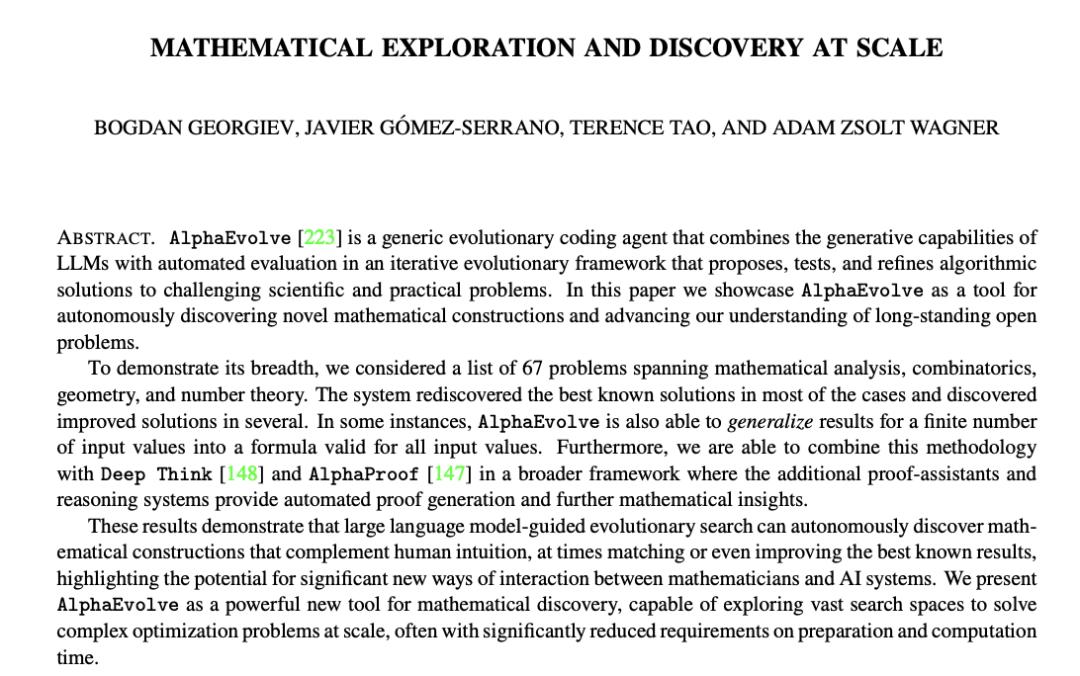
陶哲轩力推AlphaEvolve:解决67个不同数学问题,多个难题中超越人类最优解
量子位· 2025-11-07 05:32
Core Viewpoint - AlphaEvolve is presented as a powerful new tool for mathematical discovery, capable of autonomously discovering novel mathematical constructs and surpassing existing human optimal results in certain problems [2][5]. Group 1: AlphaEvolve's Capabilities - AlphaEvolve has been tested on 67 mathematical problems across various fields, including combinatorial mathematics, geometry, mathematical analysis, and number theory [4]. - The system not only reproduces many known optimal solutions but also demonstrates unique discovery capabilities, including the ability to autonomously find new mathematical constructs previously unseen by humans [6][7]. - In the Nikodym set problem, AlphaEvolve provided a preliminary construct that, while not optimal, served as an excellent intuitive jumping-off point for human researchers, leading to an improved known upper bound [8]. Group 2: Performance Metrics - AlphaEvolve outperforms traditional tools in scalability, robustness, and interpretability [9]. - In the arithmetic Kakeya conjecture, the system improved a known lower bound from 1.61226 to 1.668 and inspired mathematicians to establish new asymptotic relationships [12]. - The system's ability to generate clear and interpretable program code allows human experts to analyze and extract general mathematical formulas from its findings [12]. Group 3: Problem-Solving Techniques - AlphaEvolve effectively handles high-dimensional parameter spaces, complex geometric constraints, and Monte Carlo simulation-based scoring functions [20][21]. - In a minimum triangle density problem, the system utilized the non-convexity of the problem space to achieve scores beyond theoretical optimality, prompting researchers to design a more robust scoring function [24]. - The system demonstrated excellent generalization capabilities by discovering a universal construct that achieves optimal results for all perfect square inputs [29]. Group 4: Operational Modes - AlphaEvolve operates in two main modes: "search mode" for efficiently discovering optimal mathematical constructs and "generalizer mode" for creating universal programs applicable to any given parameter [32][33]. - In search mode, the system evolves heuristic algorithms that can trigger large-scale, inexpensive computations to explore millions of candidate constructs [35]. - The generalizer mode challenges the system to identify patterns from optimal solutions found at small scales and generalize them into a universal formula or algorithm [37]. Group 5: Human-AI Collaboration - The efficiency of AlphaEvolve is significantly enhanced by expert guidance, indicating a high sensitivity to human input [31]. - The system's architecture supports parallelization, allowing researchers to explore multiple problem instances simultaneously, which is particularly effective for multi-parameter geometric problems [31].