
文物保护与修复

Search documents
愿人人都能如获至宝
Xin Lang Cai Jing· 2026-02-10 06:37
Core Insights - The "Shanghai Museum Forum" aims to transform complex academic research into engaging stories for the audience, fostering a deeper understanding of cultural heritage and artifacts [1][2] - The initiative has evolved from traditional offline lectures to a hybrid model combining online and offline formats, enhancing its reach and impact over the past seven years [1][3] - The forum's content for the fourth season includes topics on artifact preservation, intangible cultural heritage, and the integration of traditional techniques with modern technology [3][4] Group 1 - The Shanghai Museum is committed to innovating service models to enhance cultural supply capabilities and tell Chinese stories effectively [1] - The forum has successfully adapted to changes in communication environments, optimizing content delivery and expanding its brand influence [1][3] - The goal is to create a vibrant cultural space where knowledge resonates beyond individual lectures, reaching households through books and multimedia [2] Group 2 - The fourth season of the forum covers various aspects of cultural heritage, including the science behind traditional pottery techniques and the cultural significance of artifacts like bronze drums [3] - The forum aims to provide insights into the daily work of restoration experts and the innovative practices they employ [3] - The fifth season is anticipated to further engage audiences, making cultural treasures accessible and relatable, fostering a sense of pride in shared heritage [4]
靠几张黑白远景照,他为大佛“重塑”面容
Jing Ji Guan Cha Bao· 2025-10-30 03:10
Core Viewpoint - The article discusses the historical significance and restoration efforts of the Tianti Mountain Grottoes, particularly focusing on the Great Buddha Cave, which has faced challenges due to water damage and historical alterations [1][6][21]. Group 1: Historical Significance - The Tianti Mountain Grottoes are recognized as the first royal grottoes in China, directly commissioned by a king during the Northern Liang period, showcasing early grotto art [2][3]. - The site contains over a hundred statues and hundreds of square meters of murals, along with valuable texts and artifacts from various dynasties [2][3]. Group 2: Relocation and Preservation Efforts - In 1958, the local government decided to build a reservoir, threatening to submerge the grottoes, leading to a large-scale relocation effort approved by the Gansu provincial government [4][6]. - The relocation involved moving 43 statues and 300 square meters of murals to the Gansu Museum, while the Great Buddha Cave was left in situ due to the size of its sculptures [4][6]. Group 3: Restoration Challenges - The Great Buddha Cave's sculptures suffered significant water damage, with parts submerged for over 30 years, leading to erosion and loss of structural integrity [6][21]. - Restoration efforts began in 1995, utilizing modern materials while adhering to the principle of "repairing the old as the old" despite limited historical references [19][21]. Group 4: Restoration Techniques - The restoration team, led by Li Yunhe, employed innovative techniques, including the use of steel reinforcements for the sculptures' frameworks, replacing the original wooden structures [15][19]. - The team faced the challenge of reconstructing the Buddha's head using only black-and-white photographs from the 1950s, which required significant scaling and artistic interpretation [13][14]. Group 5: Legacy and Impact - Li Yunhe's dedication to the restoration of the Tianti Mountain Grottoes has inspired a new generation of conservators, with his family continuing the tradition of cultural heritage preservation [21][23]. - The successful restoration of the Great Buddha Cave has garnered praise from experts and the public, highlighting the importance of cultural heritage conservation in China [21].
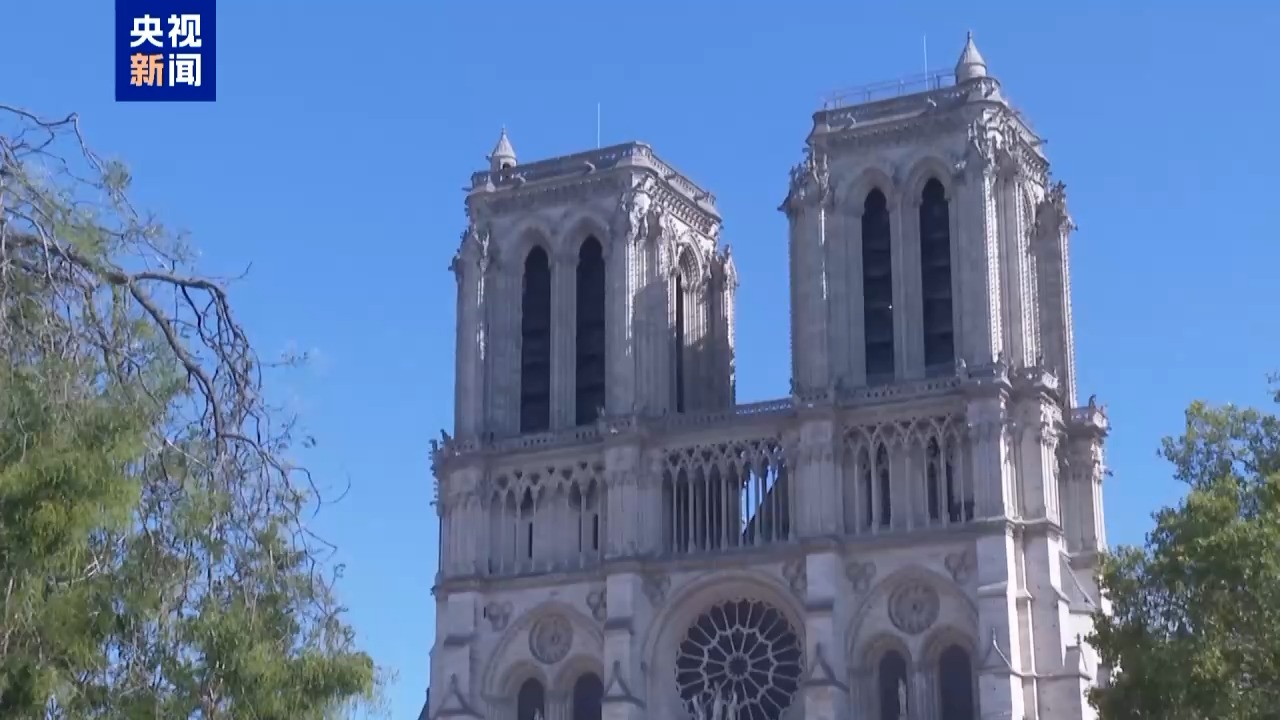
总台记者探访丨巴黎圣母院塔楼重开 缮后细节抢先看
Yang Shi Xin Wen· 2025-09-20 02:17
Core Points - The Notre-Dame Cathedral's towers have reopened to the public after six years of restoration following a devastating fire [1][8] - The restoration emphasizes a balance between modern safety features and historical preservation, showcasing craftsmanship and attention to detail [4][5][7] Restoration Details - The original stone staircases have been replaced with new wooden ones designed in a double-spiral pattern for safety and comfort [4] - The restoration adhered to the principle of "repairing old as old," with ancient wooden beams being marked and replaced where necessary [5] - The bell tower houses a 13-ton bell from the 17th century, which survived the fire, and its supporting wooden structure has been restored [6] - The roof, referred to as the "forest," was completely destroyed in the fire and has been reconstructed using over 1,200 oak trees, highlighting the complexity and artistry of the restoration [7] Cultural Significance - The reopening of the towers allows visitors to experience the historical and literary significance of the cathedral, as it intertwines history with contemporary restoration efforts [6][8] - The restoration serves as a valuable case study for global heritage conservation and restoration practices [8]

镜观·回响丨用匠心修复时光
Xin Hua Wang· 2025-07-06 14:08
Group 1 - The article highlights the importance of cultural heritage preservation and restoration in China, emphasizing the need for skilled professionals in this field [3][9] - The 2025 National Cultural Heritage Vocational Skills Competition will be held in Luzhou, Sichuan, showcasing craftsmanship and skills among participants from across the country [3][5] - The competition features a diverse range of participants, with an average age of 40.5 years, including the youngest contestant at 19 years old, indicating a multi-generational approach to skill development [5][9] Group 2 - Over the past two years, approximately 200 cultural heritage restoration workers have successfully restored over 4,000 artifacts from the Sanxingdui site, demonstrating significant progress in the field [7] - The competition has attracted a high percentage of well-educated participants, with over 53% holding a bachelor's degree or higher, including 45 master's degree holders and 1 doctoral candidate [9] - The application of new technologies and materials in cultural heritage preservation is enhancing efficiency and effectiveness, allowing for minimal intervention and restoration that maintains historical integrity [22][23]
