斯多葛哲学

Search documents
如何获得内心的安宁?在古罗马哲学家塞涅卡看来……
Xin Lang Cai Jing· 2026-01-01 08:29
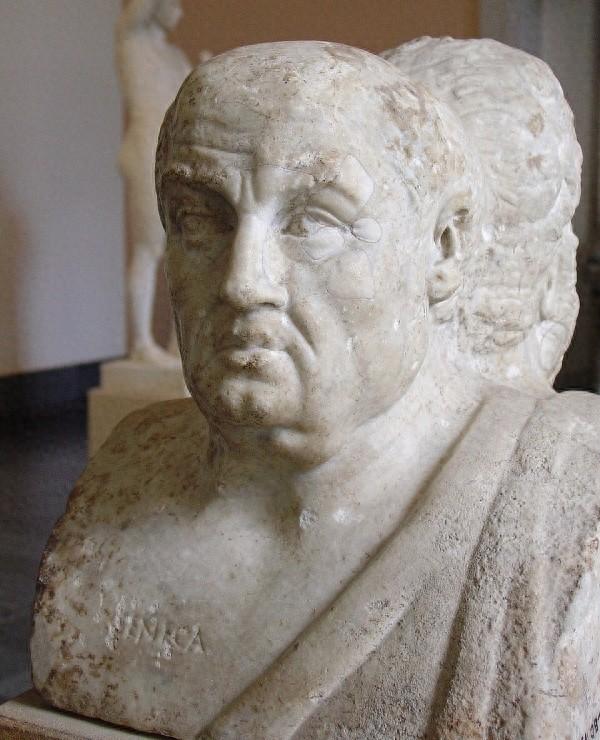
Group 1 - Seneca was a prominent figure in the Stoic school and a significant politician during the early Roman Empire, known for his extensive writings including essays and tragedies [1][4] - He was born in Cordova, Spain, to a family of the Roman equestrian class and received training in rhetoric and philosophy, particularly from the Stoic philosopher Attalus [1][3] - Seneca's early life was marked by health issues, including respiratory problems, which led him to spend time in Egypt for treatment [1] Group 2 - Seneca's political career began when he returned to Rome and quickly rose to become a senator, eventually becoming a tutor and advisor to Emperor Nero [5][6] - His tenure as a statesman was characterized by significant political maneuvering, particularly during the power struggles surrounding Nero's ascension to the throne [5][7] - Under Nero's rule, Seneca played a crucial role in stabilizing the empire, implementing reforms that benefited the populace, such as the abolition of indirect taxes and measures to curb corruption [9][11] Group 3 - After the death of Nero's mother, Agrippina, the power dynamics shifted, leading to a decline in Seneca's influence as Nero became more tyrannical and indulgent [13][14] - Seneca faced increasing political opposition and was accused of various improprieties, which culminated in a loss of favor with Nero [11][15] - Despite his attempts to retire and distance himself from court politics, Seneca remained under threat from Nero's suspicions and the machinations of his enemies [14][15] Group 4 - Seneca's death in 65 AD was a result of his alleged involvement in a conspiracy against Nero, leading to his forced suicide [16][17] - His final moments were marked by philosophical reflections and a calm acceptance of death, drawing parallels to the death of Socrates [17] Group 5 - Seneca's literary contributions include a wide range of works, primarily focusing on moral philosophy, natural philosophy, and tragedies that reflect Stoic thought [18][19] - His philosophical writings, particularly the "Moral Letters to Lucilius," cover various themes such as friendship, anxiety, fate, and the pursuit of happiness, serving as a guide for living a virtuous life [20][21] - Seneca's style is noted for its clarity and elegance, making him a significant figure in Latin literature [21]

读《贝叶斯定理》,感悟斯多葛哲学——现代人的双重生存智慧
Hua Xia Shi Bao· 2025-06-04 23:59
Core Insights - The article emphasizes the significance of Bayesian theorem as a framework for updating knowledge and making decisions under uncertainty, complementing Stoic philosophy [2][5][10] Application of Bayesian Thinking - In business, Bayesian theorem can be utilized as a "possibility dashboard" to enhance customer engagement and increase sales conversion rates through real-time probability assessments [3] - In project management, it serves as an intelligent warning system, allowing for proactive risk management by adjusting probabilities based on new evidence [4] - In medical decision-making, it provides a rational filter to assess true probabilities of conditions, countering misleading surface data [4] Complementary Thinking Systems - Bayesian theorem acts as a dynamic guide for updating cognition and quantifying uncertainty, while Stoic philosophy offers psychological resilience by distinguishing between what can and cannot be changed [5][6] - The combination of both approaches is particularly effective in various life scenarios, such as healthcare, investment, and skill acquisition [6] Practical Guidelines - Before taking action, evaluate possibilities using Bayesian theorem [8] - During execution, maintain a Stoic mindset to accept outcomes [9] - After actions, establish a feedback loop for cognitive improvement [10] Conclusion - The integration of Bayesian reasoning and Stoic philosophy is presented as an ultimate survival strategy in an uncertain world, promoting both dynamic decision-making and internal stability [10][11]