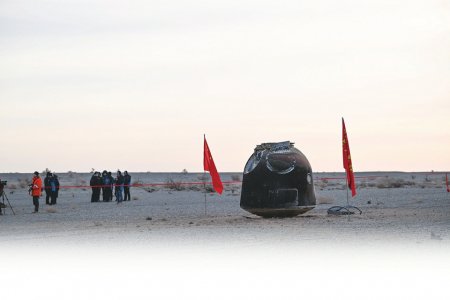
无人化搜索模式

Search documents
我国首次使用无人化模式 成功搜索神舟飞船返回舱
Xin Lang Cai Jing· 2026-01-19 21:15
Core Viewpoint - The successful landing of the Shenzhou-20 spacecraft marks a significant advancement in China's space recovery operations, utilizing an unmanned search model for the first time [2][3]. Group 1: Unmanned Search Operations - This mission is the first to employ an unmanned search model for the recovery of the Shenzhou spacecraft, replacing traditional helicopter-based aerial teams with drone and unmanned vehicle teams [2]. - The new search model combines "drone search + unmanned vehicle observation + ground handling," providing valuable experience for future missions [2]. Group 2: Operational Challenges and Preparations - The East Wind landing site, located at the edge of the Badain Jaran Desert, experienced extreme cold, with temperatures dropping to -23.8 degrees Celsius on the morning of January 19 [2]. - To ensure effective operations in the cold environment, multiple training sessions were conducted, including collaborative flight training and cold weather adaptation training [2]. Group 3: Technological Implementation - A comprehensive optical measurement and control network was established in advance to ensure clear imagery of the landing site, allowing for rapid target detection and tracking [2]. - The unmanned vehicles successfully transmitted real-time images of the landing capsule to the command center shortly after the capsule deployed its parachute [3]. Group 4: Historical Context - The East Wind landing site was first utilized in 2016, and it has since been involved in various recovery missions, including the first manned mission recovery in 2021 [3]. - The Shenzhou-20 mission represents the first unmanned spacecraft recovery operation conducted at the East Wind landing site [3].
神舟二十号飞船安全回家
Xin Lang Cai Jing· 2026-01-19 18:11
Core Viewpoint - The main mission of China's space station emergency action has been successfully completed with the safe return of the Shenzhou-20 spacecraft on January 19, 2026, marking a significant achievement in China's manned spaceflight program [3][4]. Group 1: Mission Completion - The Shenzhou-20 spacecraft successfully landed at the Dongfeng landing site at 9:34 AM on January 19, 2026, confirming the overall normal condition of the spacecraft and its internal items [3]. - The spacecraft was launched on April 24, 2025, and had a total in-orbit duration of 270 days, validating its capability for a 9-month stay in orbit [3][4]. - The mission faced a delay in return due to suspected impact from space debris, leading to the implementation of emergency measures and the successful return of the crew aboard Shenzhou-21 on November 14, 2025 [4]. Group 2: Search and Recovery Operations - The search and recovery operation for the Shenzhou-20 spacecraft utilized an unmanned mode for the first time, incorporating drone and unmanned vehicle teams, which replaced traditional helicopter units [5][6]. - The search teams quickly arrived at the landing site and successfully located the spacecraft, demonstrating the effectiveness of the new unmanned search model [5][6]. Group 3: Extravehicular Suit Retirement - The Shenzhou-20 mission also marked the retirement of China's first set of extravehicular suits, which had successfully supported 20 extravehicular activities [7][8]. - The extravehicular suit, weighing over 100 kilograms, was designed for a lifespan of three years and had exceeded its usage expectations by completing 20 extravehicular activities [8][9]. - The suit's successful performance in various missions has provided valuable data for future developments in space suit technology [11]. Group 4: Future Developments - The data and experiences gained from the Shenzhou-20 mission and the retired extravehicular suit will contribute to the development of future space suits, including the lunar exploration suit [11].