
中国载人航天

Search documents
太空年夜饭浪漫开席
Xin Lang Cai Jing· 2026-02-17 06:59
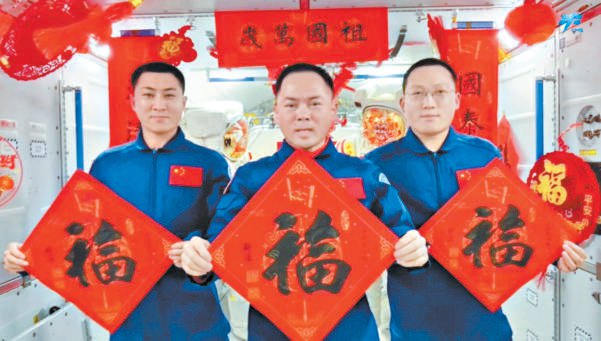
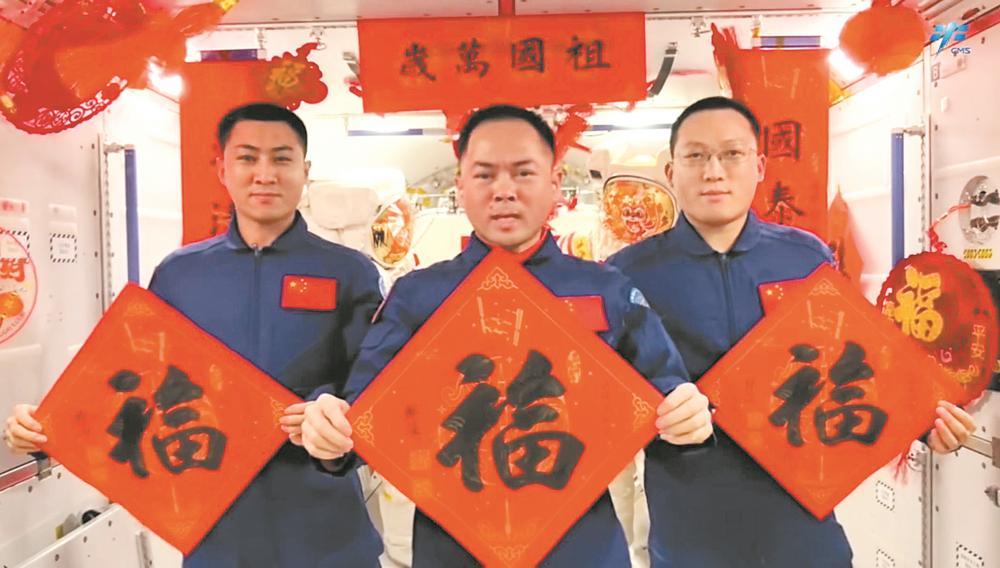
Core Viewpoint - The Shenzhou 21 crew celebrated the Lunar New Year in space, showcasing China's achievements in manned space exploration and the unique experience of celebrating traditional festivals in a microgravity environment [2][3][4] Group 1: Celebration in Space - The Shenzhou 21 astronauts decorated their space station with festive symbols, including red couplets and the character for "fortune," creating a celebratory atmosphere [2] - This marks the fourth Lunar New Year since the completion of the Chinese space station, highlighting the ongoing commitment to space exploration [2] - Astronauts expressed their wishes for national prosperity and personal well-being, emphasizing the emotional connection to their homeland while in space [2] Group 2: Unique Dining Experience - The astronauts showcased a variety of traditional dishes during their New Year's Eve dinner, including dumplings and various meats, reflecting the rich culinary culture of China [3] - The microgravity environment transformed the dining experience, with food items floating and requiring creative methods to eat, adding a playful element to the meal [4] - Notably, this was the first time Chinese astronauts enjoyed cake in space, marking a significant milestone in space dining experiences [4] Group 3: Ongoing Missions - Since the launch on October 31, 2025, the Shenzhou 21 crew has been engaged in various tasks, including scientific experiments and equipment maintenance, demonstrating the operational capabilities of the Chinese space station [4]

太空年夜饭 丰盛得超乎想象
Si Chuan Ri Bao· 2026-02-16 21:58
Core Viewpoint - The article highlights a unique New Year's Eve dinner held by Chinese astronauts aboard the Chinese space station, showcasing the achievements of China's manned space program and the cultural significance of the event [1]. Group 1: Event Description - On February 16, during the Chinese New Year's Eve, astronauts celebrated with a special dinner in a microgravity environment approximately 400 kilometers above Earth [1]. - The astronauts presented a variety of traditional dishes, including shrimp dumplings, pork and dried vegetable dumplings, and beef dumplings, creating a festive atmosphere [1]. - The dinner featured a rich assortment of foods symbolizing good fortune and family reunion, such as braised pork, bamboo shoots with meat, five-spice beef, and a cake baked in space, marking a first for Chinese astronauts [1]. Group 2: Cultural Significance - The dinner was not just a meal but a representation of human warmth and cultural traditions, bridging the gap between Earth and space [1]. - The astronauts' joyful presentation and the variety of dishes reflected the essence of Chinese New Year celebrations, emphasizing themes of abundance and togetherness [1]. - The event underscored the remarkable achievements of China's manned space program, showcasing the ability to enjoy traditional customs even in space [1].
太空里的年夜饭 浪漫开席
Xin Lang Cai Jing· 2026-02-16 19:19
Core Viewpoint - The article highlights the unique experience of Chinese astronauts celebrating the Lunar New Year in space, showcasing their festive meal and the achievements of China's manned space program [2][3]. Group 1: Celebration in Space - On the eve of the Lunar New Year, astronauts aboard the Chinese space station decorated their living space with festive symbols, creating a warm and celebratory atmosphere [2]. - The astronauts presented a variety of traditional Chinese dishes during a video broadcast, including dumplings and various meats, emphasizing the richness of their New Year's meal [2][3]. Group 2: Unique Dining Experience - The microgravity environment of space transformed the dining experience, with food items behaving in unexpected ways, such as dumplings floating away and ice cream drifting towards the astronauts' mouths [3]. - A notable highlight was the astronauts enjoying cake for the first time in space, marking a significant milestone in China's space culinary achievements [3].
神21乘组年夜饭曝光:酱肘子、笋干肉、五香酱牛肉、叉烧肉、饺子
Jin Rong Jie· 2026-02-16 10:14
Core Viewpoint - The news highlights the achievements of China's manned space program, showcasing the successful celebration of the Lunar New Year by astronauts aboard the Chinese space station, including the first-ever cake eaten in space by Chinese astronauts [1] Group 1: Achievements in Space - The astronauts Zhang Lu, Wu Fei, and Zhang Hongzhang sent New Year greetings from approximately 400 kilometers above Earth [1] - The astronauts showcased a variety of traditional Chinese New Year dishes, including braised pork, dried bamboo shoots with meat, five-spice beef, and various dumplings [1] - The successful baking of a cake in space marks a significant milestone for China's space exploration efforts, following previous achievements such as space barbecuing [1]
神二十一航天员太空迎新春 “花式”送祝福
Zhong Guo Xin Wen Wang· 2026-02-16 07:47
Group 1 - The Shenzhou 21 crew celebrated the Lunar New Year in space, sending unique blessings to everyone, wishing for happiness and prosperity in the Year of the Horse [1][2] - The crew decorated the Chinese space station with traditional Spring Festival elements, such as couplets and the character "Fu" for good fortune, creating a festive atmosphere [3] - Commander Zhang Lu expressed his feelings of nostalgia and pride while looking at the lights of homes on Earth, wishing everyone safety and success [3] Group 2 - Astronaut Wu Fei, celebrating his first New Year in space, emphasized the importance of hard work and determination for achieving dreams and wished for a prosperous year ahead [3][4] - Zhang Hongzhang, also celebrating his first New Year in orbit, highlighted the steady progress of experiments on the space station and expressed hopes for technological advancement and public well-being in the new year [3][4] - The crew creatively shared their New Year wishes through various activities, including calligraphy, exercise, and showcasing traditional dishes, each carrying auspicious meanings [4]
神二十一乘组将在中国空间站迎来春节 指令长张陆即将第二次在太空过春节
Xin Lang Cai Jing· 2026-02-15 06:20
Core Viewpoint - The Shenzhou 21 crew, led by commander Zhang Lu, is set to celebrate the Lunar New Year in space, marking a significant milestone as Zhang becomes the first astronaut in China to spend the New Year in space twice [1] Group 1 - The Shenzhou 21 crew is actively engaged in various tasks aboard the Chinese space station, including experiments on human-robot interactions [1] - The crew has successfully completed the replacement of experimental cabinet plugs and conducted maintenance checks on station equipment [1] - The upcoming Lunar New Year celebration in space highlights the advancements in China's manned space program and the ongoing commitment to space exploration [1]
神二十返回背后发生了什么?
Xin Lang Cai Jing· 2026-01-20 04:32
Core Viewpoint - The article discusses China's first emergency action in manned spaceflight, triggered by a small piece of space debris that struck the Shenzhou 20 spacecraft, leading to a significant mobilization of resources across various locations in China [1] Group 1: Incident Overview - A tiny piece of space debris, smaller than a grain of rice, unexpectedly hit the window edge of the Shenzhou 20 spacecraft's return capsule, resulting in a crack in the outer glass layer [1] - This incident caused a pause in the return process of the Shenzhou 20 spacecraft, highlighting the risks associated with space debris [1] Group 2: Response and Mobilization - The event prompted a large-scale response involving thousands of aerospace personnel from major Chinese space engineering systems located in Beijing, Jiuquan, Shanghai, and Sichuan [1] - The mobilization was described as a "space assembly call," indicating the urgency and seriousness of the situation [1]
神舟二十号飞船安全回家
Xin Lang Cai Jing· 2026-01-19 18:11
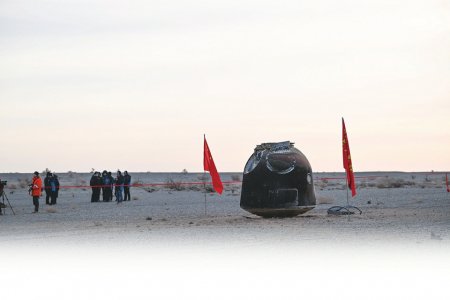
Core Viewpoint - The main mission of China's space station emergency action has been successfully completed with the safe return of the Shenzhou-20 spacecraft on January 19, 2026, marking a significant achievement in China's manned spaceflight program [3][4]. Group 1: Mission Completion - The Shenzhou-20 spacecraft successfully landed at the Dongfeng landing site at 9:34 AM on January 19, 2026, confirming the overall normal condition of the spacecraft and its internal items [3]. - The spacecraft was launched on April 24, 2025, and had a total in-orbit duration of 270 days, validating its capability for a 9-month stay in orbit [3][4]. - The mission faced a delay in return due to suspected impact from space debris, leading to the implementation of emergency measures and the successful return of the crew aboard Shenzhou-21 on November 14, 2025 [4]. Group 2: Search and Recovery Operations - The search and recovery operation for the Shenzhou-20 spacecraft utilized an unmanned mode for the first time, incorporating drone and unmanned vehicle teams, which replaced traditional helicopter units [5][6]. - The search teams quickly arrived at the landing site and successfully located the spacecraft, demonstrating the effectiveness of the new unmanned search model [5][6]. Group 3: Extravehicular Suit Retirement - The Shenzhou-20 mission also marked the retirement of China's first set of extravehicular suits, which had successfully supported 20 extravehicular activities [7][8]. - The extravehicular suit, weighing over 100 kilograms, was designed for a lifespan of three years and had exceeded its usage expectations by completing 20 extravehicular activities [8][9]. - The suit's successful performance in various missions has provided valuable data for future developments in space suit technology [11]. Group 4: Future Developments - The data and experiences gained from the Shenzhou-20 mission and the retired extravehicular suit will contribute to the development of future space suits, including the lunar exploration suit [11].
破晓——中国载人航天首次应急行动始末
Xin Hua She· 2026-01-19 16:02
Core Viewpoint - The article details China's first emergency response action in manned spaceflight, highlighting the challenges faced by the Shenzhou 20 mission after a space debris incident and the subsequent measures taken to ensure the safety of the astronauts and the success of the mission [1][6]. Group 1: Incident and Response - A piece of space debris struck the Shenzhou 20 spacecraft, leading to the discovery of a crack in the outer layer of the spacecraft's window, which prompted an immediate emergency response [3][5]. - The emergency response mechanism was swiftly activated, involving multiple teams across various locations including Beijing, Jiuquan, and Shanghai to analyze the situation [4][5]. - A consensus was reached during a critical meeting that prioritized astronaut safety and mission success, resulting in the decision to delay the return of the Shenzhou 20 mission [6][8]. Group 2: Safety Assessments and Preparations - Simulations and tests were conducted to assess the impact of the crack on the spacecraft's ability to safely re-enter the atmosphere, with various experiments being performed to replicate the damage [7][8]. - A comprehensive safety assessment report was prepared, incorporating findings from multiple experiments and expert opinions to evaluate the return strategy for the astronauts [8][9]. - The mission control decided to launch an emergency backup mission, Shenzhou 22, to ensure the safety of the astronauts and facilitate their return [9][10]. Group 3: Execution of Emergency Launch - The emergency launch process was initiated, compressing the timeline for testing and preparation of the backup rocket and spacecraft to just 16 days [10][19]. - The team faced significant time constraints and resource challenges, leading to a collaborative effort across various departments to ensure all necessary preparations were completed on time [12][18]. - The Shenzhou 22 spacecraft was successfully launched on November 25, 2025, demonstrating the effectiveness of the emergency response protocols [19][20]. Group 4: Successful Return and Future Prospects - The Shenzhou 20 crew successfully returned to Earth on November 14, 2025, after overcoming the challenges posed by the initial incident [13][19]. - The successful return highlighted the dedication and resilience of the Chinese space program, reinforcing the commitment to astronaut safety and mission integrity [19][21]. - Looking ahead, the article emphasizes the potential advancements in China's manned space missions, including long-term stays in space and lunar exploration, as part of the ongoing development of the country's space capabilities [20][21].
神舟二十号飞船安全顺利返回东风着陆场
Yang Shi Xin Wen· 2026-01-19 02:35
Core Points - The Shenzhou-20 spacecraft successfully returned to Earth on January 19, 2026, after a mission duration of 270 days, validating its capability for a 9-month stay in orbit [1] - The mission faced challenges due to suspected impact from space debris, leading to adjustments in the mission plan and the implementation of emergency measures [2] Group 1 - The Shenzhou-20 spacecraft launched on April 24, 2025, and docked with the space station, but its return was delayed due to potential damage from micro-debris [1] - An emergency response was initiated, including the installation of a window crack treatment device by astronauts to enhance the spacecraft's thermal protection and sealing capabilities [1][2] - The Shenzhou-21 crew returned safely on November 14, 2025, and the Shenzhou-22 was launched as part of the emergency response, marking the first emergency launch in China's manned space history [2] Group 2 - The Shenzhou-23 spacecraft has arrived at the Jiuquan Satellite Launch Center, ready to take over backup duties [2] - The successful completion of the emergency actions related to the Shenzhou-20 mission signifies a significant achievement in China's space station operations [2]