春节仪式感

Search documents
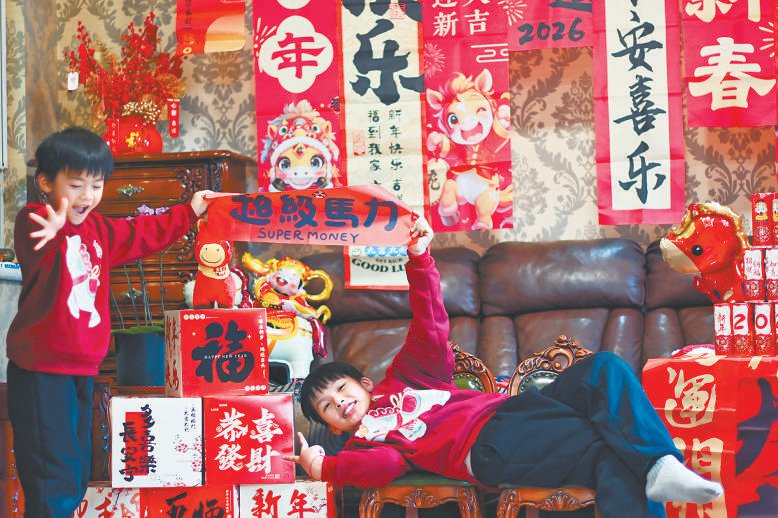
陪孩子找回消失的年味儿
Xin Lang Cai Jing· 2026-02-24 05:59
Core Viewpoint - The article highlights the importance of family traditions and creative activities in enhancing the experience of the Chinese New Year for children, emphasizing the transmission of cultural values and memories through engaging rituals and hands-on participation [1][5]. Group 1: Family Engagement in Traditions - Parents are actively creating a sense of "Nian Wei" (the flavor of the New Year) for their children through various engaging activities, such as making a "New Year calendar" to track traditional tasks [3][5]. - Children are involved in the preparation of traditional foods, which not only teaches them about cultural practices but also encourages them to try new foods, as seen with a child who began to enjoy tofu after making it himself [3][6]. - The process of making and decorating for the New Year, including creating props for photos, fosters a sense of accomplishment and family bonding [6][9]. Group 2: Creative Celebrations - Families are innovating traditional celebrations by incorporating creative games and performances, such as a "New Year theater" where children participate in role-playing based on popular stories [7][8]. - The introduction of games during the New Year festivities, like "ring toss" for gifts, enhances children's engagement and creates memorable experiences [9][10]. - Unique methods of giving "lucky money" are being developed, such as using games to distribute cash, which adds an element of fun and surprise for children [9][10].

年味,需要传承和营造
Xin Lang Cai Jing· 2026-02-20 23:49
Group 1 - The essence of the Spring Festival is changing, with many people feeling that the festive atmosphere has diminished compared to the past [2][3] - The traditional practices associated with the Spring Festival, such as preparing food and visiting relatives, are being replaced by more convenient options like online shopping and restaurant dining, leading to a loss of ritual significance [2][3] - Urbanization and modernization have altered the social dynamics, reducing the frequency of family gatherings and neighborhood interactions during the Spring Festival [3] Group 2 - The Spring Festival represents a unique cultural connection to one's hometown and emphasizes the importance of spending quality time with family and friends [3][4] - There is a call for individuals to actively participate in preserving the traditions of the Spring Festival by engaging in face-to-face interactions and shared experiences [3][4] - The celebration of the Spring Festival is evolving, with new ways to enjoy the festivities, such as participating in local cultural events and performances [4][5]
图解数据|今年过年,你“晒春节”了吗?
Xin Lang Cai Jing· 2026-02-19 13:47
Core Insights - The article highlights the increasing trend among young people in China to share their Spring Festival experiences on social media, with 54.2% of respondents participating in this activity [1][4]. Group 1: Celebration Methods - 60.4% of respondents expressed a desire to showcase their New Year's Eve dinner [4]. - 65.4% celebrated the festival by gathering with family for a New Year's Eve dinner [6]. - Traditional activities such as making dumplings or rice cakes were performed by 54.4% of respondents [7]. Group 2: Demographics of Respondents - The survey included 44.2% male and 55.8% female respondents [1]. - The age distribution shows that 18.8% are from the post-2000 generation, 18.4% from the post-1995 generation, and 29.6% from the post-1990 generation [1]. - Respondents from first-tier cities accounted for 33.4%, while second-tier cities made up 34.7% [1]. Group 3: Reasons for Sharing - 59.7% of respondents believe sharing enhances the festive atmosphere and visibility of the New Year spirit [6]. - 55.9% indicated that sharing creates beautiful "digital memories" for families [6]. - 53.2% view sharing as a way to report safety and joy to friends and family, serving as a form of "online reunion" [6].

过年没有仪式感的家庭,养不出幸福的孩子,这7件小事过年一定要带孩子做
Jing Ji Guan Cha Bao· 2026-02-15 01:49
Core Idea - The article emphasizes the importance of ritual and tradition during the Spring Festival for children, suggesting that these practices foster a sense of belonging, family connection, and happiness in their lives [1]. Group 1: Importance of Rituals - The Spring Festival rituals help children establish a stable psychological connection, allowing them to understand their identity and origins [2]. - Traditional activities like pasting couplets and ancestral worship serve as carriers of cultural heritage and family bonds, enabling children to feel the strength of their family and remember their roots [3]. Group 2: Family Interaction - The Spring Festival is an ideal time for family gatherings, which can strengthen familial ties that are often neglected during busy times [4]. - Research indicates that frequent and high-quality family interactions can help children feel loved and valued, fostering empathy and gratitude [5]. Group 3: Creating Anticipation and Happiness - Children's happiness can stem from simple things like anticipation, red envelopes, and dedicated time with family [6]. - The "expectation effect" in psychology suggests that clear expectations can lead to positive emotions and a sense of happiness [7]. - Anticipating various Spring Festival activities can instill a lasting sense of joy and positivity in children [8]. Group 4: Suggested Activities - Involving children in preparing for the festival, such as shopping for goods, can help them feel the excitement of the upcoming celebration and learn about making choices [10][11]. - Engaging in traditional cleaning rituals together can instill a sense of responsibility and warmth within the family [12][13]. - Cooking the New Year's Eve dinner as a family emphasizes togetherness and allows children to learn the significance of each dish [14][15]. - Crafting decorations like couplets and lanterns together can create cherished memories and pass on cultural traditions [16][18]. - Planning a family outing during the festival can enhance the experience of cultural customs and strengthen parent-child relationships [19]. - Taking a family photo each year serves as a meaningful ritual that captures the essence of togetherness [20][22]. - Discussing the use of red envelope money with children can teach them about financial responsibility and the value of blessings from elders [23][24]. Conclusion - The article encourages families to engage in these seven activities during the Spring Festival to revive the festive spirit and ensure that children experience warmth and happiness [25].
京东年货消费观察:AI玩具、家政服务、宠物年服跻身“新年货” ,情绪价值成为年货新要素
Sou Hu Cai Jing· 2026-02-06 01:22
Core Insights - The Chinese New Year shopping season has officially begun, with a significant increase in consumer interest and spending on traditional goods and gifts, as evidenced by a fourfold increase in related search volume on JD.com since the launch of the New Year shopping festival on January 25 [10][3]. Consumer Behavior - Consumers exhibit strong planning and high engagement in their New Year shopping, with 68.8% starting their purchasing plans more than two weeks in advance, and 82.6% creating shopping lists before buying [3][10]. - The shopping process is characterized by a clear rhythm, with 79.4% of consumers purchasing different types of goods in stages, prioritizing high-value items and gifts first [4][13]. New Year Goods Trends - New types of goods are emerging, including "good fortune" items and tech products, with 58.8% of consumers favoring good fortune decorations and 58.2% opting for trendy food items [5][18]. - The demand for pet-related products is rising, with 45.7% of consumers purchasing New Year outfits for their pets, indicating that pets are becoming part of the New Year celebrations [19][24]. Cultural Significance - The cultural significance of the New Year is reflected in consumer preferences, with 84.5% showing interest in zodiac-themed goods, particularly those related to the Year of the Horse [20][22]. - Traditional customs remain vital, with 55.3% of consumers identifying the period around the Laba Festival as the start of the New Year atmosphere, emphasizing the importance of family gatherings and rituals [7][9]. Market Dynamics - The market for household appliances is experiencing a notable transformation, particularly in rural areas, with significant sales increases for smart home devices such as robotic vacuum cleaners and multi-functional cooking appliances [6][23]. - The trend towards online shopping continues, with 65.4% of consumers preferring online channels for their New Year purchases, highlighting the importance of logistics and product authenticity [15][19].