智慧航空物流

Search documents
从“秒筛”到“监护”航空物流装上智慧“加速器”
Yang Shi Wang· 2025-12-24 00:10
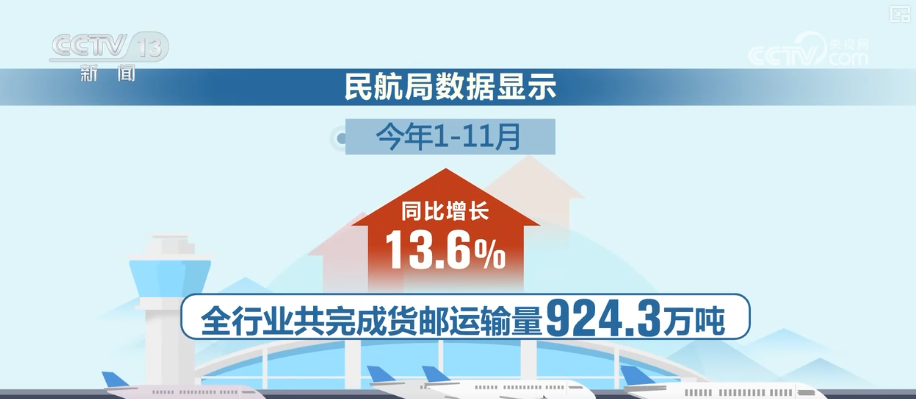
Core Insights - The overall situation of air cargo in China has been improving since 2025, with business scale expanding and international air cargo becoming the main driver for growth [2] Group 1: Air Cargo Growth - In the first 11 months of 2025, the total cargo and mail transport volume reached 924.3 thousand tons, a year-on-year increase of 13.6% [2] - Domestic routes accounted for 525.4 thousand tons, growing by 8.1%, while international routes saw a significant increase of 21.8%, totaling 398.8 thousand tons [2] - The number of cargo flights has been increasing, with an average of 1,767 flights per week, up 15.7% from 2024 [3] Group 2: Technological Advancements - New technologies are enhancing air logistics efficiency and safety, with innovations like the "large cargo weak magnetic material rapid screening system" improving inspection times to about 20 seconds [4][5] - This technology allows for the screening of entire pallets of cross-border e-commerce goods, significantly increasing efficiency compared to traditional methods [6][7] - The introduction of temperature monitoring solutions for perishable goods is addressing critical issues in cold chain logistics, ensuring the quality of high-value products during transport [8][9] Group 3: Multi-Modal Transportation - The "air-sea-land" multi-modal transport service is addressing diverse market demands, allowing for efficient logistics solutions that combine speed, cost, and flexibility [10] - The "truck flight" model enables rapid ground transport of goods, with a reported 95% year-on-year increase in cargo transport volume to Ningbo Airport [15][16] - By the end of November, 44 "truck flight" routes had been established across Zhejiang Province, connecting 26 cities, enhancing the logistics network [16][17]
航空货运有“量”有“质”又有“智” 从“秒筛”到“监护”航空物流装上智慧“加速器”
Yang Shi Wang· 2025-12-21 09:03
Core Insights - The overall situation of air cargo transport in China has been improving since 2025, with a significant increase in business scale and international air cargo routes being the main driver of growth [1][3] Group 1: Air Cargo Volume and Growth - In the first 11 months of 2025, the total cargo and mail transport volume reached 9.243 million tons, a year-on-year increase of 13.6% [1] - Domestic routes accounted for 5.254 million tons, growing by 8.1%, while international routes saw a larger increase of 21.8%, totaling 3.988 million tons [1] Group 2: Flight Operations and Capacity - The number of cargo flights has been steadily increasing, with an average of 1,767 flights per week, up by 15.7% compared to 2024 [3] - By the end of November, there were 13 all-cargo airlines in the country, with a fleet of 288 cargo aircraft, an increase of 20 aircraft from the end of 2024 [3] Group 3: Technological Innovations in Air Cargo - New technologies are enhancing air logistics efficiency and safety, with innovations like the "large cargo weak magnetic material rapid screening system" improving inspection processes [4][7] - This technology allows for the rapid screening of entire containers of cross-border e-commerce goods, significantly increasing efficiency compared to traditional methods [9] Group 4: Cold Chain Logistics - The air logistics sector has seen significant growth in fresh produce logistics, with innovations like temperature control labels addressing industry pain points [9][12] - The "Dongdong Measurement" system provides real-time monitoring of cargo temperature, enhancing transparency in the logistics process [12] Group 5: Multi-Modal Transport Solutions - The "air-sea-land" service model is being developed to meet diverse market demands, allowing for efficient transport of high-value products [16] - The "virtual flight" concept, where trucks act as "flight" segments for ground transport, offers flexibility and speed in logistics operations [19] Group 6: Case Study of Fresh Produce Transport - A cargo flight carrying 13 tons of blue crabs demonstrates the efficiency of the logistics process, with rapid unloading and distribution to local markets [20] - The logistics operations prioritize high-value products, such as electronics and fresh goods, which require higher safety and timeliness standards [22]