智能体记忆

Search documents
高效智能体的「幕后推手」是谁?一篇综述带你从记忆×工具学习×规划看透
机器之心· 2026-01-27 06:00
Core Insights - The article emphasizes the shift in focus within the industry from "can the model do it" to "can the agent be deployed" as large model capabilities advance [2] - It highlights the importance of efficiency in deploying intelligent agents, as high performance at a high cost is not sustainable for large-scale production [2] Group 1: Memory of Intelligent Agents - Efficient memory systems are crucial for intelligent agents to handle long tasks without overwhelming token usage and degrading performance [6] - The paper outlines a three-step memory lifecycle: construction, management, and access, focusing on transforming long dialogues into usable memory while balancing cost and fidelity [7] - The trend of multi-agent memory is emerging, categorized into shared memory, local memory, and hybrid memory [8] Group 2: Tool Learning - Tools enable agents to transition from "speaking" to "doing," but costs can escalate quickly in the toolchain [9] - The paper identifies three main strategies for improving efficiency: tool selection, tool invocation, and tool fusion reasoning [11] Group 3: Planning of Intelligent Agents - Planning determines how agents act in multi-step decision spaces, with efficiency issues arising from either single-agent reasoning or multi-agent collaboration [15] - The paper discusses memory management strategies to prevent "memory explosion" and ensure efficient retrieval [12] - It emphasizes the need for effective tool selection and invocation to minimize delays and unnecessary calls [13] Group 4: Benchmarking and Evaluation - Establishing a clear benchmark for efficiency is essential, as efficiency must be built on effectiveness [16] - The paper reviews existing benchmarks that incorporate efficiency signals and summarizes common efficiency metrics used in agent methodologies [17] Group 5: Challenges and Future Directions - The paper outlines several challenges, including the need for a unified evaluation framework and the exploration of latent reasoning in intelligent agents [19] - It highlights the importance of considering deployment costs in multi-agent scenarios and the need for efficiency research in multi-modal agents [20] - Strategies for single-agent efficiency focus on adaptive budgeting and structured search, while multi-agent strategies aim to reduce communication costs without losing information [21]


AI智能体时代中的记忆:形式、功能与动态综述
Xin Lang Cai Jing· 2025-12-17 04:42
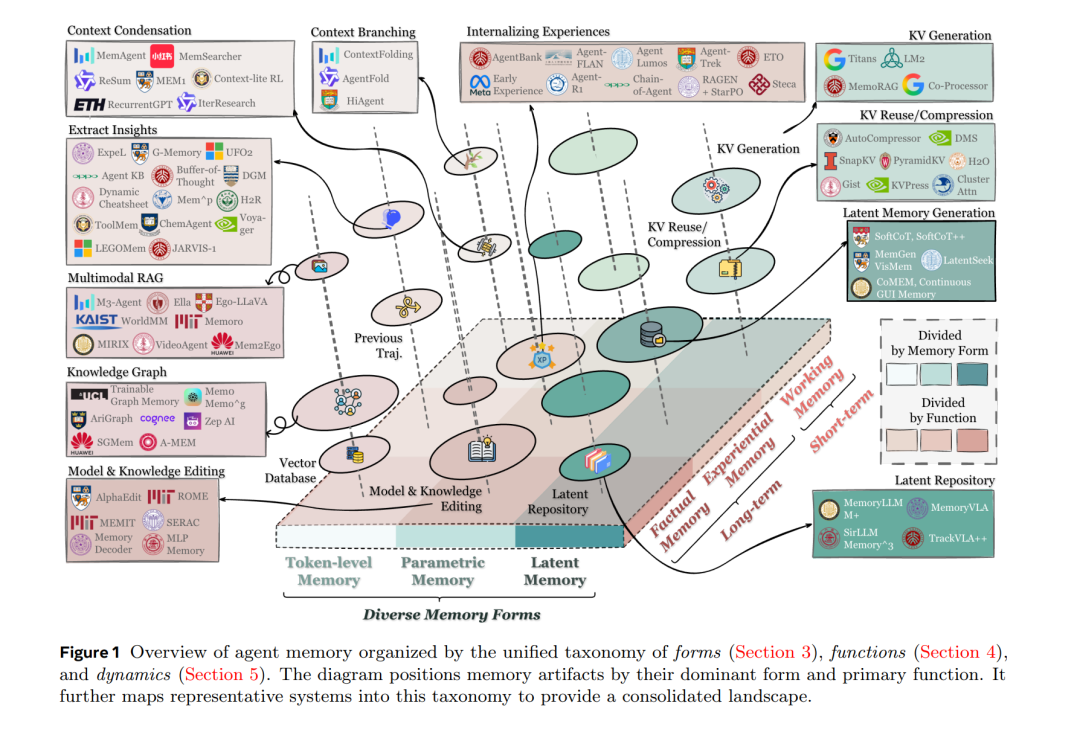
Core Insights - Memory is identified as a core capability for agents based on foundational models, facilitating long-term reasoning, continuous adaptation, and effective interaction with complex environments [1][11][15] - The field of agent memory research is rapidly expanding but is becoming increasingly fragmented, with significant differences in motivation, implementation, assumptions, and evaluation schemes [1][11][16] - Traditional classifications of memory, such as long-term and short-term memory, are insufficient to capture the diversity and dynamics of contemporary agent memory systems [1][11][16] Summary by Sections Introduction - Over the past two years, powerful large language models (LLMs) have evolved into robust AI agents, achieving significant progress across various fields such as deep research, software engineering, and scientific discovery [4][14] - There is a growing consensus in academia that agents require capabilities beyond just LLMs, including reasoning, planning, perception, memory, and tool usage [4][14][15] Importance of Memory - Memory is crucial for transforming static LLMs into adaptive agents capable of continuous adaptation through environmental interaction [5][15] - Various applications, including personalized chatbots, recommendation systems, social simulations, and financial investigations, depend on agents' ability to manage historical information actively [5][15] Need for New Classification - The increasing importance of agent memory systems necessitates a new perspective on contemporary agent memory research [6][16] - Existing classification systems are outdated and do not reflect the breadth and complexity of current research, highlighting the need for a coherent classification that unifies emerging concepts [6][16] Framework and Key Questions - The review aims to establish a systematic framework to reconcile existing definitions and connect emerging trends in agent memory [19] - Key questions addressed include the definition of agent memory, its relationship with related concepts, its forms, functions, and dynamics, as well as emerging research frontiers [19] Emerging Research Directions - The review identifies several promising research directions, including automated memory design, integration of reinforcement learning with memory systems, multimodal memory, shared memory in multi-agent systems, and issues of trustworthiness [20][12] Contributions of the Review - The review proposes a multidimensional classification of agent memory from a "form-function-dynamics" perspective, providing a structured view of current developments in the field [20] - It explores the applicability and interaction of different memory forms and functions, offering insights on aligning various memory types with different agent objectives [20] - A comprehensive resource collection, including benchmark tests and open-source frameworks, is compiled to support further exploration of agent memory systems [20]
4万星开源项目被指造假,MemGPT作者开撕Mem0:为营销随便造数据,净搞没有意义的测试
3 6 Ke· 2025-08-15 09:31
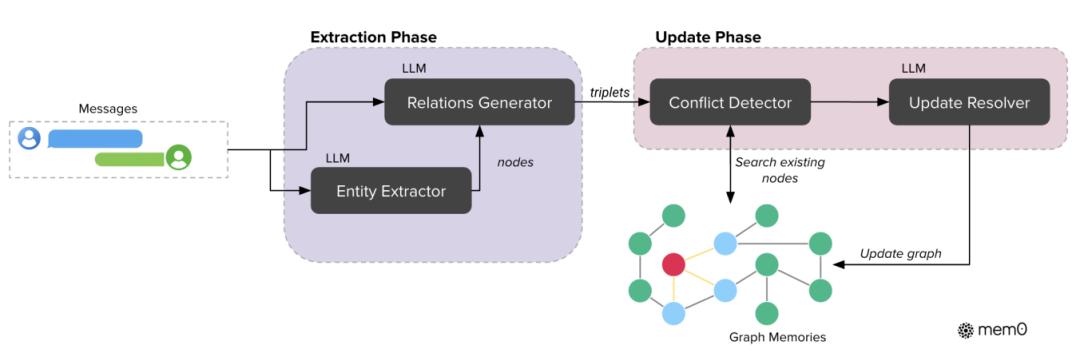
Core Insights - The article discusses the controversy surrounding the performance claims of two AI memory frameworks, Mem0 and MemGPT, particularly in relation to the LoCoMo benchmark, highlighting discrepancies in their reported results and methodologies [1][18][22] Group 1: Mem0 and MemGPT Overview - Mem0 claims to have achieved a 26% improvement over OpenAI in the "LLM-as-a-Judge" metric on the LoCoMo benchmark [1] - MemGPT, developed by Letta AI, utilizes a memory management system inspired by traditional operating systems to enhance AI agents' long-term memory capabilities [4][6] - Both frameworks aim to address the limitations of large models regarding fixed context lengths and memory retention [3][4] Group 2: Controversy and Claims - Letta AI's CTO publicly questioned the validity of Mem0's benchmark results, stating that the testing methodology was unclear and potentially flawed [1][18] - Letta achieved a 74.0% accuracy on the LoCoMo benchmark using a simple file system approach, outperforming Mem0's reported best score of 68.5% [18][19] - The article emphasizes that the effectiveness of memory tools is more dependent on how well AI agents manage context rather than the specific retrieval mechanisms used [19][20] Group 3: Industry Context and Implications - The rise of Mem0 and MemGPT reflects a growing focus on enhancing AI agents' memory capabilities, which is critical for complex tasks and long-term learning [3][4] - The controversy highlights the challenges in evaluating AI memory systems, suggesting that traditional benchmarks may not adequately capture the true memory capabilities of AI agents [22][23] - Letta proposes new benchmarking methods that assess memory management in dynamic contexts, moving beyond simple retrieval tasks [22][23]