智能化与AI融合

Search documents
2025年中国计算机网络设备制造行业技术发展分析 专利公开数量大幅增加【组图】
Qian Zhan Wang· 2026-02-04 12:41
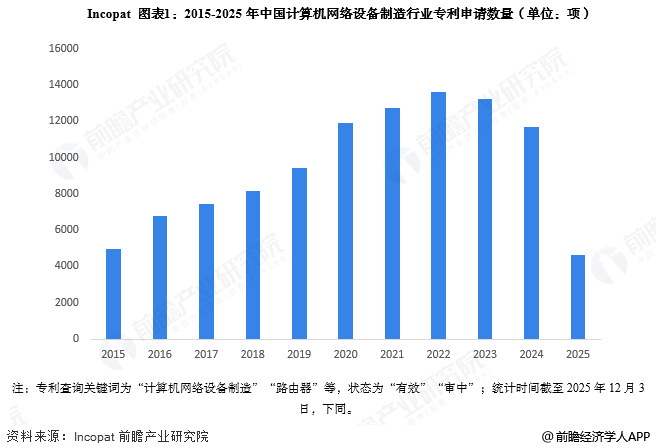
Core Insights - The Chinese computer network equipment manufacturing industry is experiencing a significant increase in patent applications and publications, indicating a robust growth trajectory in innovation and technology development [1][3]. Patent Applications - The number of patent applications in the Chinese computer network equipment manufacturing sector has been on the rise, reaching a peak of 13,596 applications in 2022, with a projected total of 4,654 applications by December 2025 [1]. - Huawei Technologies Co., Ltd. leads in patent applications with a total of 4,121, followed by State Grid Corporation with 1,258 applications [6]. Patent Publications - The number of patent publications in the industry is also growing rapidly, with an expected total of 16,244 publications in 2024 and 12,967 by December 2025 [3]. Key Technologies - The focus of patent applications is heavily on H04L (digital information transmission) with 54,874 applications, followed by H04W (wireless communication networks) with 16,936 applications [8]. Development Directions - The main development directions in the industry include: - High-speed and low-latency technologies driven by advancements in 5G-A and 6G, aiming for higher transmission rates and lower latency [11]. - Integration of artificial intelligence in network devices for smart traffic management and operational efficiency [11]. - Adoption of green energy technologies to meet carbon neutrality goals, including liquid cooling and modular designs [11]. - Focus on domestic production of core components to enhance supply chain security and reduce reliance on imports [11].

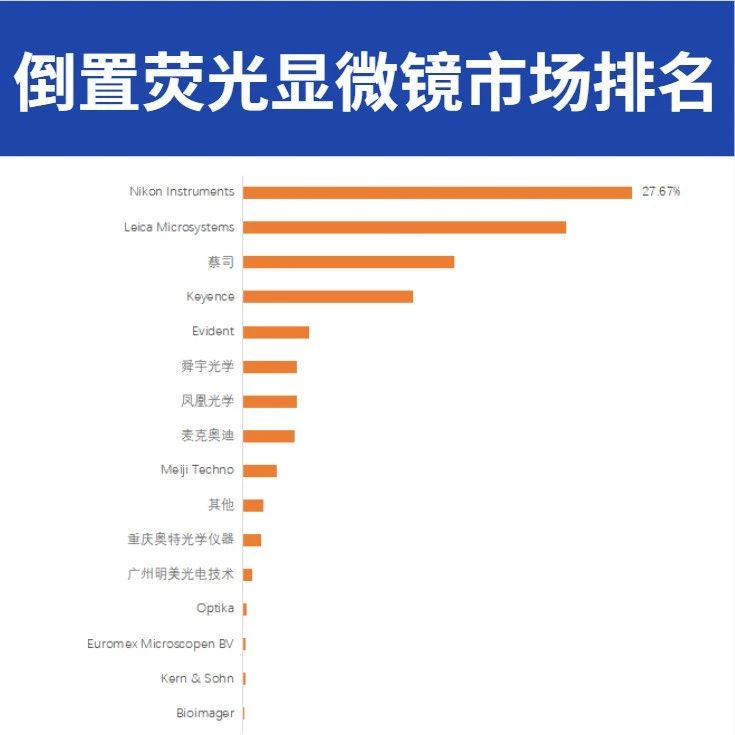
全球倒置荧光显微镜市场前15强生产商排名及市场占有率
QYResearch· 2025-07-08 10:07
Core Viewpoint - The inverted fluorescence microscope market is projected to reach $505 million by 2030, with a compound annual growth rate (CAGR) of 6.54% in the coming years [1]. Market Overview - The global market for inverted fluorescence microscopes is expected to show steady growth, with sales reaching $319 million in 2024 and projected to hit $491 million by 2031, reflecting a CAGR of 6.05% from 2025 to 2031 [14]. - The primary demand for these microscopes is driven by advancements in life sciences, industrial inspection upgrades, and the promotion of STEM education [14]. Key Manufacturers - Major manufacturers in the global inverted fluorescence microscope market include Leica Microsystems, Nikon Instruments, Zeiss, Keyence, and Evident, with the top five companies holding approximately 82.39% of the market share [5]. Product Type Segmentation - The three-microscope type currently dominates the market, accounting for about 77% of the total market share [8]. Application Segmentation - Hospitals represent the largest downstream market for inverted fluorescence microscopes, capturing approximately 44.09% of the market share [10]. Technological Advancements - The integration of AI and automation in devices has significantly improved research efficiency and data accuracy, with features like automatic focusing and image recognition [15]. - High-resolution imaging and multi-modal integration technologies are enhancing imaging quality, particularly in tumor diagnosis [16]. Industry Challenges - Rapid technological iteration poses a significant challenge, with international giants maintaining high barriers to entry through advanced technologies [18]. - Domestic companies face difficulties in high-end optical components, relying heavily on imports from German and Japanese firms [18]. Opportunities for Growth - Chinese government policies are favoring high-end equipment development, with a special fund of 5 billion yuan allocated for research [20]. - Increased international research funding is expected to drive demand for high-end equipment, particularly in North America and Europe [20]. - Emerging fields such as materials science, environmental monitoring, and pharmaceuticals are identified as new growth points [22].