智能化技术融合

Search documents
行业聚焦:全球航空级铝材行业头部企业排名情况(附TOP3 厂商介绍)
QYResearch· 2025-11-11 02:10
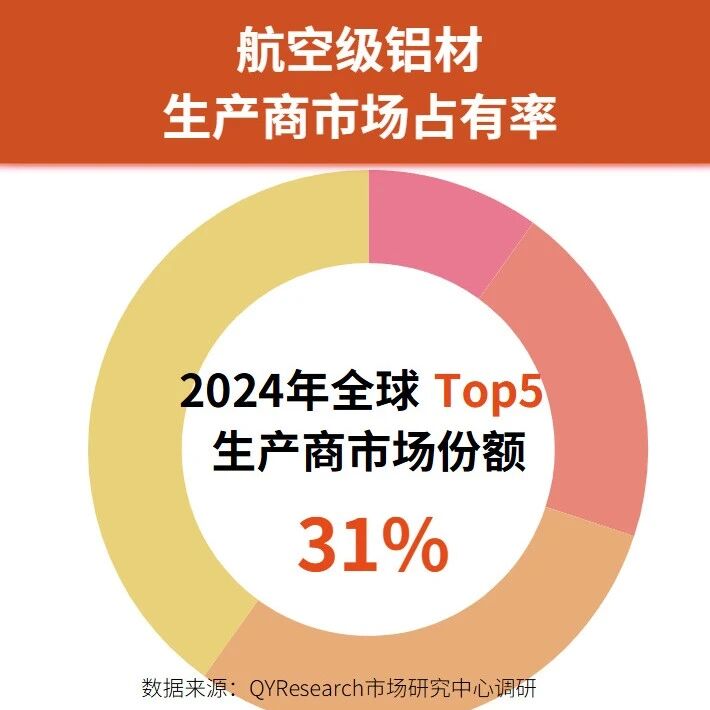
Core Viewpoint - The aviation-grade aluminum market is projected to grow significantly, with a compound annual growth rate (CAGR) of 7.30% expected to reach a market size of $20.6 billion by 2031, driven by increasing demand in aerospace applications and advancements in material technology [3][16]. Global Market Overview - By 2024, global production capacity for aviation-grade aluminum is estimated to be approximately 5.5 million tons, with an output of around 3.6 million tons and an average market price of $3,500 per ton, resulting in an industry gross margin of about 32% [3][11]. - The top five manufacturers are expected to hold around 31% of the market share in 2024 [6]. Key Manufacturers - Major players in the aviation-grade aluminum market include Constellium, Rio Tinto, UC Rusal, Kaiser Aluminum, and Alcoa, among others [5][6]. - Constellium's Airware® series aluminum-lithium alloys can reduce aircraft structure weight by up to 25%, showcasing its commitment to high-performance materials [7]. - Rio Tinto's AIRWARE™ aerospace aluminum alloy series is designed to meet the stringent requirements of the aerospace industry [9]. - UC Rusal focuses on environmentally friendly aluminum production, with over 90% of its energy sourced from renewable resources [10]. Industry Chain Analysis - The upstream segment involves the extraction of bauxite and the production of alumina, which are essential for high-performance aluminum materials [11]. - The midstream segment is responsible for the precise processing of aluminum ingots and alloy elements through various manufacturing techniques to produce semi-finished products [12][13]. - The downstream segment primarily serves the aerospace manufacturing sector, where certified high-performance aluminum is used in critical aircraft components [14]. Industry Development Trends - The industry is moving towards lightweight and high-strength materials, driven by energy-saving and emission-reduction initiatives [16]. - Innovations in environmentally friendly technologies are pushing the industry towards green manufacturing practices [16]. - The integration of smart technologies, such as big data and AI, is optimizing production processes and improving product quality [16]. - The application of aviation-grade aluminum is expanding into new markets, including electric vertical takeoff and landing (eVTOL) aircraft and green buildings [16]. Growth Opportunities - The demand for aviation-grade aluminum is expected to rise due to the commercialization of large aircraft and ongoing military aviation projects [17][18]. - The growth of the low-altitude economy and general aviation is providing new market opportunities for high-performance aluminum materials [18]. Barriers to Entry - The industry faces challenges such as reliance on imported high-end products and long certification cycles that increase market entry costs [19]. - Fluctuations in raw material prices can significantly impact production costs and profit margins [19]. - International trade barriers and protectionist policies pose additional challenges for manufacturers [19]. Industry Barriers - High technical requirements in alloy design and processing create significant entry barriers for new players [20]. - The capital-intensive nature of the industry necessitates substantial investment in equipment and R&D [20]. - Strict certification processes for aviation-grade materials further complicate market entry for new companies [20]. - Established brands enjoy strong customer loyalty, making it difficult for newcomers to gain market share [20].

2025年中国瑜伽用品行业发展背景、产业链、市场规模、重点品牌及未来前景展望:居民健康意识显著提升,带动瑜伽用品规模增长至285亿元[图]
Chan Ye Xin Xi Wang· 2025-10-21 01:23
Core Insights - The yoga products market in China is experiencing significant growth, driven by increased health awareness and consumer demand for high-quality products. The market size is projected to grow from 82 billion yuan in 2016 to 248 billion yuan by 2024, with a compound annual growth rate (CAGR) of 14.84% [1][9][10] - The industry is evolving towards product diversification and quality enhancement, with a focus on design aesthetics, technological integration, and user experience [1][9][10] - Future growth is expected to be supported by innovations in smart technology, material experiences, and personalized customization, with the market size anticipated to reach 285 billion yuan by 2025 [1][9][10] Industry Overview - Yoga products are designed to enhance the comfort, safety, and effectiveness of yoga practice, including items like yoga mats, clothing, bricks, straps, balls, wheels, and blankets [3][9] - The rise of yoga as a popular low-intensity, high-flexibility exercise has led to a booming market for yoga products in China [1][9] Market Dynamics - The Chinese yoga industry market size is projected to grow from 198 billion yuan in 2016 to 600 billion yuan by 2024, with a CAGR of 14.86% [5][6] - The expanding consumer base and the increasing demand for specialized and diversified products are driving steady growth in product demand [6] Industry Chain - The yoga products industry chain consists of upstream raw materials (synthetic and natural fibers), midstream manufacturing, and downstream sales channels (supermarkets, specialty stores, e-commerce) [6][9] Key Product Segments - The yoga mat market is particularly thriving, with its size expected to grow from 35 billion yuan in 2020 to 62.5 billion yuan by 2024, reflecting a CAGR of 15.6% [11] Competitive Landscape - The market is highly competitive, with both international brands (e.g., Lululemon, Manduka) and domestic brands (e.g., Keep, Decathlon) vying for market share [12][15] - Domestic brands leverage price advantages and localized strategies to capture market segments [15] Future Trends - The future of yoga products will focus on deep integration of smart technology, enhancing user experience through real-time feedback and personalized training [15][16] - Innovations in materials will prioritize functionality, sustainability, and user comfort, with a shift towards eco-friendly and adaptive materials [16] - There will be a trend towards personalized customization, allowing consumers to tailor products to their specific needs and preferences [17]