
智能手机市场销量

Search documents
1月中国智能手机销量排名:华为/苹果/OPPO前三
Ju Chao Zi Xun· 2026-02-13 08:10
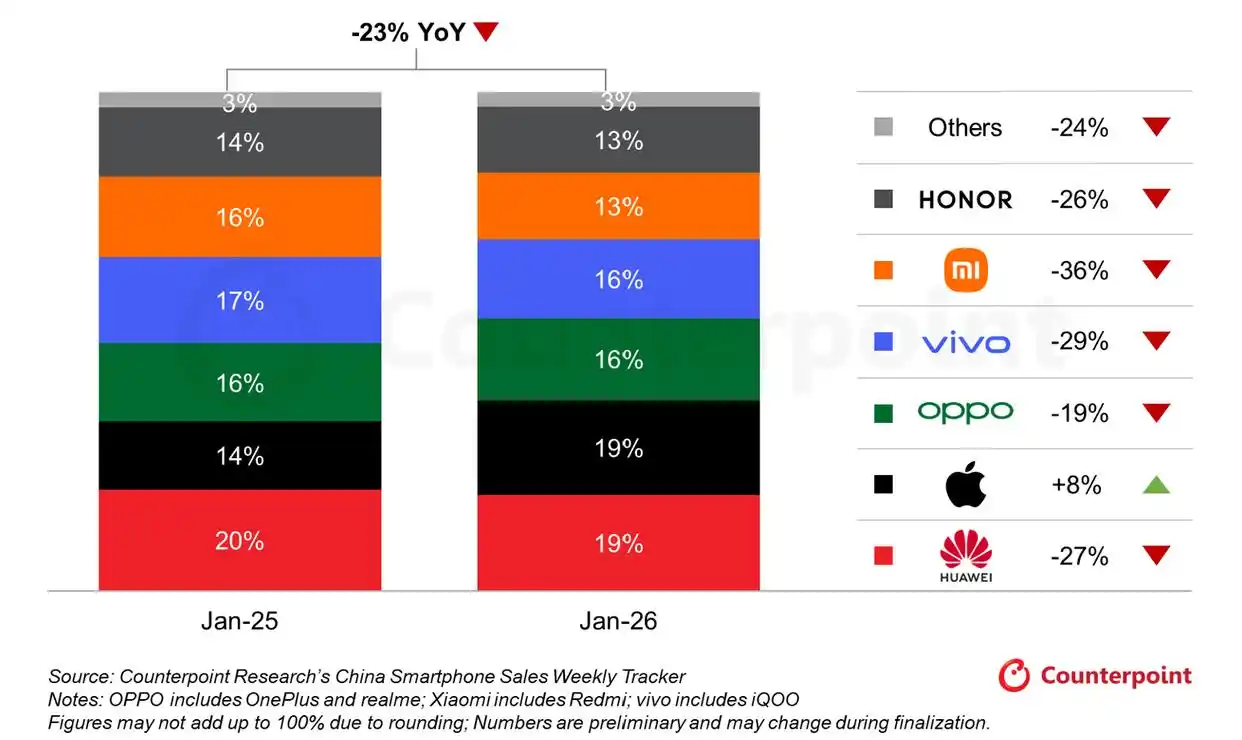
Core Insights - The overall smartphone market in China is projected to decline by 23% year-on-year in January 2026, primarily due to the high base effect from subsidy policies in early 2025, reduced subsidy intensity in 2026, and the impact of the Lunar New Year on consumer spending [1][3] Group 1: Market Performance - Huawei leads the market with a 19% share but faces a 27% year-on-year decline in sales, influenced by high base effects and underperformance of the Nova series [1] - Apple is the only major brand to achieve growth, with an 8% increase in sales and market share reaching its highest level in nearly five years, driven by the popularity of the iPhone 17 series [3] - Other domestic brands experienced significant declines: Xiaomi (including Redmi) down 36%, vivo (including iQOO) down 29%, OPPO (including OnePlus and realme) down 19%, and Honor down 26% [3] Group 2: Market Dynamics - The decline in sales for many brands is attributed to the "overdraft effect" of the subsidy policy from early 2025, which pulled forward demand due to the timing of the Lunar New Year promotions [3] - Despite the January market slump, there is an optimistic forecast for February, as seasonal consumption during the Lunar New Year is expected to boost sales, providing a critical window for inventory clearance and performance improvement for manufacturers [3]


未知机构:Counterpoint数据显示2026年1月中国智能手机销量同比-20260213
未知机构· 2026-02-13 02:00
Summary of Key Points Industry Overview - The smartphone industry in China experienced a significant decline in sales, with a year-on-year decrease of 23% in January 2026, primarily due to the high base effect from last year's subsidies and the impact of the Lunar New Year timing [1][2] - Overall market demand remains weak, but an improvement in sales is expected in February due to seasonal purchasing during the Lunar New Year [1] Company Performance - **Huawei**: Despite a 27% decline in sales, Huawei maintained a leading market share of 19%, attributed to aggressive trade-in offers and subsidies [1] - **Apple**: Apple was the only major brand to achieve growth, with an 8% increase in sales, driven by the strong performance of the iPhone 17, which qualified for government subsidies. Its market share rose to a five-year high of 19% in January [2] - **OPPO**: Experienced a 19% decline in sales, holding a market share of 16% [2] - **Vivo**: Saw a significant decline of 29% in sales, with a market share of 16% [2] - **Xiaomi**: Faced a 36% drop in sales, resulting in a market share of 13% [2] - **Honor**: Reported a 26% decline in sales, with a market share of 13% [2] - **Other Brands**: Combined, other brands experienced a 24% decline, holding a market share of 13% [2] Market Share Comparison - January 2026 market shares: - Huawei: 19% - Apple: 19% - OPPO: 16% - Vivo: 16% - Xiaomi: 13% - Honor: 13% - Other brands: 13% [2] - January 2025 market shares for comparison: - Huawei: 20% - Apple: 14% - OPPO: 16% - Vivo: 17% - Xiaomi: 16% - Honor: 14% - Other brands: 3% [1] Additional Insights - The data indicates a challenging environment for most smartphone brands, with only Apple showing resilience and growth amidst a declining market [1][2] - The aggressive strategies employed by Huawei, such as trade-in offers, highlight the competitive nature of the market and the importance of subsidies in driving sales [1]