智能手机BOM成本结构转变

Search documents
存储价格飙升引发智能手机BOM结构转变
Counterpoint Research· 2026-03-19 04:45
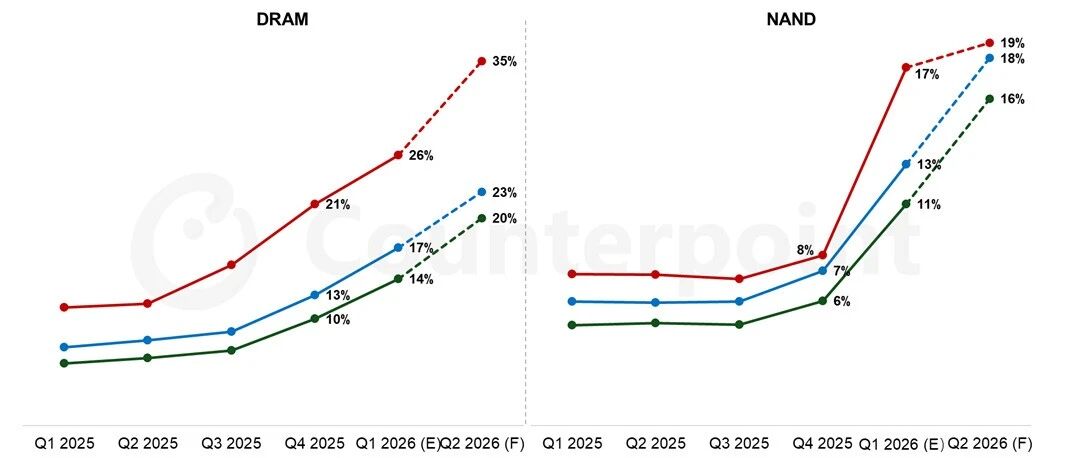
Core Insights - The article discusses the significant impact of rising memory prices on the cost structure of smartphone bill of materials (BOM) [4][5][9] - It highlights that by Q1 2026, DRAM prices are expected to increase by over 50% and NAND prices by over 90% [5] - The article emphasizes the challenges smartphone manufacturers will face in balancing costs, gross margins, and shipment targets due to these rising costs [7] Cost Structure Changes - In the low-end segment (wholesale price below $200), the BOM cost is projected to increase by 25% due to rising storage prices, with storage devices accounting for 43% of the total BOM [5] - For the mid-range segment (wholesale price between $400 and $600), the cost share of DRAM and NAND is expected to rise to 20% and 16% respectively by Q2 2026 [5] - In the flagship segment (wholesale price above $800), BOM costs are anticipated to increase by $100 to $150, with DRAM and NAND making up 23% and 18% of total costs by Q2 2026 [6] Manufacturer Strategies - To mitigate cost pressures, smartphone manufacturers are simplifying product lines and lowering shipment expectations for low-end models [7][9] - Manufacturers are also optimizing specifications by controlling hardware configurations and reducing non-core specifications to offset rising costs [7] - The article predicts that retail prices for smartphones will inevitably rise, with low-end models increasing by approximately $30 and high-end flagship models by $150 to $200 [7]