
替身经济

Search documents
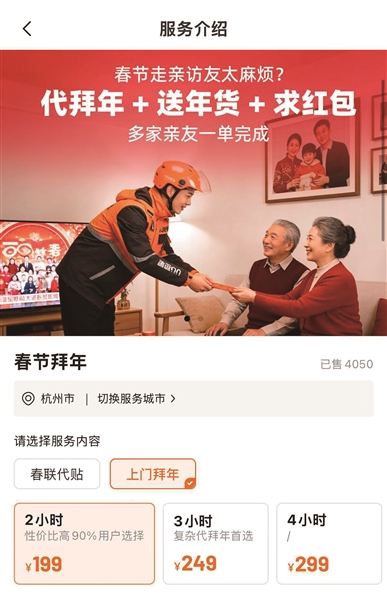
跑腿平台试水春节“替身经济”
Mei Ri Shang Bao· 2026-02-24 22:23
Group 1 - The core idea of the article revolves around the emergence of "substitute economy" during the Spring Festival, highlighted by UU Run's introduction of services like "home visit for New Year greetings" and "couplet posting" [2][3] - UU Run launched the "home visit for New Year greetings" service on February 9, with initial offerings including "buying and delivering gifts," "asking for red envelopes," and "performing three kowtows," with prices reaching up to 999 yuan for 2 hours [2] - After the removal of the kowtow service on February 11, the pricing was adjusted to 199 yuan for 2 hours, 249 yuan for 3 hours, and 299 yuan for 4 hours, with a maximum duration of 10 hours priced at 599 yuan [2] Group 2 - The demand for substitute services has been growing, with various offerings like "substitute matchmaking" and "substitute friend gatherings" gaining popularity during the holiday season [3][4] - A notable example includes a young woman seeking a substitute for a matchmaking event, highlighting the willingness of consumers to pay for such services, with prices ranging from 50 yuan to 200 yuan per hour for different types of substitute services [4] - The rise of substitute services reflects a broader trend in consumer behavior, where individuals seek to alleviate social pressures and efficiently manage their personal affairs, indicating a diversification in consumption patterns [5]

基层培训“鸡同鸭讲” 成长之旅为何变成“打卡任务”
Zhong Guo Qing Nian Bao· 2025-11-28 00:55
Core Insights - The article highlights the emergence of a "substitute economy" in professional training, where participants hire substitutes to attend training sessions on their behalf, undermining the intended purpose of these educational programs [1][2][3] Group 1: Training Practices and Issues - Many professionals, especially in government and enterprises, are required to participate in continuing education, but the training often fails to meet actual needs, leading to a disconnect between content and practical application [2][3] - Training sessions are frequently conducted in a "crash course" manner at the end of the year, conflicting with critical work periods, driven by budget management practices that penalize unspent funds [3] - The lack of genuine engagement in training is evident, with many attendees distracted by their phones or not participating actively, indicating a need for better content and delivery methods [2][3] Group 2: Comparison with Other Training Models - In contrast to professional training, non-academic extracurricular training for students is more effective because it is self-selected, personally funded, and focused on core developmental needs, leading to higher quality and effectiveness [3][4] - The article suggests that valuable training should not rely on attendance tracking or formal titles but should instead foster a genuine desire for personal growth and development [4]