最低限度豁免政策

Search documents
美国终结“最低限度豁免”政策,全球800美元以下包裹将全面征税
Sou Hu Cai Jing· 2025-08-07 03:24
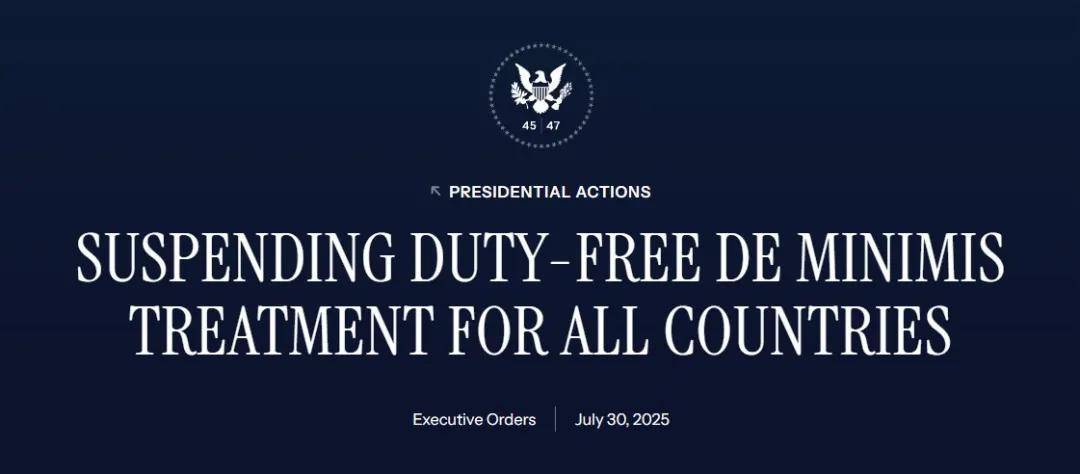
Policy Changes - The U.S. government has announced a suspension of the "de minimis" policy, effective August 29, which previously allowed commercial packages valued under $800 to enter the U.S. tax-free, now requiring full tariffs to be paid [1] - The new regulation applies globally, expanding beyond the previous focus on China and Hong Kong, and introduces two taxation options for packages: either a tax based on the country of origin or a transitional specific duty of $80-$200 per item within six months [2] - The implementation timeline has been accelerated by two years due to a declared "national emergency," despite Congress previously setting a 2027 deadline for the repeal of the exemption [2] Security and Trade Imbalance - The White House has framed this action as a response to a "catastrophic loophole," with data showing a dramatic increase in tax-free package volume from 134 million in 2015 to an estimated 1.36 billion in 2024, a tenfold increase [3] - A significant portion of drug seizures (97%) and intellectual property infringement items (98%) in 2024 are linked to tax-free packages, which are seen as a conduit for smuggling synthetic opioids like fentanyl [3] Impact on Sellers and Buyers - Chinese cross-border e-commerce platforms, such as Shein and Temu, are expected to be severely impacted, as the global policy will eliminate the ability to circumvent tariffs through third-country shipping [4] - The logistics industry will also face major changes, with air freight companies now responsible for collecting tariffs, leading to a projected decline in cross-border small package shipments [4] - U.S. consumers are likely to experience price increases of 10%-20% on previously tax-free goods, such as affordable clothing and electronics, along with longer shipping times [4] Divided Trade Opinions - Supporters, including the National Council of Textile Organizations (NCTO), view the policy as a "game changer" that addresses the issue of cheap Chinese textile imports undermining domestic manufacturing [5] - Conversely, there are concerns from U.S. consumers and small business owners about the financial burden of increased tariffs, with estimates suggesting an additional expenditure of $11 billion to $13 billion for American consumers, translating to an extra $34 to $41 per person [6]

取消800美元免税,TEMU、SHEIN等企业的中国直邮模式将受到怎样的冲击?
Sou Hu Cai Jing· 2025-04-07 14:57
Core Viewpoint - The new U.S. tariff policy will significantly impact e-commerce platforms and cross-border merchants that rely on direct shipping from China, as it eliminates the "de minimis" exemption for certain imported goods [3][4][6]. Group 1: Tariff Policy Changes - Starting May 2, imported goods from mainland China and Hong Kong will no longer qualify for the "de minimis" exemption, leading to the imposition of all applicable tariffs unless shipped via international postal networks [3][4]. - Goods entering through the postal system will face either a 30% tariff based on value or a fixed fee of $25 per item, with the fee increasing to $50 from June 1 [3][4]. - The U.S. government has already imposed a 20% tariff on Chinese goods and plans to increase tariffs to 34% on certain imports starting April 9 [4]. Group 2: Impact on E-commerce and Retail - The adjustment of the "de minimis" policy provides clarity for shippers who previously struggled with the fluctuating regulations related to small-value exemptions [4][5]. - E-commerce companies like SHEIN and TEMU, which have rapidly expanded in the U.S. market, have benefited from the "de minimis" policy, allowing them to maintain low shipping costs and a light inventory model [5][6]. - The number of packages entering the U.S. under the "de minimis" exemption reached 1.4 billion in FY 2024, nearly double that of 2022, with the total value of goods imported under this policy soaring from $5.3 billion in 2018 to $66 billion in 2023 [5][6]. Group 3: Market Dynamics and Consumer Impact - The cancellation of the "de minimis" exemption is expected to increase annual consumer spending in the U.S. by $11 billion to $13 billion, translating to an additional burden of $35 to $80 per person [7]. - Retailers like Amazon, which rely on U.S. warehouse distribution, may gain market share as competitors are affected by the new tariffs [7]. - The policy change may lead to a shift in the cross-border e-commerce supply chain, with Chinese companies potentially establishing local warehouses in the U.S. or utilizing alternative routes through countries that still enjoy the exemption [7][8].