月球地质演化

Search documents
嫦娥六号玄武岩为揭示月球地质演化提供关键线索
Ren Min Ri Bao· 2026-01-14 20:33
Core Insights - The research team from the Institute of Geology and Geophysics of the Chinese Academy of Sciences has conducted high-precision potassium isotope analysis on samples collected by the Chang'e 6 mission, revealing significant insights into the impact event of the South Pole-Aitken Basin and its effects on the Moon's evolution [1] Group 1 - The Chang'e 6 mission collected samples from the largest impact basin on the Moon, the South Pole-Aitken Basin, providing critical samples for studying the effects of this large-scale impact event [1] - The research team performed high-precision potassium isotope analysis on milligram-scale basalt single grains from the Chang'e 6 mission, finding that the basalt has higher potassium-41 and potassium-39 ratios compared to Apollo samples from the Moon's near side [1] - The study confirmed that the impact event altered the potassium isotope composition of the Moon's mantle, leading to potassium loss and elevated isotope ratios, which may have suppressed volcanic activity on the Moon's far side [1]
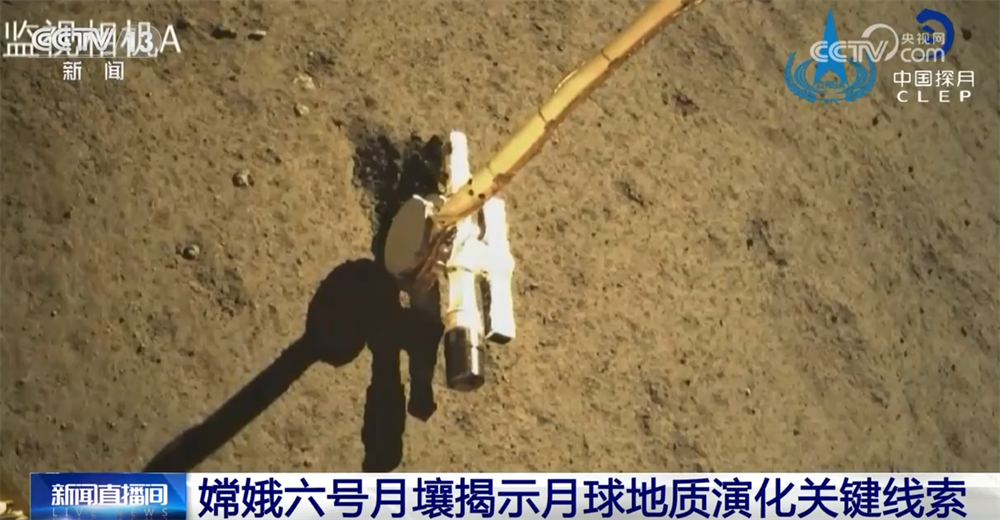
“探月”研究成果“上新”!嫦娥六号月壤揭示月球地质演化关键线索
Yang Shi Wang· 2026-01-13 09:41
Core Insights - The research team from the Chinese Academy of Sciences has revealed that a major impact event approximately 4.25 billion years ago in the South Pole-Aitken Basin caused the loss of certain volatile elements on the Moon, providing critical scientific clues for understanding the impact of large collisions on lunar evolution and explaining the geological differences between the Moon's near and far sides [1][6] Group 1 - The analysis of basalt samples collected by the Chang'e 6 mission indicates that the potassium isotope ratio, specifically potassium-41, is significantly higher in these samples compared to those from the Apollo missions on the Moon's near side [4] - High-precision isotopic analysis shows that the asteroid impact altered the potassium isotope composition in the Moon's deep mantle, with lighter potassium-39 isotopes being more volatile and lost during the high-temperature and high-pressure conditions of the impact [6] - The loss of volatile elements likely made the rocks more difficult to melt, thereby weakening magma formation and volcanic activity, which is crucial for understanding the asymmetric geological evolution history of the Moon's near and far sides [6]