月球氧化作用研究

Search documents
嫦娥六号月球样品中发现晶质赤铁矿和磁赤铁矿 揭示月球氧化新机制与磁异常成因
Yang Guang Wang· 2025-11-17 01:58
Core Insights - The research team from the National Space Administration, Shandong University, and the Chinese Academy of Sciences has made a significant breakthrough in lunar science by discovering micron-sized hematite and magnetite crystals, which reveal a new mechanism for lunar oxidation reactions [1][2] - This discovery provides empirical evidence for the impact causes surrounding the South Pole-Aitken Basin's magnetic anomalies, marking a major advancement in understanding lunar geological processes [1] Group 1 - The research identified trivalent iron ions in the lunar samples, indicating the presence of hematite and magnetite, which are crucial for studying lunar oxidation [1] - The findings suggest that the formation of hematite may be closely related to large impact events in the moon's history, challenging previous assumptions about the lunar environment [1][2] Group 2 - The results have been published in the international journal "Science Advances," providing a significant scientific basis for future lunar research and enhancing understanding of the moon's evolutionary history [2] - The discovery is expected to pave the way for more research on lunar oxidation processes, opening a new chapter in human understanding of the moon [2]
赤铁矿、磁赤铁矿,首次发现!我国科研团队在月球氧化作用研究取得重大突破
Yang Shi Wang· 2025-11-16 06:03
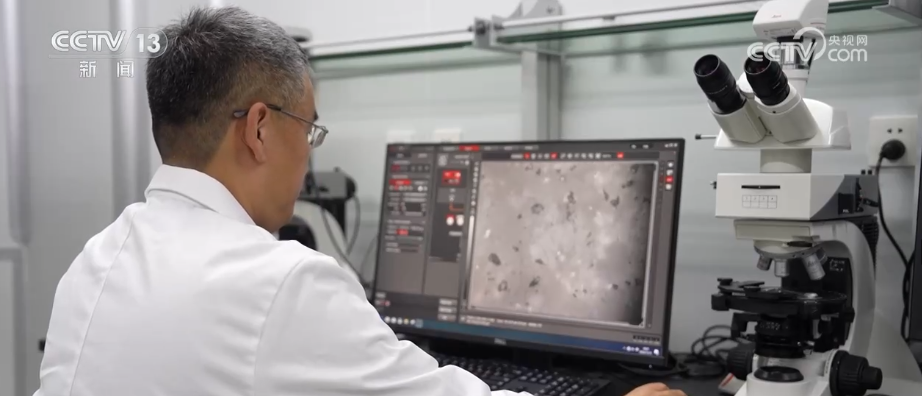
Core Insights - The research team has made a significant breakthrough in lunar science by discovering micrometer-scale hematite and maghemite crystals in lunar samples returned by the Chang'e-6 mission, revealing a new lunar oxidation mechanism [1][4][16] Group 1: Research Findings - The study was conducted by a collaborative team from Shandong University, the Chinese Academy of Sciences, and Yunnan University, analyzing 3000 milligrams of lunar samples [4] - The team identified the presence of trivalent iron ions in the form of hematite and maghemite, marking a major scientific advancement in understanding lunar oxidation processes [6][9] - The formation of hematite is closely linked to large impact events in the moon's history, suggesting that these impacts may have contributed to the magnetic anomalies observed in the South Pole-Aitken basin [11][13] Group 2: Implications - This discovery challenges the previous understanding that the lunar surface is predominantly in a reduced state, highlighting the importance of oxidation processes that were previously overlooked [9][13] - The findings are expected to pave the way for further research on lunar oxidation, enhancing knowledge of the moon's evolutionary history [16]