磁赤铁矿

Search documents
月球也会“生锈”?答案藏在嫦娥六号带回的月壤里
Yang Shi Xin Wen Ke Hu Duan· 2025-12-14 23:24
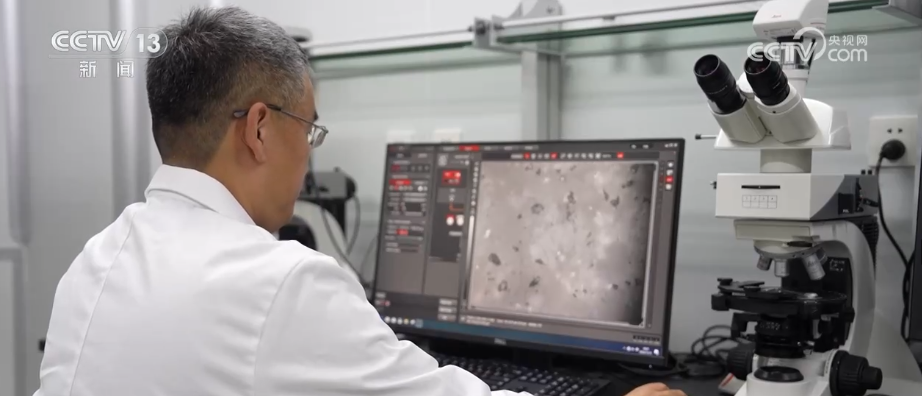
Core Insights - Recent findings from the Chang'e 6 mission reveal evidence of "rust" on the Moon, specifically micro-sized hematite and magnetite crystals, challenging the long-held belief that the Moon is a dry and oxygen-free environment [1][5][7] Group 1: Geological Significance - The presence of iron oxides in lunar soil provides new insights into the Moon's geological evolution and the processes it has undergone since its formation [2][4] - The study of redox reactions in lunar soil serves as a "chemical diary," offering clues about the Moon's early formation and environmental history [2][3] Group 2: Implications for Lunar Exploration - Understanding the oxidation processes on the Moon can help identify potential oxygen sources, which is crucial for future manned lunar missions and can alleviate the logistical burden of supplying oxygen for astronauts [2][4] - The discovery of rust indicates that the Moon can form highly oxidized minerals under specific conditions, suggesting that large impact events can create localized oxidizing environments [7][10] Group 3: Magnetic Anomalies - The findings provide important clues regarding the Moon's magnetic anomalies, which are areas where the magnetic field strength is significantly higher than the surrounding regions [8][9] - The transformation of iron sulfide to hematite during impact events may produce magnetic minerals, contributing to the understanding of the Moon's magnetic field history [9][10] - This research opens new avenues for exploring the origins of lunar magnetic anomalies, suggesting that some may not solely originate from ancient internal magnetic generators but could also result from impact processes [10][11]
【人民网】嫦娥六号月球样品中首次发现晶质赤铁矿
Ren Min Wang· 2025-11-18 02:05
Core Insights - China's research team has made a significant breakthrough in lunar science by discovering micron-sized hematite (α-Fe2O3) and magnetite (γ-Fe2O3) crystals from samples returned by the Chang'e 6 mission, revealing a new lunar oxidation reaction mechanism [1][2] - The study suggests that the formation of hematite is closely related to large impact events in the Moon's history, which created a transient high oxygen fugacity gas environment that oxidized iron elements [2] Group 1 - The research was conducted by a collaboration between Shandong University, the Chinese Academy of Sciences, and Yunnan University, supported by the National Space Administration's lunar sample [1] - The findings have been published in the journal Science Advances, providing important scientific evidence for future lunar research and enhancing the understanding of the Moon's evolutionary history [1] Group 2 - The study indicates that the intermediate products of the oxidation reaction include magnetic magnetite and magnetite, which may serve as mineral carriers for the magnetic anomalies at the edges of the South Pole-Aitken Basin [2] - This research confirms the presence of strong oxidizing substances like hematite on the lunar surface under a highly reduced background, shedding light on the Moon's redox state and the causes of magnetic anomalies [2]

赤铁矿、磁赤铁矿,首次发现!我国科研团队在月球氧化作用研究取得重大突破
Yang Shi Wang· 2025-11-16 06:03
Core Insights - The research team has made a significant breakthrough in lunar science by discovering micrometer-scale hematite and maghemite crystals in lunar samples returned by the Chang'e-6 mission, revealing a new lunar oxidation mechanism [1][4][16] Group 1: Research Findings - The study was conducted by a collaborative team from Shandong University, the Chinese Academy of Sciences, and Yunnan University, analyzing 3000 milligrams of lunar samples [4] - The team identified the presence of trivalent iron ions in the form of hematite and maghemite, marking a major scientific advancement in understanding lunar oxidation processes [6][9] - The formation of hematite is closely linked to large impact events in the moon's history, suggesting that these impacts may have contributed to the magnetic anomalies observed in the South Pole-Aitken basin [11][13] Group 2: Implications - This discovery challenges the previous understanding that the lunar surface is predominantly in a reduced state, highlighting the importance of oxidation processes that were previously overlooked [9][13] - The findings are expected to pave the way for further research on lunar oxidation, enhancing knowledge of the moon's evolutionary history [16]