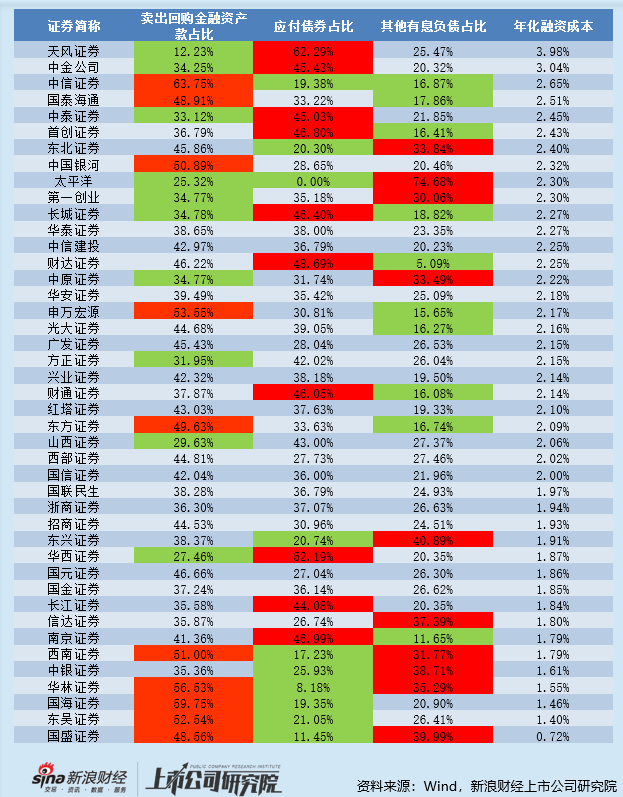
有息负债融资成本

Search documents
申万宏源杠杆率指标居于行业前列 卖出回购金融资产款占有息负债的比例超50% 该融资模式有何利弊?
Xin Lang Cai Jing· 2025-11-27 08:29
Core Insights - The A-share market has been strong since July 2025, leading to a significant increase in bond issuance by brokerages, with a total issuance exceeding 1.7 trillion yuan, a nearly 50% year-on-year increase [1] - The expansion of brokerages' balance sheets is driven by increased operational settlement funds due to market conditions and a strategic shift towards heavier asset management businesses [1] - Major brokerages like China Galaxy, Guotai Junan, and Huatai Securities have issued the most bonds this year, with issuance amounts of 138.9 billion, 127.3 billion, and 125.6 billion yuan respectively, yet their leverage ratios remain relatively low [1][2] Debt Structure and Financing Costs - As of Q3 2025, the equity multipliers (excluding client transaction margins) for the top three brokerages are 4.23, 4.69, and 3.86, ranking them ninth, sixth, and thirteenth among 43 listed brokerages [2] - The highest equity multipliers are held by CICC, Shenwan Hongyuan, and CITIC Securities, at 5.42, 5.26, and 4.83 respectively, indicating a reliance on interbank financing rather than bond issuance [3] - The sell-buyback financial assets account for 24.40% and 17.53% of total liabilities for the 43 listed brokerages, with other liabilities not exceeding 8% [3] Sell-Buyback Financing - Shenwan Hongyuan's sell-buyback financial assets account for 32.72% of its total liabilities, ranking third in the industry, indicating a strong reliance on this financing method [4] - The average financing cost for CITIC Securities is 2.65%, with a significant portion of its liabilities coming from sell-buyback agreements, which typically have lower interest rates compared to bond issuance [4] - The financing cost structure shows that brokerages with higher sell-buyback ratios tend to have lower overall financing costs, with the lowest costs observed in Guosheng Securities, Dongwu Securities, Guohai Securities, and Hualin Securities [5] Market Trends and Historical Context - The reliance on sell-buyback financing peaked in 2014, with a total of 788.6 billion yuan, but decreased significantly after 2015 due to tighter liquidity and regulatory changes [10] - Following the resolution of major health issues in 2022, the capital market entered a new "interest rate reduction" cycle, leading to a 25% increase in sell-buyback financial assets from 1.96 trillion yuan in 2022 to 2.46 trillion yuan in 2024 [11] - The current trend indicates that brokerages favor sell-buyback financing for its lower costs and flexibility, but this approach carries risks related to market volatility and liquidity [11]