机器人AI视觉

Search documents
奥比中光不超9.8亿定增获上交所通过 中金公司建功
Zhong Guo Jing Ji Wang· 2026-02-06 07:22
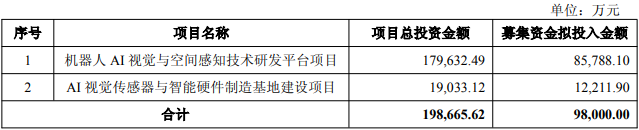
Core Viewpoint - The company, OBI Technology Group Co., Ltd. (奥比中光), has received approval from the Shanghai Stock Exchange for its application to issue A-shares to specific investors in 2025, pending final approval from the China Securities Regulatory Commission (CSRC) [1][5]. Summary by Sections Issuance Details - The company plans to raise a total of up to RMB 980 million (approximately 98,000 million) through this issuance, which will be allocated to projects including the development of an AI vision and spatial perception technology platform and the construction of an AI visual sensor and smart hardware manufacturing base [1][3]. - The total investment for the AI vision and spatial perception technology platform project is RMB 179,632.49 million, with RMB 85,788.10 million expected to be funded from the issuance. The AI visual sensor and smart hardware manufacturing base project has a total investment of RMB 19,033.12 million, with RMB 12,211.90 million planned from the issuance [3]. Issuance Mechanism - The issuance will be directed towards no more than 35 specific investors, including qualified institutional investors and natural persons, as per CSRC regulations. The pricing will be based on 80% of the average trading price over the 20 trading days prior to the issuance date [4]. - The maximum number of shares to be issued is capped at 120,343,272 shares, which is 30% of the company's total share capital prior to the issuance [4]. Control and Ownership - As of June 30, 2025, the company's total share capital is 401,099,840 shares, with the controlling shareholder, Huang Yuanhao, holding 27.15% directly and an additional 8.48% indirectly, totaling 35.64% of the voting rights [5][6]. - Post-issuance, Huang Yuanhao is expected to control 27.41% of the shares and 55.66% of the voting rights, ensuring that the control of the company remains unchanged [6]. Sponsorship - The issuance is sponsored by China International Capital Corporation Limited, with representatives Yang He and Peng Zhao Zhen overseeing the process [6].



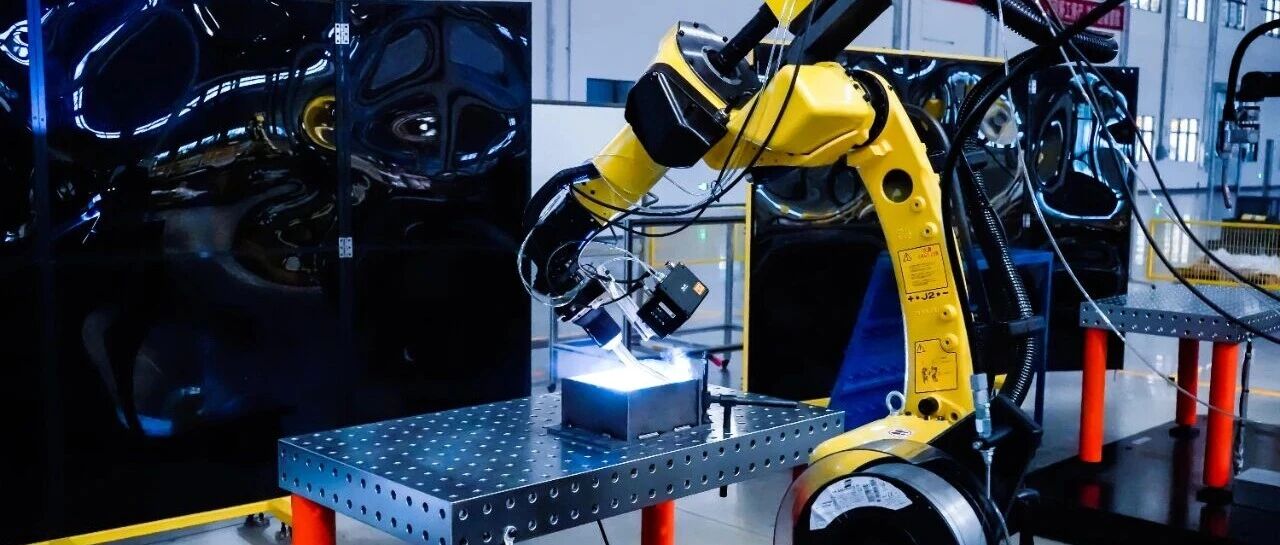
机器人AI视觉重构产业制造逻辑 中国凭什么能够领跑全球?
机器人大讲堂· 2025-09-27 04:15
Core Insights - The article emphasizes the growing importance of AI vision technology in the industrial robotics sector, driven by the demand for high precision and efficiency in manufacturing processes [1][2][7]. Market Overview - The global machine vision market is projected to reach 95.754 billion yuan by 2025, with China's market expected to reach 29.042 billion yuan. By 2032, the global market is forecasted to grow to 164.07 billion yuan, reflecting a compound annual growth rate (CAGR) of 8.0% from 2025 to 2032 [1]. Precision in Manufacturing - AI vision technology is crucial for achieving micron-level precision in industries such as automotive manufacturing, where the detection of defects has shifted from millimeter to micron levels. For instance, a welding deviation of just 0.01 millimeters can lead to significant safety hazards in battery production [2][4]. Efficiency in Logistics - The logistics and warehousing sector is rapidly transitioning to "unmanned and clustered" operations, with AI vision technology enhancing sorting efficiency. AI-powered sorting robots can process over 3,000 items per hour with an error rate below 0.05%, compared to human workers who sort about 2,000 items daily with a 1.5% error rate [6][7]. Competitive Landscape - China is emerging as a leader in the global AI vision industry, with its machine vision system market expected to reach 73.164 billion yuan (approximately 10.2 billion USD) by 2025, accounting for over 24% of the global market share [7][15]. Technological Advancements - Traditional machine vision systems face limitations due to insufficient algorithm precision and hardware response delays. Recent advancements in AI algorithms and hardware integration are overcoming these challenges, enabling real-time detection and decision-making capabilities [8][10]. Full-Process Empowerment - AI vision technology is evolving from mere defect detection to full-process empowerment in manufacturing. This transformation enhances efficiency and product quality by integrating perception, decision-making, and execution capabilities [13][14]. Policy and Ecosystem Support - The rapid development of China's AI vision industry is supported by government policies and a robust industrial ecosystem. Initiatives like the "14th Five-Year Plan for Intelligent Manufacturing" aim to digitize and network a significant portion of the manufacturing sector by 2025 [15][16][18]. Future Trends - The future of AI vision technology in robotics is expected to focus on multi-modal data integration, enhanced edge intelligence, and collaborative ecosystems that facilitate interoperability among different manufacturers' systems [19].