极地天文研究

Search documents
【新华社】瞄深空!南极“天眼”看见了啥?
Xin Hua She· 2026-01-27 02:24
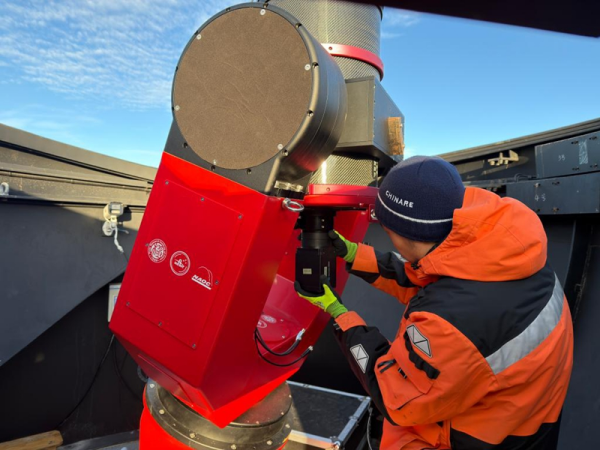
Core Viewpoint - China's Antarctic astronomical research has achieved significant breakthroughs over the past two decades, enhancing capabilities in space debris monitoring and deep space exploration [7]. Group 1: Space Debris Monitoring - The Antarctic region, particularly the Zhongshan Station, serves as an ideal location for observing space debris due to its stable atmospheric conditions and extended periods of darkness [5]. - The Chinese 42nd Antarctic Expedition has established a monitoring system consisting of a fixed array of four 150mm telescopes and one 310mm fast-tracking telescope, which can achieve a tracking precision of better than 50 meters for low Earth orbit debris [5]. - The 310mm telescope can detect low Earth targets up to 10 times a day, providing critical collision warning and decision support for spacecraft [5]. Group 2: Deep Space Exploration - In July 2025, the Zhongshan Station successfully observed the interstellar object ATLAS (3I/ATLAS), marking a significant milestone in observing celestial bodies beyond the solar system [6]. - The observation utilized advanced techniques, including 30-second single exposures and stacking 21 images to extract faint signals from a complex star background [6]. - The Antarctic telescope system is continuously improving its rapid response and high-precision pointing capabilities for observing fast-moving astronomical targets [6]. Group 3: Scientific Achievements - Since the first optical telescope array installation in 2008, China's Antarctic astronomical research has made substantial progress, including the deployment of the first Antarctic survey telescope in 2011 and participation in the detection of gravitational wave events in 2017 [7]. - Future plans include constructing optical and infrared telescopes at the Kunlun Station to further enhance capabilities in deep space exploration and contribute to polar astronomical research [7].