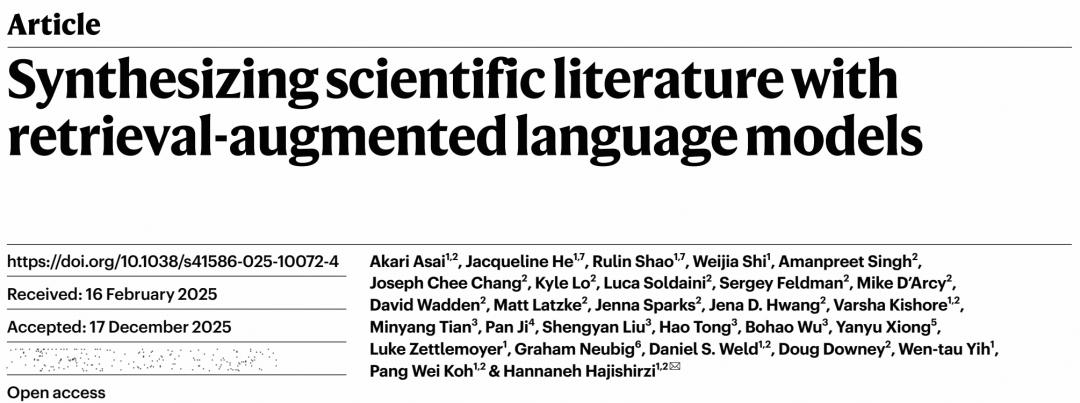
检索增强生成(RAG)语言模型

Search documents
刚刚,全球首个完全开放科学文献综述AI,登上Nature
3 6 Ke· 2026-02-05 02:24
Core Insights - OpenScholar is the world's first fully open-source retrieval-augmented generation (RAG) language model specifically designed for scientific research, developed by the University of Washington and the Allen Institute for AI [1][4] - The model aims to assist scientists in managing the increasing complexity and volume of scientific literature reviews by providing accurate citations and high-quality responses [1][4] Technology Innovations - OpenScholar features a proprietary database (OSDS) that includes 45 million open-access scientific papers and 236 million paragraph embedding vectors, ensuring comprehensive and timely retrieval [4] - The system employs an adaptive retrieval mechanism that goes beyond simple keyword matching, allowing for precise identification and extraction of relevant literature based on semantic depth [4] - A self-feedback mechanism is integrated, enabling the model to iteratively check and optimize its outputs for factual accuracy, coverage, and citation correctness, significantly enhancing response quality [4][6] Performance Evaluation - OpenScholar was evaluated using ScholarQABench, a large-scale, multi-domain benchmark that simulates real-world scientific challenges, containing 2,967 expert-written queries and 208 long-form answers across various fields [7] - The lightweight OpenScholar-8B model outperformed GPT-4o by 6.1% in overall accuracy and surpassed the dedicated system PaperQA2 by 5.5%, demonstrating comprehensive performance superiority [8] - In citation accuracy, OpenScholar achieved results comparable to human experts, with its performance only slightly below that of human-generated answers [8][10] Practical Applications - OpenScholar's design emphasizes practicality, utilizing a lightweight dedicated retriever that significantly reduces operational and computational costs compared to large general models, making high-quality literature review assistance more sustainable and widely applicable [12] Future Directions - The research team plans to integrate user feedback to continuously improve retrieval quality, citation accuracy, and overall usability, while also expanding the model's application to more scientific fields and multilingual scenarios [15] - Collaboration with academic publishing institutions is being sought to explore compliant data usage mechanisms that balance intellectual property rights with open access [15]